
What is MiniRAG
MiniRAG is a novel retrieval-augmented generation (RAG) system launched by the University of Hong Kong, designed for efficient deployment of small language models (SLMs) in resource-constrained scenarios. MiniRAG achieves this goal based on two key technologies: first, a semantics-aware heterogeneous graph indexing mechanism that combines text snippets and named entities, reducing reliance on complex semantic understanding; second, a lightweight topology-enhanced retrieval method that uses graph structures for efficient knowledge discovery without requiring advanced language capabilities. In experiments, MiniRAG demonstrates performance comparable to large language model (LLM) methods while requiring only 25% of the storage space. MiniRAG provides a comprehensive benchmark dataset to evaluate the performance of lightweight RAG systems in real-world device scenarios, promoting the development of efficient and private RAG systems in resource-constrained environments.
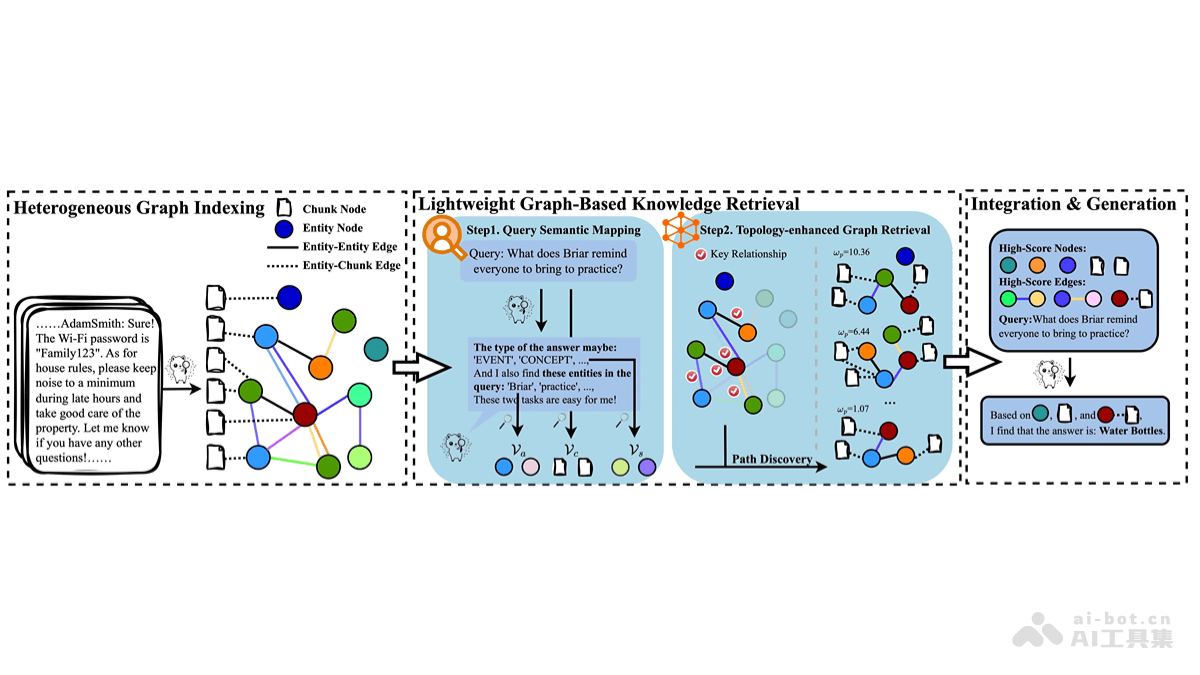
Main features of MiniRAG
- Efficient knowledge retrieval: Based on a unique heterogeneous graph indexing mechanism, it quickly and accurately retrieves the knowledge most relevant to user queries from large amounts of data, providing support for generating accurate answers.
- Lightweight model compatibility: Designed specifically for small language models (SLMs), it significantly reduces the demand for computing resources and storage space without sacrificing too much performance, making it more suitable for running on resource-constrained devices.
- Powerful reasoning capability: With the help of a query-guided reasoning path discovery mechanism, MiniRAG can handle complex, multi-step reasoning tasks, and can effectively find the correct answers even when the semantic understanding capability of SLMs is limited.
- Strong adaptability: MiniRAG can adapt to different application scenarios, including instant messaging, personal content management, local document retrieval, etc., providing users with personalized information retrieval and generation services.
Technical principles of MiniRAG
- Semantics-aware heterogeneous graph indexing mechanism:
- Text chunk nodes (Vc): Preserve the contextual integrity of the original text and directly participate in the retrieval stage, ensuring identification of the most relevant contextual content.
- Entity nodes (Ve): Key semantic elements extracted from text chunks, such as events, locations, temporal references, and domain-specific concepts, used to anchor semantic understanding.
- Entity-entity connections (Eα): Capture semantic relationships, hierarchical structures, and spatiotemporal dependencies between named entities.
- Entity-text chunk connections (Eβ): Connect named entities and their corresponding contexts, maintaining contextual relevance and semantic coherence.
- Semantic descriptions of edges: Descriptions generated based on language models provide clear relational context for connected nodes, enhancing the graph's semantic understanding capability.
- Lightweight topology-enhanced retrieval method:
- Query semantic mapping: Use entity extraction and lightweight sentence embedding models to align user input queries with graph index data and identify text chunks relevant to the query.
- Query-driven reasoning path discovery: Based on an intelligent query guidance mechanism, construct reasoning paths in the heterogeneous graph, comprehensively considering the semantic relevance between the query and entity nodes and the structural coherence between entities.
- Topology-enhanced graph retrieval: Combining embedding-based similarity search with topology information of the graph structure, identify high-quality entity-entity connections relevant to the query, and extract logically relevant reasoning chains based on a path discovery mechanism.
- Retrieval of Query-Relevant Text Chunks: Based on entity-text chunk connections, collect text chunks related to the reasoning paths, compute the semantic similarity between the input query and the text chunks as well as their edge descriptions, and finally select the most relevant text chunks for use in subsequent generation tasks.
- Fusion-Augmented Generation: Integrate the retrieved key relations and optimal text chunks with the previously determined answer nodes based on a designed fusion strategy to construct a comprehensive and structured input representation for use in the final augmented generation process.
MiniRAG Project Address
- GitHub Repository:https://github.com/HKUDS/MiniRAG/
- arXiv Technical Paper:https://arxiv.org/pdf/2501.06713
MiniRAG Application Scenarios
- Instant Messaging: Quickly retrieve historical chat records, generate smart replies, and provide knowledge assistance.
- Personal Content Management: Retrieve personal notes, generate content summaries and reminders, and manage schedules.
- Local Document Retrieval: Retrieve local document content, integrate information from multiple documents, and generate intelligent summaries.
- Privacy-Sensitive Applications: Securely manage medical and financial information, and provide privacy-preserving question-answering services.
- Edge Device Applications: Provide fast responses and intelligent services on devices such as smartwatches and smart speakers.