
What is MiniMax-Remover
MiniMax-Remover is a novel video object removal method that addresses common issues in existing technologies such as hallucinated objects, visual artifacts, and slow inference speed. It adopts a two-stage approach: the first stage is based on a simplified DiT architecture, removing text input and cross-attention layers to obtain a more lightweight and efficient model; the second stage distills the model through a minimax optimization strategy, identifying adversarial input noise and training the model to generate high-quality results under these conditions. It requires only 6 sampling steps and does not rely on classifier-free guidance (CFG), achieving state-of-the-art video object removal results and significantly improving inference efficiency.
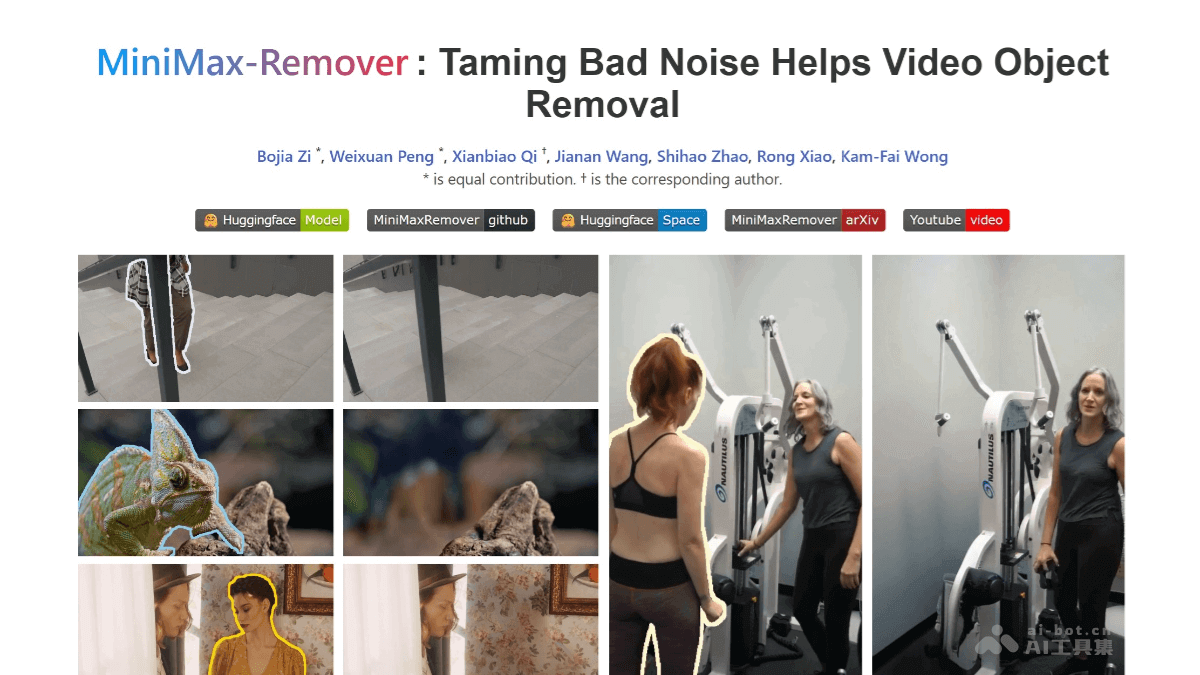
Main Features of MiniMax-Remover
-
Efficient Video Object Removal: Adopts a two-stage approach. The first stage is based on a simplified DiT architecture, removing text input and cross-attention layers to obtain a more lightweight and efficient model architecture; the second stage distills the remover through a minimax optimization strategy, further improving editing quality and inference speed.
-
Fast Inference Speed: Requires only 6 sampling steps and does not rely on classifier-free guidance (CFG), achieving state-of-the-art video object removal results and significantly improving inference efficiency.
-
High-Quality Removal Results: Through an inner maximization step to identify adversarial input noise and an outer minimization step to train the model to generate high-quality results under these conditions, it avoids issues such as hallucinated objects and visual artifacts.
Technical Principles of MiniMax-Remover
- First Stage: Model Architecture Optimization: MiniMax-Remover first adopts a simplified DiT (Diffusion in Time) architecture, removing text input and cross-attention layers to obtain a more lightweight and efficient model architecture. The goal of this stage is to reduce model complexity and improve inference speed while maintaining basic video object removal capability.
- Second Stage: Minimax Optimization: Building on the first stage, MiniMax-Remover further distills the model through a minimax optimization strategy to improve editing quality and inference speed. The specific steps are as follows:
- Inner Maximization: Identifies adversarial input noise (“bad noise”) that would cause removal failure. The noise simulates the worst-case scenarios that may be encountered in practical applications, helping the model learn how to handle these challenges.
- Outer Minimization: Trains the model to generate high-quality removal results even under these adversarial conditions. In this way, the model can maintain good performance even in the worst case.
Project Address of MiniMax-Remover
- Project Official Website:https://minimax-remover.github.io/
Application Scenarios of MiniMax-Remover
-
Film and Television Post-Production: In the post-production of films, TV dramas, advertisements, and other film and television works, unwanted elements such as visible props, redundant actors, logos, etc., often need to be removed. MiniMax-Remover can complete these tasks quickly and with high quality, saving time and cost in post-production.
-
Video Content Creation: For self-media video creators, MiniMax-Remover can help them easily remove distracting elements in videos, such as irrelevant people in the background, billboards, etc., making the video content more concise and professional and enhancing the viewing experience for the audience.
-
Video Restoration and Optimization: In the restoration of some old or damaged videos, MiniMax-Remover can be used to remove blemishes, stains, etc. from the video, restoring the video's clarity and integrity.
-
Video Special Effects Production: When producing video special effects, MiniMax-Remover can serve as a preprocessing tool to remove original elements from the video, providing a clean background for subsequent addition of special effects.