
What is MiniMax-M1
MiniMax-M1 is the latest open-source reasoning model launched by the MiniMax team. It combines a Mixture of Experts (MoE) architecture with lightning attention, with a total parameter count of 456 billion and 45.9 billion parameters activated per token. The model surpasses domestic closed-source models and approaches the most leading overseas models, offering the highest cost-effectiveness in the industry. MiniMax-M1 natively supports a context length of 1 million tokens and provides two reasoning budget versions, 40K and 80K, making it suitable for handling long inputs and complex reasoning tasks. In benchmark tests, MiniMax-M1 surpasses open-source models such as DeepSeek on multiple performance metrics and performs excellently in tasks such as complex software engineering, long-context understanding, and tool use. The model's efficient computational capability and strong reasoning ability make it a powerful foundation for the next generation of language model agents.
Main features of MiniMax-M1
- Long-context processing: Supports input of 1 million tokens and output of 80K tokens, suitable for handling long documents and complex reasoning tasks.
- Efficient reasoning: Provides two reasoning budget versions, 40K and 80K, optimizing computational resources and reducing inference costs.
- Multi-domain task optimization: Performs excellently in tasks such as mathematical reasoning, software engineering, long-context understanding, and tool use, adapting to diverse application scenarios.
- Function calling: Supports structured function calling, can recognize and output external function call parameters, facilitating interaction with external tools.
Technical principles of MiniMax-M1
- Mixture of Experts (MoE) architecture: Based on a Mixture of Experts architecture, the model is divided into multiple expert modules (Experts), each responsible for handling specific subtasks or data subsets. Input data is dynamically allocated to different expert modules based on its features, achieving efficient utilization of computational resources and parallel processing capability. Based on the MoE architecture, the model can maintain efficient computational performance under large-scale parameters while supporting more complex task processing.
- Lightning Attention: The lightning attention mechanism is based on optimizing the computational process, reducing redundant computation, and significantly improving the efficiency of the attention module. It uses sparse attention patterns, focusing only on key parts of the input sequence, further reducing computational complexity. It supports efficient processing of long sequence data and enables the model to handle contexts of up to 1 million tokens.
- Large-scale reinforcement learning (RL) training: The user conducts large-scale reinforcement learning training, optimizing the model's output based on reward signals so that it performs better in complex tasks. A new RL algorithm, CISPO, is proposed, which is based on clipping importance sampling weights rather than token updates, improving training efficiency and model performance. The hybrid attention design naturally enhances the efficiency of RL, addressing the unique challenges of scaling RL in hybrid architectures.
Performance of MiniMax-M1
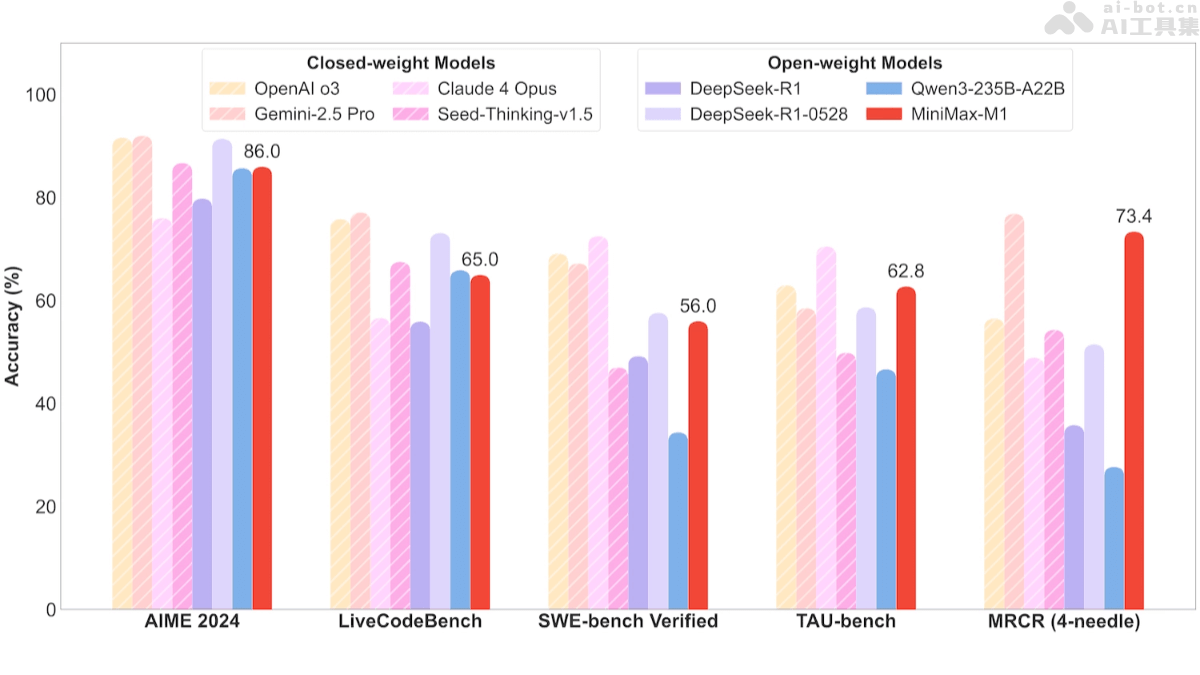
- Software engineering tasks: On the SWE-bench validation benchmark, MiniMax-M1-40k and MiniMax-M1-80k achieved 55.6% and 56.0% respectively, slightly behind DeepSeek-R1-0528 's 57.6%, but significantly surpassing other open-source weight models.
- Long-context understanding tasks: Relying on a million-level context window, the M1 series performs excellently in long-context understanding tasks, comprehensively surpassing all open-source weight models, even surpassing OpenAI o3 and Claude 4 Opus, ranking second globally, only slightly behind Gemini 2.5 Pro。
- Tool use scenarios: In the agent tool use scenario (TAU-bench), MiniMax-M1-40k leads all open-weight models, defeating Gemini-2.5 Pro.
MiniMax-M1 project address
- GitHub repository:https://github.com/MiniMax-AI/MiniMax-M1
- HuggingFace model library:https://huggingface.co/collections/MiniMaxAI/minimax-m1
- Technical paper:https://github.com/MiniMax-AI/MiniMax-M1/blob/main/MiniMax_M1_tech_report
MiniMax-M1 product pricing
- API call inference cost pricing:
- 0-32k input length:
- Input cost: 0.8 yuan per million tokens.
- Output cost: 8 yuan per million tokens.
- 32k-128k input length:
- Input cost: 1.2 yuan per million tokens.
- Output cost: 16 yuan per million tokens.
- 128k-1M input length:
- Input cost: 2.4 yuan per million tokens.
- Output cost: 24 yuan per million tokens.
- 0-32k input length:
- APP and Web: Stay unlimited and free to use on the MiniMax APP and Web.
MiniMax-M1 application scenarios
- Complex software engineering:Supports code generation, optimization, debugging, and documentation generation, helping developers quickly implement functional modules and improve development efficiency.
- Long text processing: Capable of generating long reports, academic papers, novels, etc., while also supporting long text analysis and multi-document summarization to meet diverse needs.
- Mathematics and logical reasoning: Solves complex mathematical problems, such as competition math problems and mathematical modeling, handles logical reasoning tasks, and provides clear problem-solving approaches.
- Tool use and interaction: Acts as an intelligent assistant to call external tools, complete multi-step tasks, provide automated solutions, and improve work efficiency.