
What is MiniCPM-Robot
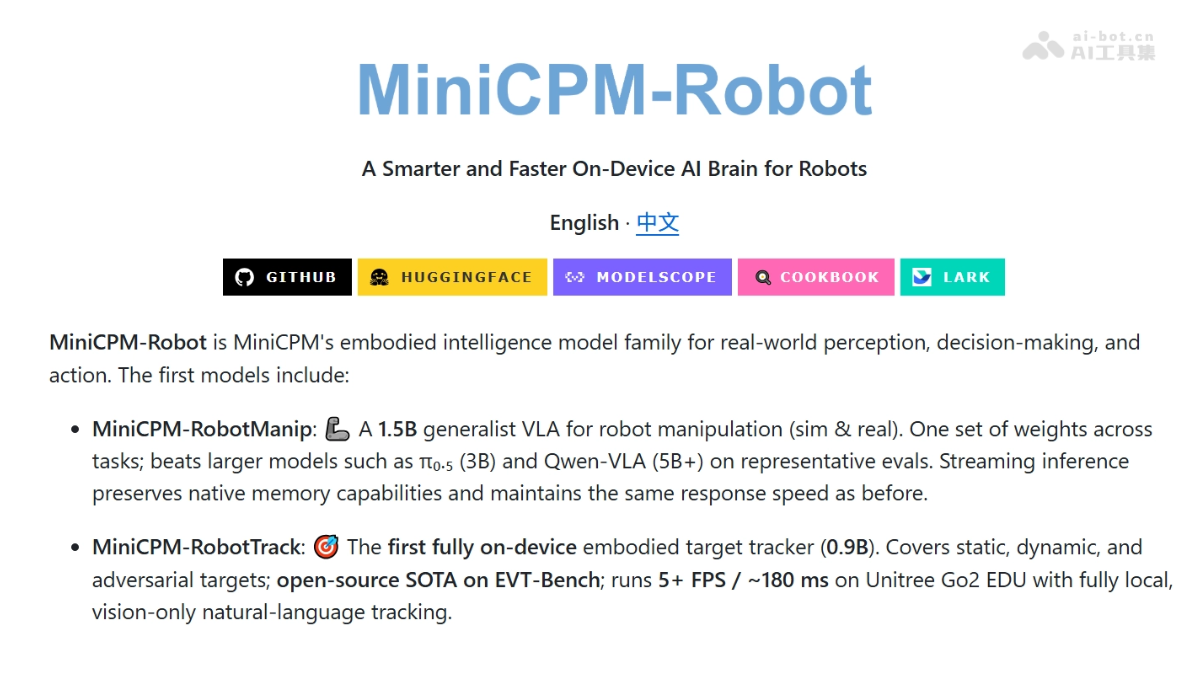
MiniCPM-Robot is ModelBest's open-source lightweight embodied intelligence VLA model series, including the 1.5B-parameter MiniCPM-RobotManip general manipulation model and the 0.9B-parameter MiniCPM-RobotTrack tracking and navigation model, accompanied by the PhyAI inference framework. The models employ visual token compression and streaming context memory technology, support long-horizon fine manipulation by robotic arms and indoor/outdoor target tracking by robot dogs, and can run locally on-device in weak-network environments with inference latency as low as 120ms, ranking among the top tier in mainstream benchmarks.
Main Features of MiniCPM-Robot
-
MiniCPM-RobotManip: Controls robotic arms to complete long-horizon manipulation tasks (such as making a sandwich), supports multi-camera input, and has context memory capability, able to remember task progress and historical actions.
-
MiniCPM-RobotTrack: Enables a robot dog to continuously track a specified target according to natural language instructions, supports single-target tracking, multi-person interference tracking, and ambiguous target tracking, and can run locally in weak-network/no-network environments.
Technical Principles of MiniCPM-Robot
-
Visual Token Compression: Filters out redundant visual information irrelevant to the task, reducing the computation per inference.
-
Streaming Context Memory: Reuses already-processed historical information, so new frames only require incremental computation, avoiding explosive growth in computation for long tasks.
-
Self-Evolving Data Pipeline: Proactively exposes the model's weak points in simulation and real environments, collecting error scenarios for expert correction and closed-loop training.

Follow WeChat and reply "Open Source" to join theAI Open Source Project Communication Group
How to Use MiniCPM-Robot
- Environment Preparation:
-
Clone the GitHub repository and install dependencies.
-
Prepare hardware: a robotic arm (RobotManip) or a Unitree Go2 Edu robot dog (RobotTrack).
-
- Model Loading: Download the corresponding model weights from Hugging Face. Load the model through the PhyAI framework to complete quantization and operator optimization.
- Camera Connection: Configure the wrist camera and main-view camera (RobotManip) or the robot dog's original camera (RobotTrack).
- Instruction Input: Input natural language instructions (such as "follow the person in black ahead" or "make a sandwich").
- One-Click Launch: Run the open-source script; the model receives visual and language input, outputs robot action instructions, and executes them.
Core Advantages of MiniCPM-Robot
-
Extremely Small Parameters, Top-Tier Performance: With 1.5B parameters, it rivals larger models such as π0.5 in benchmarks including LIBERO, Calvin, and RoboTwin2; its RMBench context memory score is about 53 points, far exceeding π0.5's about 10 points.
-
Halved Inference Latency: Single-frame decision latency on H100 is about 120ms, nearly half of π0.5 (234ms).
-
Pure On-Device Operation: The robot dog's local compute alone can stably track at over 5Hz, and it can continue working even when disconnected from the network.
MiniCPM-Robot Project Address
- Project Website:https://github.com/OpenBMB/MiniCPM-Robot
- HuggingFace Model Repository:
- https://huggingface.co/openbmb/MiniCPM-RobotManip
- https://huggingface.co/openbmb/MiniCPM-RobotTrack
Comparison of MiniCPM-Robot with Similar Competing Products
| Dimension | MiniCPM-RobotManip | π0.5 |
|---|---|---|
| Parameter Count | 1.5B | 3B |
| Open Source | ✓ | ✓ |
| LIBERO | 97.5 | 96.9 |
| Calvin | 4.1 | 4.1 |
| RMBench | 53.5 | ~10 |
| Single-Frame Latency | ~120ms | ~234ms |
| Contextual memory | Streaming reuse of historical information | Mainly based on single-frame judgment |
| On-device deployment | Supports local operation | Usually requires cloud computing power |
Application scenarios of MiniCPM-Robot
-
Food preparation: A dual-arm robotic arm completes long-horizon sandwich-making tasks such as picking up bread and adding lettuce, ham, and eggs according to instructions.
-
Exhibition hall guided tours: In a network-free environment, the robot completes offline explanations, free-form Q&A, and route planning based on a local knowledge base.
-
Park inspections: The robot dog identifies illegal parking, road abnormalities, and public facility issues, and sensitive images are processed locally without being uploaded to the cloud.
-
Warehousing and logistics: The robot performs long-horizon operations such as picking and placing items on shelves and material handling, and automatically retries and recovers upon failure.
-
Indoor and outdoor following: The robot dog continuously tracks a target person in weak-network environments such as elevators and underground parking lots according to natural language instructions.