
What is MiniCPM 4.1
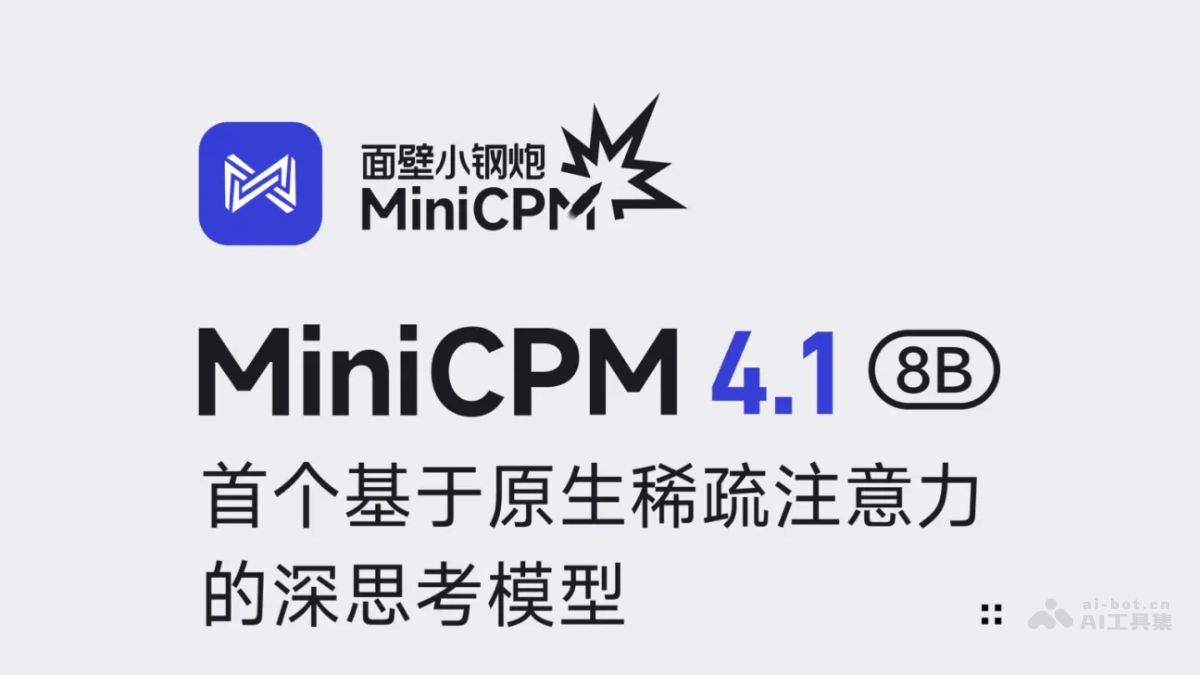
MiniCPM 4.1 is a hybrid reasoning model launched by ModelBest. It adopts the InfLLM v2 sparse attention architecture, where each token only needs to compute relevance with less than 5% of tokens, significantly reducing the overhead of long-text processing. In 128K long-text scenarios, it greatly reduces cache storage space compared with traditional models. MiniCPM 4.1 supports an efficient dual-frequency shift mechanism, automatically switching attention modes according to the task type to balance computational efficiency and output accuracy. It has achieved first place among models of the same size on multiple evaluation benchmarks, with comprehensive capabilities reaching the optimal level of its class. MiniCPM 4.1 provides multiple deployment formats, such as GPTQ and AutoAWQ, making it convenient for efficient deployment on different edge devices.
Main Features of MiniCPM 4.1
-
Efficient Sparse Architecture: It adopts the InfLLM v2 sparse attention architecture, where each token only needs to compute relevance with less than 5% of tokens. In 128K long-text scenarios, it greatly reduces cache storage space compared with traditional models, significantly lowering the overhead of long-text processing.
-
Dual-Frequency Shift Mechanism: It automatically switches attention modes according to the task type, using sparse attention for long texts and dense attention for short texts, balancing computational efficiency and output accuracy.
-
Outstanding Comprehensive Performance: It has achieved first place among models of the same size on multiple evaluation benchmarks, with comprehensive capabilities reaching the optimal level of its class, performing excellently in knowledge, reasoning, programming, instruction following, and other aspects.
-
Edge-Friendly: In tests such as LiveCodeBench and AIME, its inference speed is more than 3 times faster than open-source models of the same size. In 128K long-text scenarios, it requires only 25% of the cache storage space, so edge computing power is no longer under pressure.
-
Multiple Deployment Formats: It provides multiple deployment formats, such as GPTQ and AutoAWQ, making it convenient for efficient deployment on different edge devices.
Technical Principles of MiniCPM 4.1
-
Sparse Attention Mechanism: MiniCPM 4.1 adopts the InfLLM v2 sparse attention architecture, where each token only needs to compute relevance with less than 5% of tokens, greatly reducing the computational complexity and memory overhead of long-text processing.
-
Dual-Frequency Shift Mechanism: It automatically switches attention modes according to task characteristics. For long-text tasks, sparse attention is enabled to reduce computational complexity, while for short-text tasks, it switches to dense attention to ensure accuracy and speed.
-
Efficient Inference Framework: The self-developed CPM.cu inference framework integrates technologies such as sparse attention, model quantization, and speculative sampling to achieve efficient prefill and decoding, improving edge inference efficiency.
-
Long-Text Processing Optimization: By processing text in blocks and regions, it intelligently selects key regions for attention computation, greatly reducing the computational load of long-text processing and supporting 128K or even longer text processing.
-
Data and Training Optimization: It uses high-quality pre-training datasets and supervised fine-tuning datasets, combined with efficient training algorithms such as BitCPM extreme ternary quantization technology, to achieve extreme compression of model parameters and improve training efficiency and model performance.
Project Address of MiniCPM 4.1
- Github Repository:https://github.com/openbmb/minicpm
- HuggingFace Model Library:https://huggingface.co/openbmb/MiniCPM4.1-8B
Application Scenarios of MiniCPM 4.1
-
Edge Device Applications: MiniCPM 4.1 is specifically designed for edge devices, suitable for smartphones, tablets, smart speakers, and other devices. It can run efficiently locally on the device, protecting user privacy and reducing reliance on cloud computing.
-
Long Text Processing: Sparse attention mechanisms and long-text optimization can efficiently handle long-text tasks, such as long document generation, story creation, technical documentation writing, etc., suitable for scenarios that require processing large amounts of contextual information.
-
Knowledge Q&A and Education: With powerful knowledge understanding and reasoning capabilities, it can be used in educational applications such as knowledge Q&A systems and intelligent tutoring tools, helping users quickly obtain accurate information and assisting learning and research.
-
Programming Assistance: It performs excellently in code generation, code completion, programming question answering, etc., and can serve as a programming assistant for developers, improving programming efficiency and quality.
-
Content Creation: It can assist users with various content creation tasks such as creative writing, copywriting, and news reporting, providing inspiration and writing support.