
What is Mini-Omni
Mini-Omni is an open-source end-to-end speech dialogue model with real-time speech input and output capabilities, enabling "thinking while speaking" during conversations. The model is designed to support direct speech-to-speech dialogue without the need for additional automatic speech recognition (ASR) or text-to-speech (TTS) systems. Mini-Omni adopts a text-guided speech generation method, improving performance during inference through a batch parallel strategy while maintaining the language capabilities of the original model.
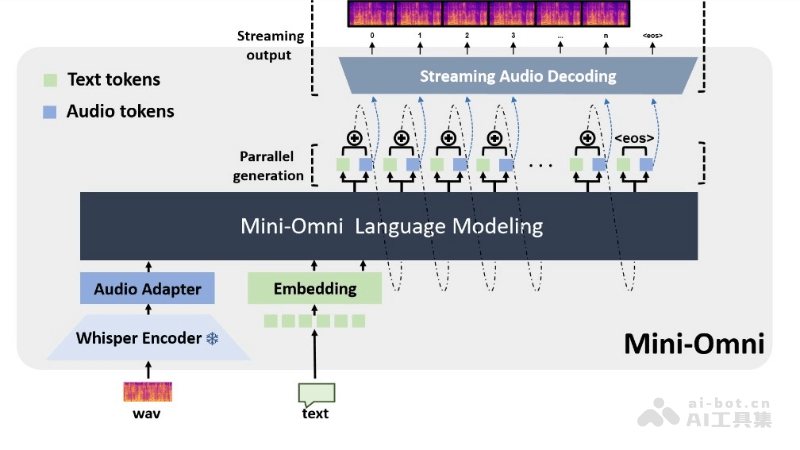
Main Features of Mini-Omni
- Real-Time Speech Interaction: It can conduct end-to-end real-time speech dialogue without relying on additional automatic speech recognition (ASR) or text-to-speech (TTS) systems.
- Parallel Text and Speech Generation: During inference, the model can simultaneously generate text and speech output, using text information to guide speech generation, improving the naturalness and fluency of speech interaction.
- Batch Parallel Inference: It adopts a batch parallel strategy, enhancing the model's inference capability during streaming audio output, making speech responses richer and more accurate.
- Audio Language Modeling: It converts continuous speech signals into discrete audio tokens, enabling large language models to perform reasoning and interaction in the audio modality.
- Cross-Modal Understanding: The model can understand and process inputs from multiple modalities, including text and audio, achieving cross-modal interaction capabilities.
Technical Principles of Mini-Omni
- End-to-End Architecture: Mini-Omni adopts an end-to-end design, capable of directly handling the entire process from audio input to text and audio output, without the intervention of traditional separate ASR and TTS systems.
- Text-Guided Speech Generation: When generating speech output, the model first generates the corresponding text information, then uses the text information to guide speech synthesis. Based on the powerful capabilities of language models in text processing, it improves the quality and naturalness of speech generation.
- Parallel Generation Strategy: Mini-Omni adopts a parallel generation strategy, simultaneously generating text and audio tokens during inference. The strategy supports the model in maintaining understanding and reasoning of text content while generating speech, achieving more coherent and consistent dialogue.
- Batch Parallel Inference: To further enhance the model's inference capability, Mini-Omni adopts a batch parallel inference strategy. In this strategy, the model processes multiple inputs simultaneously, enhancing the quality of audio generation through text generation.
- Audio Encoding and Decoding: Mini-Omni uses an audio encoder (such as Whisper) to convert continuous speech signals into discrete audio tokens, then uses an audio decoder (such as SNAC) to convert these tokens back into audio signals.
Mini-Omni Project Address
- Github Repository:https://github.com/gpt-omni/mini-omni
- HuggingFace Model Library:https://huggingface.co/gpt-omni/mini-omni
- arXiv Technical Paper:https://arxiv.org/pdf/2408.16725
Application Scenarios of Mini-Omni
- Smart Assistants and Virtual Assistants: On smartphones, tablets, and computers, Mini-Omni can serve as a smart assistant, helping users perform tasks through speech interaction, such as setting reminders, querying information, controlling devices, etc.
- Customer Service: In the field of customer service, Mini-Omni can serve as a chatbot or voice assistant, providing 24/7 automated customer support, handling inquiries, resolving issues, and executing transactions.
- Smart Home Control: In smart home systems, Mini-Omni can control smart devices in the home through voice commands, such as lights, temperature, security systems, etc.
- Education and Training: Mini-Omni can serve as an educational tool, providing voice-interactive learning experiences to help students learn languages, history, or other subjects.
- In-Vehicle Systems: In cars, Mini-Omni can be integrated into in-vehicle infotainment systems to provide voice-controlled navigation, music playback, communication, and other functions.