
What is Mini-LLaVA
Mini-LLaVA is a lightweight multimodal large language model jointly developed by research teams from Tsinghua University and Beihang University. It can process image, text, and video inputs to achieve efficient multimodal data processing. Mini-LLaVA is based on the Llama 3.1 model, with an optimized code structure, and can run on a single GPU, making it suitable for complex vision-text association tasks. The project has been open-sourced on GitHub for researchers and developers to download and use. The design of Mini-LLaVA focuses on code readability and feature extensibility, supports customization and fine-tuning, and adapts to different application scenarios.
Main Features of Mini-LLaVA
- Image Understanding: The model analyzes image content and generates descriptions or answers related questions based on the image content.
- Video Analysis: Mini-LLaVA can process video data, understand video content, and provide corresponding text output.
- Text Generation: Based on the input image or video, the model generates related text descriptions or summaries.
- Vision-Text Association: The model can understand the association between images and text and reflect this relationship in the generated text.
- Flexibility: Based on its lightweight and simplified code structure, Mini-LLaVA can be deployed in resource-limited environments, such as a single GPU.
Technical Principles of Mini-LLaVA
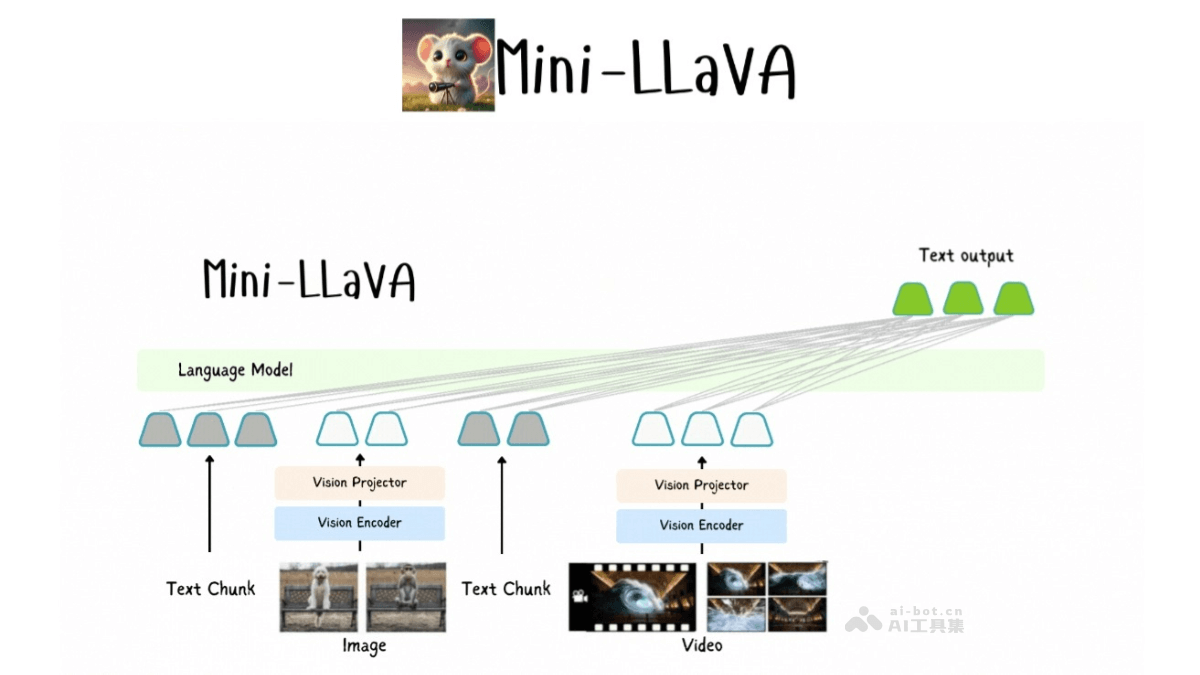
- Multimodal Input Processing: Mini-LLaVA can receive and process multiple types of input, including text, images, and videos. It integrates a visual encoder and a language decoder to achieve understanding and analysis of data from different modalities.
- Based on Llama 3.1: Based on the Llama 3.1 model, through additional training and adjustment, it has the ability to process visual data.
- Simplified Code Structure: The code design of Mini-LLaVA focuses on simplicity, making the model easier to understand and modify.
- Interleaved Processing: The model supports interleaved processing of images, videos, and text, analyzing and responding to data from different modalities while preserving the input order.
- Pre-trained Adapter: Mini-LLaVA enhances the visual processing capability of the Llama 3.1 model based on a pre-trained adapter, allowing the model to better understand and generate outputs related to the input.
Project Address of Mini-LLaVA
- GitHub Repository:https://github.com/fangyuan-ksgk/Mini-LLaVA
Application Scenarios of Mini-LLaVA
- Education and Training: As a teaching tool, it helps students understand complex concepts and provides a rich learning experience through the combination of images, videos, and text.
- Content Creation: It assists content creators in generating image descriptions, video subtitles, or automatically generating articles and reports.
- Media and Entertainment: In film, game, and video production, it generates scripts, character dialogues, or automatically generates descriptions of video content.
- Intelligent Assistant: As part of a chatbot or virtual assistant, it provides image and video understanding capabilities to better interact with users.
- Social Media Analysis: It analyzes image and video content on social media, extracts key information, and helps brands and individuals understand public reactions to content.
- Security Monitoring: In the security field, it performs real-time analysis of surveillance videos to identify abnormal behavior or events.