
What is Ming-UniAudio
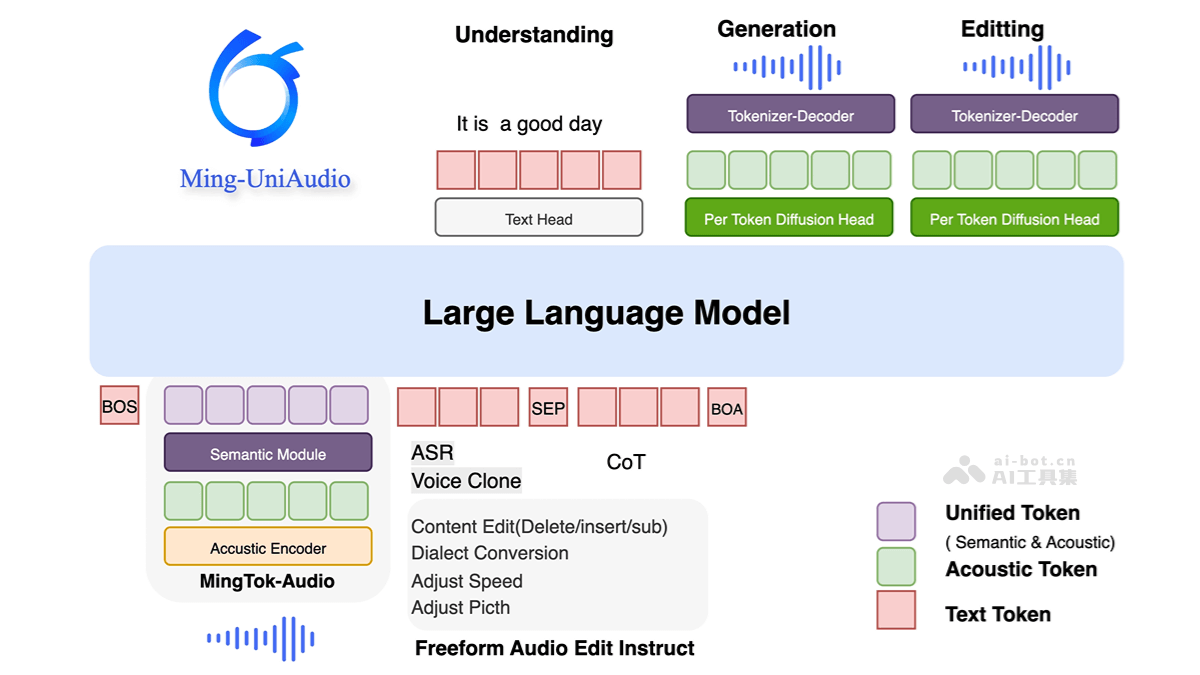
Ming-UniAudio is an open-source audio multimodal model from Ant Group that unifies speech understanding, generation, and editing tasks. At its core is MingTok-Audio, a continuous speech tokenizer based on a VAE framework and causal Transformer architecture that effectively integrates semantic and acoustic features. Based on this, Ming-UniAudio developed an end-to-end speech language model that balances generation and understanding capabilities, and ensures high-quality speech synthesis through a diffusion head. Ming-UniAudio provides the first instruction-guided free-form speech editing framework, supporting complex semantic and acoustic modifications without the need to manually specify editing regions. In multiple benchmarks, Ming-UniAudio has demonstrated strong performance, whether in speech tokenization, speech understanding, speech generation, or speech editing tasks. The model supports multiple languages and dialects and is suitable for a variety of application scenarios, such as voice assistants, audiobooks, and audio post-production.
Main Features of Ming-UniAudio
-
Speech Understanding: Accurately recognizes speech content and performs transcription, supports multiple languages and dialects, and is suitable for scenarios such as voice assistants and meeting notes.
-
Speech Generation: Generates natural and fluent speech from text, and can be used for applications such as audiobooks and voice announcements.
-
Speech Editing: Supports free-form speech editing, such as insertion, deletion, and replacement, without the need to manually specify editing regions, and is suitable for audio post-production and speech content creation.
-
Multimodal Fusion: Supports multiple modal inputs such as text and audio, and can enable complex multimodal interaction tasks.
-
Efficient Tokenization: Uses the unified continuous speech tokenizer MingTok-Audio to effectively integrate semantic and acoustic features and improve model performance.
-
High-Quality Synthesis: Uses diffusion head technology to ensure the high quality and naturalness of generated speech.
-
Instruction-Driven: Supports speech editing guided by natural language instructions, simplifying the editing process and improving the user experience.
-
Open Source and Easy to Use: Provides open-source code and pretrained models, making it convenient for developers to quickly deploy and conduct secondary development.
Technical Principles of Ming-UniAudio
-
Unified Continuous Speech Tokenizer: Ming-UniAudio proposes MingTok-Audio, the first continuous speech tokenizer based on a VAE (variational autoencoder) framework and causal Transformer architecture. It can effectively integrate semantic and acoustic features and is suitable for understanding and generation tasks.
-
End-to-End Speech Language Model: Pretrained an end-to-end unified speech language model that supports speech understanding and generation tasks and ensures high-quality speech synthesis through diffusion head technology.
-
Instruction-Guided Free-Form Speech Editing: Introduced the first instruction-guided free-form speech editing framework, supporting comprehensive semantic and acoustic editing without explicitly specifying editing regions, simplifying the editing process.
-
Multimodal Fusion: Supports multiple modal inputs such as text and audio, can enable complex multimodal interaction tasks, and improves the model's generality and flexibility.
-
High-Quality Speech Synthesis: Through diffusion model technology, Ming-UniAudio can generate high-quality, natural, and fluent speech, and is suitable for a variety of speech generation scenarios.
-
Multi-Task Learning: Through multi-task learning, the model balances speech generation and understanding capabilities, improving performance across different tasks.
-
Large-scale pre-training: Pre-training on large-scale audio and text data enhances the model's language understanding and generation capabilities, enabling it to handle complex speech tasks.
Ming-UniAudio project address
- Project official website:https://xqacmer.github.io/Ming-Unitok-Audio.github.io/
- Github repository:https://github.com/inclusionAI/Ming-UniAudio
- HuggingFace model library:https://huggingface.co/inclusionAI/Ming-UniAudio-16B-A3B
Ming-UniAudio application scenarios
- Multimodal interaction and dialogue: Supports mixed input of audio, text, images, and video, enabling real-time cross-modal dialogue and interaction, suitable for intelligent assistants and immersive communication scenarios.
- Speech synthesis and cloning: Can generate natural speech, supports multi-dialect speech cloning and personalized voiceprint customization, suitable for audio content creation and voice interaction applications.
- Audio understanding and question answering: Possesses end-to-end speech understanding capabilities, can handle open question answering, instruction execution, and multimodal knowledge reasoning, applied in education, customer service, and audio content analysis scenarios.
- Multimodal generation and editing: Supports tasks such as text-to-speech, image generation and editing, and video dubbing, used for media creation and cross-modal content production.