
What is Ming-flash-omni-2.0
Ming-flash-omni-2.0 is an omni-modal large model open-sourced by Ant Group, adopting a MoE architecture with 100B total parameters / 6B activated parameters. As the industry's SOTA open-source omni-MLLM, the model uniformly supports multimodal understanding and generation of images, video, audio, and text. It features expert-level visual cognition (precise recognition of animals, plants, and cultural relics), immersive unified acoustic synthesis (single-channel real-time generation of speech/music/sound effects), and highly dynamic image editing (intelligent generation and fine-grained processing), achieving integrated end-to-end perception and generation.
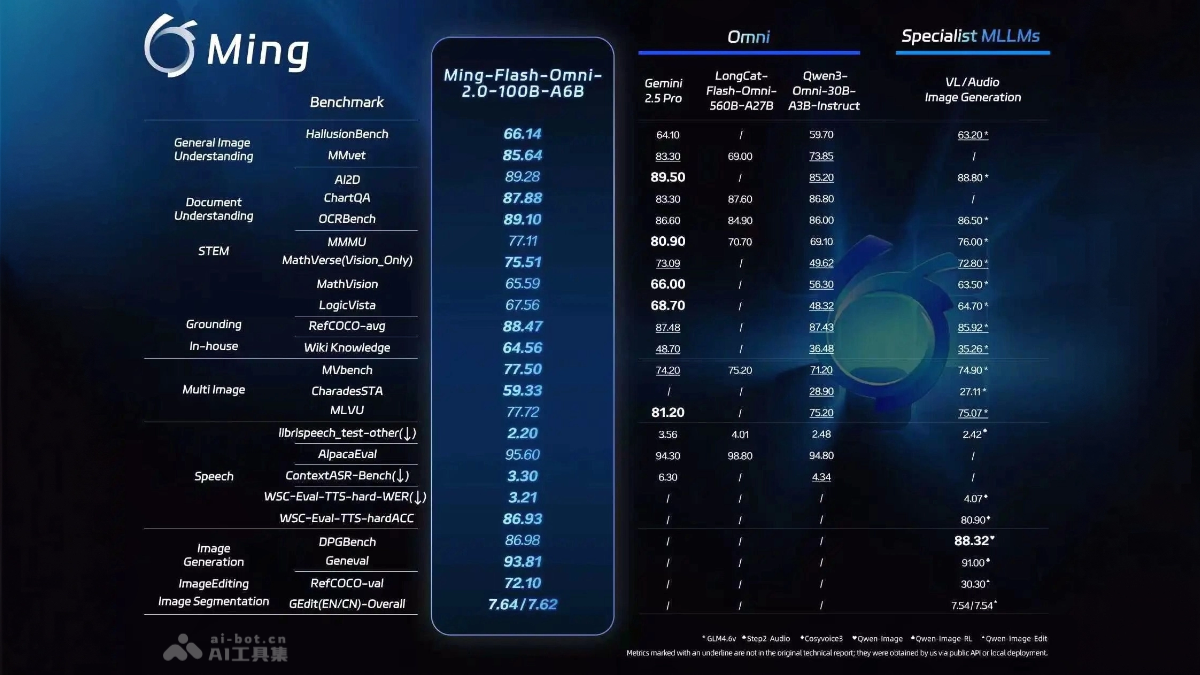
Main Features of Ming-flash-omni-2.0
- Multimodal Understanding: The model can simultaneously process image, video, audio, and text inputs, achieving cross-modal information fusion and comprehensive reasoning.
- Expert-Level Visual Cognition: Supports precise identification of animal and plant species, interpretation of cultural allusions and global landmarks, and can perform professional analysis of cultural relics in terms of era, form, and craftsmanship.
- Unified Acoustic Synthesis: End-to-end generation of speech, environmental sound effects, and music within a single channel, supporting zero-shot voice cloning and fine-grained control over emotion, timbre, and atmosphere.
- Highly Dynamic Image Processing: Natively integrates segmentation, generation, and editing capabilities, enabling complex operations such as intelligent object removal, seamless scene synthesis, and atmospheric reconstruction.
- Real-Time Interaction Capability: Supports streaming video dialogue and real-time audio generation with inference speeds as low as 3.1Hz, meeting low-latency interaction needs.
Technical Principles of Ming-flash-omni-2.0
- MoE Sparse Architecture: The model is based on the Ling-2.0 framework and adopts a mixture-of-experts design with 100B total parameters and 6B activated parameters. Through a sparse activation mechanism, it significantly reduces inference computational overhead while maintaining model capacity.
- Unified Multimodal Encoding: Visual information is processed by a dedicated visual encoder, audio features are extracted through a Whisper encoder, and features from each modality are mapped to a unified semantic space via linear projection layers, achieving deep fusion with the language model.
- End-to-End Audio Generation: Introduces a unified architecture with a continuous autoregressive joint diffusion Transformer (DiT) head, breaking through the limitations of traditional text-to-speech and modeling speech, sound effects, and music as a unified generation problem of continuous signals.
- Native Multi-Task Image Architecture: Abandons modular assembly approaches and natively integrates segmentation, generation, and editing tasks within a single framework, achieving precise manipulation and consistency preservation of highly dynamic content through a spatiotemporal semantic decoupling mechanism.
- Efficient Inference Optimization: Adopts Flash Attention 2 to accelerate attention computation, supports BF16 mixed precision and multi-GPU distributed deployment, and works with device mapping strategies to achieve efficient inference of large-scale models.
Project Address of Ming-flash-omni-2.0
- HuggingFace Model Repository:https://huggingface.co/inclusionAI/Ming-flash-omni-2.0
Application Scenarios of Ming-flash-omni-2.0
-
Intelligent Educational Tutoring: The model can analyze teaching videos and illustrated materials in real time, generate explanatory speech, and intelligently annotate images, providing an immersive personalized learning experience.
-
Content Creation and Production: One-click completion of video script writing, voiceover synthesis, background music generation, and cover image design, enabling end-to-end automated creation of multimedia content.
-
Cultural Heritage Digitization: The model supports precise recognition of cultural relic details and generates professional commentary, combining speech synthesis to recreate the atmosphere of historical scenes, facilitating intelligent display for museums and archaeological research.
-
Real-time Interactive Entertainment: Supports low-latency video dialogue and controllable voice interaction, suitable for virtual streamers, game NPCs, and immersive metaverse social scenarios.
-
Intelligent Image Processing: Quickly completes editing tasks such as product image background replacement, old photo restoration, and video object removal, meeting the high-efficiency needs of e-commerce operations and visual design.