
What is MinerU
MinerU is an open-source intelligent data extraction tool launched by the OpenDataLab team at Shanghai AI Laboratory, focusing on efficient parsing and extraction of complex PDF documents. MinerU can convert multimodal PDF documents containing elements such as images, formulas, and tables into an easy-to-analyze Markdown format, support content extraction from web pages and e-books, and improve the efficiency of AI corpus preparation. MinerU has a high-precision PDF model parsing toolchain, supports multiple input models, automatically recognizes garbled text, preserves document structure, and converts formulas to LaTeX. It is suitable for many fields such as academia, finance, and law, supports CPU and GPU, is compatible with Windows/Linux/Mac platforms, and delivers excellent performance.

Main features of MinerU
- PDF to Markdown conversion: Convert PDF documents containing multiple types of content into a structured Markdown format for further editing and analysis.
- Multimodal content processing: Can recognize and process various content in PDFs such as images, formulas, tables, and text.
- Structure and format preservation: During conversion, preserve the structure and format of the original document, such as headings, paragraphs, and lists.
- Formula recognition and conversion: Especially for mathematical formulas, it can recognize and convert them into LaTeX format, facilitating academic communication and the use of technical documents.
- Removal of interfering elements: Automatically delete non-content elements such as headers, footers, footnotes, and page numbers to purify document information.
- Garbled text recognition and processing: Automatically recognize and correct garbled text in PDF documents to improve the accuracy of information extraction.
- High-quality parsing toolchain: Integrates advanced PDF parsing tools, including layout detection, formula detection, and optical character recognition (OCR), to ensure high accuracy of extraction results.
Technical principles of MinerU
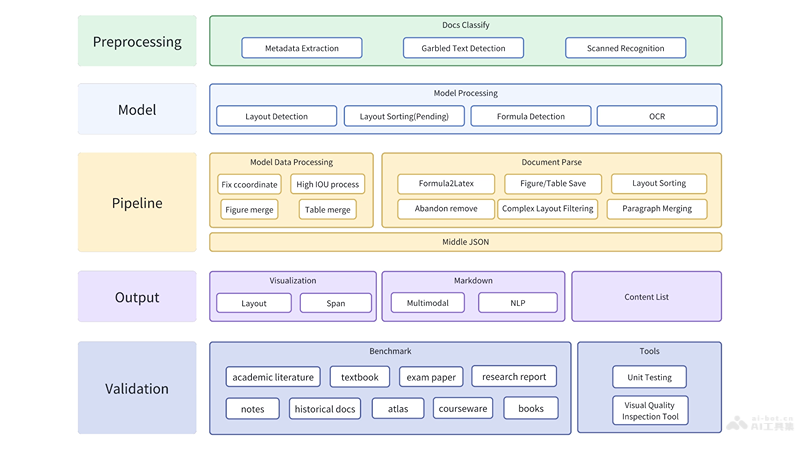
- PDF document classification preprocessing: Before processing a PDF document, MinerU first classifies the document, identifies its type (such as text-based, layered, or scanned PDF), and performs corresponding preprocessing, such as detecting garbled text and identifying whether it is a scanned document.
- Model parsing and content extraction:
- Layout detection: Use deep learning-based models such as LayoutLMv3 for region detection, identifying different regions in the document such as images, tables, headings, and text.
- Formula detection: Use a self-developed model based on YOLOv8 to identify mathematical formulas in documents and distinguish inline formulas from display formulas.
- Formula recognition: Use the self-developed UniMERNet model to recognize and parse mathematical formulas and convert them into LaTeX format.
- Optical character recognition (OCR): Use OCR technologies such as PaddleOCR to recognize text content in documents.
- Pipeline processing: Input the data obtained from model parsing into the processing pipeline for post-processing, including:
- Determine the block-level order.
- Delete useless elements.
- Sort and assemble content according to the layout to ensure the fluency of the main text.
- Perform operations such as coordinate repair, high IoU processing, image and table description merging, formula replacement, icon dumping, and Layout sorting.
- Output in multiple formats: The processed document information can be converted into a unified intermediate format (middle-json), and output into different formats as needed, such as Layout, Span, Markdown, or Content list, etc.
- PDF extraction result quality inspection: Use a manually annotated PDF self-assessment evaluation set to test the entire process, ensuring the optimization of extraction results. Use visualization quality inspection tools for manual quality inspection and annotation, and feed the results back into model training to further improve model capabilities.
MinerU's project address
- Project official website:https://opendatalab.com/OpenSourceTools/Extractor/PDF
- GitHub repository:https://github.com/opendatalab/PDF-Extract-Kit
- HuggingFace model library:https://huggingface.co/wanderkid/PDF-Extract-Kit
- ModelScope community model library:https://www.modelscope.cn/models/wanderkid/PDF-Extract-Kit
MinerU's application scenarios
- Academic research: Researchers can extract key information from academic papers and journals, including text, formulas, and charts, supporting literature reviews and data analysis.
- Legal document processing: Legal professionals can use MinerU to extract clauses and evidence from contracts, legal opinions, and other legal documents, improving work efficiency.
- Technical document management: Engineers and technical writers can extract technical specifications and operating procedures from technical manuals and product documents, facilitating knowledge management and technical dissemination.
- Knowledge management and information retrieval: Enterprises and organizations can use MinerU to extract information from internal document libraries, build knowledge bases, and improve the efficiency of information retrieval.
- Data mining and natural language processing (NLP): Data scientists and NLP researchers can use data extracted by MinerU to train and optimize machine learning models.