
What is MindVLA-o1
MindVLA-o1 is the next-generation autonomous driving foundation model launched by Li Auto. It adopts a native multimodal MoE architecture that unifies and integrates three modalities: vision, language, and action. The model achieves spatial understanding through a 3D ViT encoder, performs future prediction with an implicit world model, and outputs driving trajectories via a unified action generation mechanism. Combined with closed-loop reinforcement learning and software-hardware co-design, MindVLA-o1 can see farther, think deeper, and drive more steadily, marking a key step in the evolution of autonomous driving toward general embodied agents.
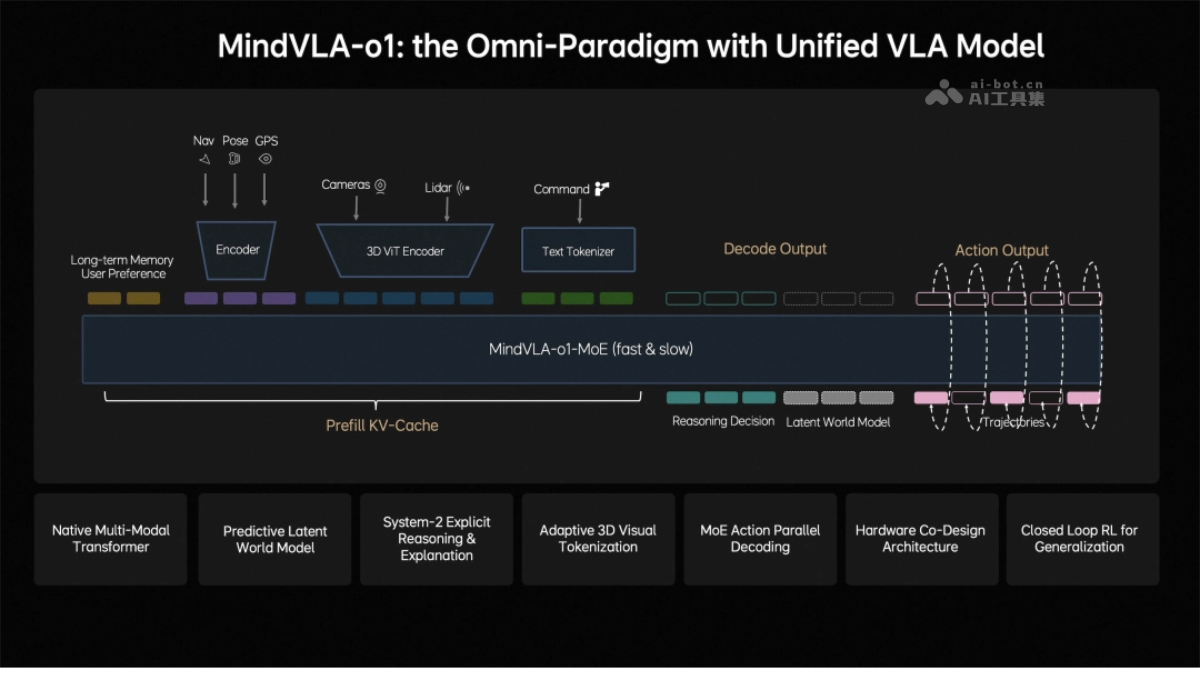
Main Features of MindVLA-o1
- 3D Spatial Perception: MindVLA-o1 achieves 3D spatial perception through a 3D ViT encoder and feed-forward 3DGS representation, accurately understanding both static environments and dynamic objects in the scene.
- Multimodal Thinking and Reasoning: The model introduces a predictive implicit world model to simulate future scene evolution in latent space, achieving deep integration of visual understanding and language reasoning.
- Unified Action Generation: The system adopts a VLA-MoE architecture and parallel decoding mechanism to generate high-precision driving trajectories that conform to dynamic constraints and meet real-time requirements.
- Closed-Loop Self-Evolution: Based on feed-forward scene reconstruction and a reinforcement learning framework, the model continuously self-evolves in simulated environments, breaking through the scale limitations of real-world data.
- Efficient On-Device Deployment: Through optimization under the law of software-hardware co-design, the system achieves efficient deployment on in-vehicle edge chips, balancing model accuracy and inference efficiency.
Technical Principles of MindVLA-o1
- 3D Self-Supervised Visual Encoding: The model uses a vision-centric 3D ViT encoder that takes LiDAR point clouds as geometric prompts and introduces feed-forward 3DGS representation to separately model static environments and dynamic objects. Through next-frame prediction tasks for self-supervised training, the model simultaneously possesses semantic understanding and 3D perception capabilities.
- Predictive Implicit World Model: To avoid the high computational cost of directly generating future images, the model performs efficient prediction in a compact latent space. Through three-stage training, it builds latent space representation and simulation capabilities for future scenes, achieving a unification of understanding the present, imagining the future, and logical judgment.
- Unified Action Generation: The Action Expert in the VLA-MoE architecture specializes in driving trajectory generation. It uses parallel decoding to output all trajectory points in one pass to meet real-time requirements, and performs multi-round iterative optimization through discrete diffusion to ensure trajectory spatial continuity and conformity to dynamic constraints.
- Closed-Loop Reinforcement Learning: It upgrades traditional step-by-step optimized reconstruction to feed-forward scene reconstruction, combines generative models to expand simulation capabilities, and relies on a unified 3DGS rendering engine and distributed training framework to achieve a low-cost, high-efficiency reinforcement learning loop.
- Software-Hardware Co-Design: Based on the Roofline model to characterize hardware constraints, it evaluates nearly 2,000 architecture configurations to find the Pareto optimal solution for accuracy and latency. It finds that wider and shallower model architectures are more efficient in edge scenarios, shortening the architecture exploration cycle from months to days.
Key Information and Usage Requirements of MindVLA-o1
- Positioning: Li Auto's next-generation autonomous driving foundation model, a native multimodal VLA architecture oriented toward embodied intelligence.
- Release Date: March 17, 2026, officially released by Zhan Kun, head of the foundation model, at NVIDIA GTC 2026.
- Five Major Technological Innovations: 3D spatial understanding, multimodal thinking, unified behavior generation, closed-loop reinforcement learning, and software-hardware co-design.
- Technological Evolution: From end-to-end to VLA and then to native multimodality, representing the beginning of the era of physical AI.
- Application Expansion: The same VLA model can control vehicles and robots; autonomous driving is only the starting point of physical AI.
- Data Level: Relies on the MindData unified VLA data engine to continuously collect, clean, and automatically annotate large-scale driving data.
- Computing Power Level: Needs to work with the MindSim controllable multimodal world model and RL Infra reinforcement learning infrastructure to support large-scale closed-loop training.
- Hardware Level: Deployed on the NVIDIA Drive Orin or Thor platform, and needs to satisfy the Pareto-optimal configuration of model precision and inference latency.
- Simulation Level: Relying on a unified 3DGS rendering engine and distributed training framework to achieve low-cost and high-efficiency reinforcement learning iteration.
Core Advantages of MindVLA-o1
- Native Multimodal Unified Architecture: MindVLA-o1 incorporates the three modalities of vision, language, and behavior into the same framework for joint training and alignment, rather than post-hoc stitching, achieving higher efficiency and better generalization ability.
- Deep 3D Spatial Understanding: Through the 3D ViT encoder and feed-forward 3DGS representation, the model possesses both semantic understanding and 3D perception capabilities, breaking through the limitations of traditional BEV flattening of scenes and OCC being overly dense.
- Efficient Latent Space Reasoning: The predictive latent world model "imagines" the future in a compact latent space, avoiding the high computational cost of directly generating images and achieving the unification of understanding the present and predicting the future.
- Real-Time Precise Decision-Making: The VLA-MoE architecture combines Action Expert, parallel decoding, and discrete diffusion optimization, balancing trajectory generation precision and real-time requirements..
- Efficient On-Device Deployment: The software-hardware co-design law shortens the architecture exploration cycle from months to days, finding the optimal balance between precision and latency on vehicle-mounted chips.
Comparison of MindVLA-o1 with Similar Competitors
| Comparison Dimension | MindVLA-o1 | Tesla FSD | Huawei ADS |
|---|---|---|---|
| Architecture Route | Native multimodal VLA unified architecture | End-to-end pure vision | End-to-end + multi-sensor fusion |
| Perception Scheme | Vision-dominant + LiDAR geometric prompts | Pure vision | Multi-sensor fusion |
| Reasoning Capability | Latent world model predicts the future | End-to-end implicit reasoning | Rule + AI hybrid |
| Behavior Generation | MoE + parallel decoding + discrete diffusion | End-to-end direct output | Segmented decision-making |
| Simulation Training | Feed-forward reconstruction + reinforcement learning | Shadow mode + simulation | Data closed loop as the main approach |
| Deployment Optimization | Software-hardware co-design law | Self-developed chips Dojo/HW4.0 | Ascend chip optimization |
| Application Expansion | Vehicle + robot general-purpose VLA | Focus on autonomous driving | Focus on autonomous driving |
| Technology Stage | Physical AI/Embodied Intelligence | AI-based End-to-End | AI-based End-to-End |
Application Scenarios of MindVLA-o1
- Autonomous Driving: As a next-generation autonomous driving foundation model, MindVLA-o1 can handle full-scenario driving tasks such as urban roads, highways, and complex intersections, achieving full-chain intelligence from perception and understanding to decision-making and planning.
- Intelligent Cockpit Interaction: Relying on the language understanding capability of the native multimodal architecture, the system can understand passengers' voice commands and, combined with visual perception, achieve natural human-machine interaction and proactive services.
- Robot Control: The same VLA model can be extended to robot platforms, driving different forms of embodied intelligent agents such as robotic arms and wheeled robots to complete tasks in the physical world.
- Simulation Testing and Validation: Through the MindSim world model, high-fidelity virtual scenarios are generated, supporting large-scale closed-loop testing and model iteration for long-tail scenarios such as extreme weather and rare accidents.
- Intelligent Traffic Management: Based on 3D spatial understanding and prediction capabilities, it can be extended to urban-level intelligent transportation systems such as vehicle-road cooperation and traffic flow prediction.