
What is MindOmni
MindOmni is a multimodal large language model launched by Tencent ARC Lab in collaboration with Tsinghua University Shenzhen International Graduate School, The Chinese University of Hong Kong, and The University of Hong Kong. Based on a reinforcement learning algorithm (RGPO), it significantly improves the reasoning and generation capabilities of vision-language models. The model uses a three-stage training strategy: first, a unified vision-language model is built, then supervised fine-tuning is performed based on chain-of-thought (CoT) data, and the RGPO algorithm is used to optimize reasoning generation. MindOmni performs excellently in multimodal understanding and generation tasks, demonstrating strong reasoning and generation capabilities in complex scenarios such as mathematical reasoning, opening up a new path for the development of multimodal AI.
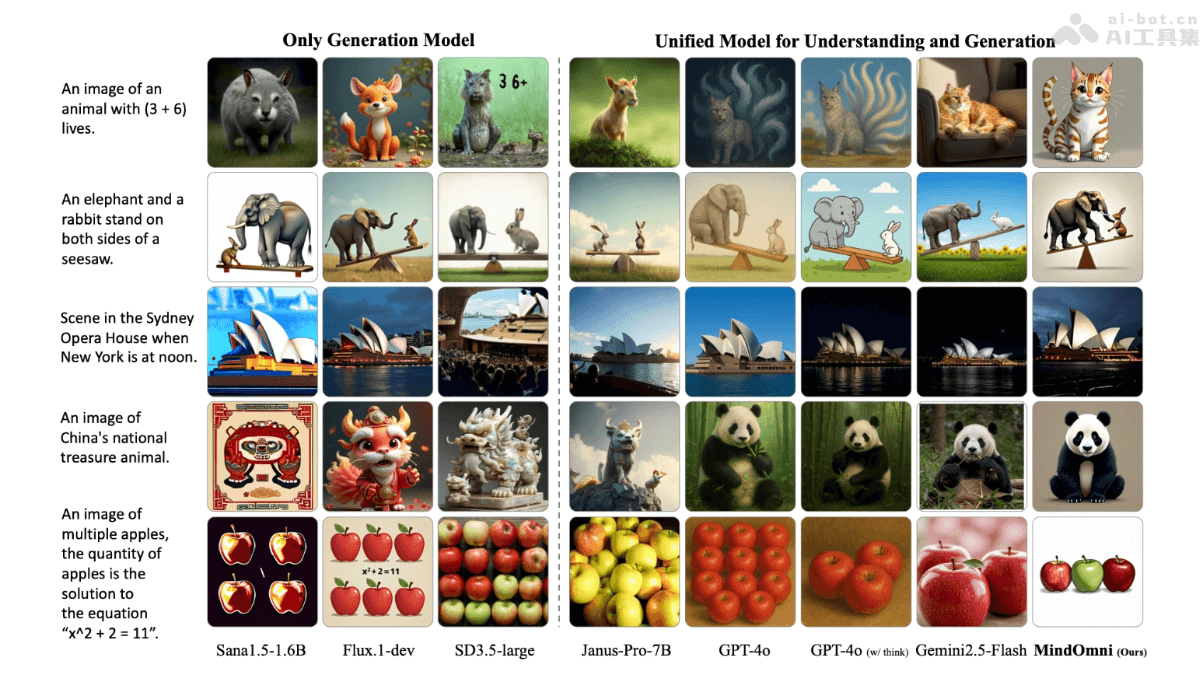
Main features of MindOmni
- Visual understanding: Supports understanding and interpreting image content, and answering image-related questions.
- Text-to-image generation: Generates high-quality images based on text descriptions.
- Reasoning generation: Can perform complex logical reasoning and generate images that include the reasoning process.
- Visual editing: Edits existing images, such as adding, deleting, or modifying elements in the image.
- Multimodal input processing: Supports processing text and image inputs simultaneously and generating corresponding outputs.
Technical principles of MindOmni
- Model architecture:
- Vision-language model (VLM): Extracts image features based on a pretrained ViT (Vision Transformer), and uses a text encoder to convert text input into discrete text tokens.
- Lightweight connector: Used to connect the VLM and the diffusion decoder, ensuring effective transfer of features between different modules.
- Text head: Processes text input and generates text output.
- Decoder diffusion module: Responsible for generating images, converting latent noise into actual images based on a denoising process.
- Three-stage training strategy:
- First stage: Pretraining, enabling the model to have basic text-to-image generation and editing capabilities. The connector is trained on image-text pairs and X2I data pairs to ensure that the diffusion decoder can seamlessly process the semantic representations of the VLM. Diffusion loss and KL divergence loss are used as the optimization objective functions.
- Second stage: Further optimizes the model based on chain-of-thought (CoT) instruction data to generate logical reasoning processes. A series of coarse-to-fine CoT instruction data is constructed, and the model is supervised fine-tuned with the instruction data.
- Third stage: Further improves the model's reasoning generation capability based on reinforcement learning, ensuring the quality and accuracy of the generated content. The Reasoning Generation Policy Optimization (RGPO) algorithm is introduced, using multimodal feedback signals (including image and text features) to guide policy updates. A format reward function and a consistency reward function are introduced to evaluate vision-language alignment. A KL divergence regularizer is used to stabilize the training process and prevent knowledge forgetting.
MindOmni project address
- Project official website:https://mindomni.github.io/
- GitHub repository:https://github.com/TencentARC/MindOmni
- arXiv technical paper:https://arxiv.org/pdf/2505.13031
- Online experience Demo:https://huggingface.co/spaces/stevengrove/MindOmni
Application scenarios of MindOmni
- Content creation: Generates high-quality images based on text descriptions, used in visual content creation in industries such as advertising, gaming, and film and television, accelerating the creative design process.
- Education: Generate images and explanations related to teaching content to assist instruction, help students better understand and remember complex concepts, and improve learning outcomes.
- Entertainment Industry: Generate characters, scenes, and props in game development to accelerate the development process; provide storyboards and concept art for film and television production to enrich creative expression.
- Advertising Industry: Generate attractive advertising images and videos to improve advertising effectiveness.
- Intelligent Assistant: Combine voice, text, and image input to provide a more natural and intelligent interactive experience and meet users' diverse needs.