
What is MimiClaw
MimiClaw isbased on the ESP32-S3 chip'sultra-lightweight AI assistant, written in pure C and capable of running directly on bare metal, with no need for Linux, Node.js, or an operating system. MimiClaw runs 24/7 online and provides Claude/GPT intelligent services via Telegram or WebSocket. MimiClaw features a persistent memory system (SOUL.md/USER.md/MEMORY.md), tool calling with support for search/scheduled tasks and hardware control capabilities, and stores all data locally with privacy first, making it an ultimate engineering practice of edge AI and Agent hardwareization.
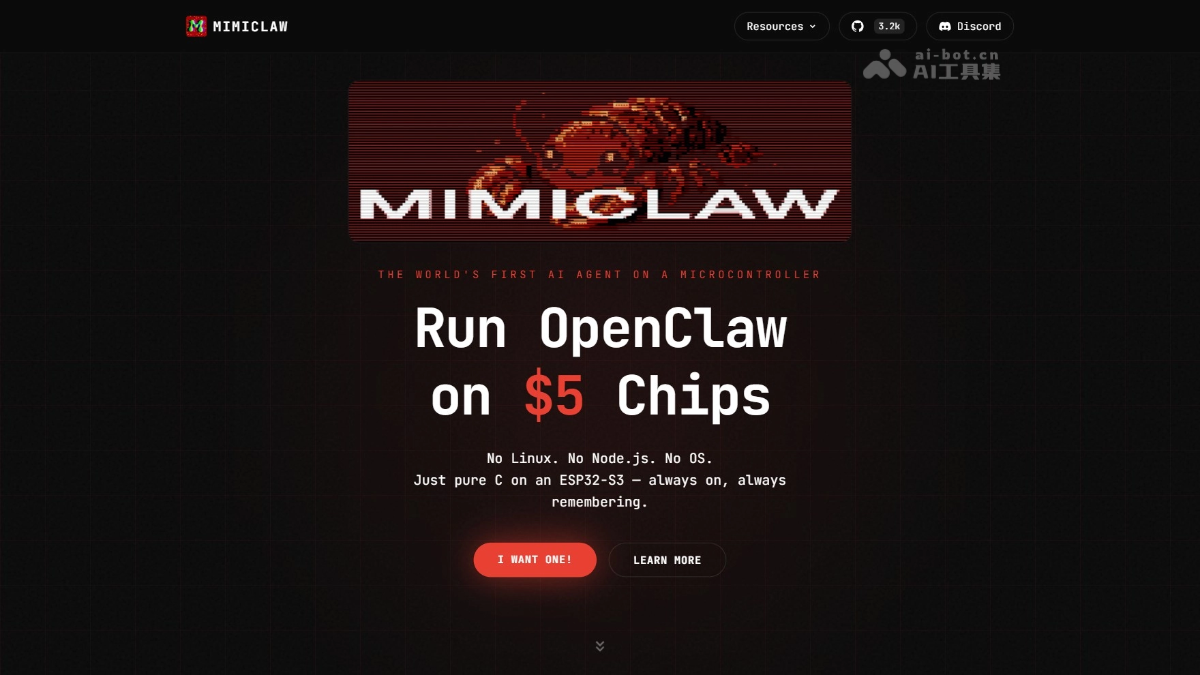
Main features of MimiClaw
-
Intelligent conversation: Chat in real time with Claude/GPT models via Telegram Bot or WebSocket, with runtime switching between dual providers.
-
Local memory: MimiClaw persistently stores the AI persona, user information, and long-term memory as Markdown files, which survive power loss and restart.
-
Autonomous scheduling: A built-in Cron scheduler and heartbeat mechanism enable the AI to create scheduled tasks and proactively check and execute to-dos.
-
Tool calling: Supports tools such as web search, time retrieval, and GPIO hardware control, implementing a ReAct-mode Agent loop.
-
Wireless operations: Supports OTA firmware updates and an HTTP proxy, enabling deployment and network adaptation without a physical connection.
Technical principles of MimiClaw
- Bare-metal architecture: Developed in pure C based on the ESP-IDF framework, it runs directly on ESP32-S3 hardware without a Linux or Node.js runtime, keeping the code size within 16MB Flash through minimal dependencies.
- Dual-core task allocation: Using the ESP32-S3's dual-core Xtensa LX7 processor, the network IO protocol stack is bound to CPU0, while Agent reasoning and tool execution are placed on CPU1, achieving concurrent processing and avoiding blocking.
- Streaming memory management: To address the 512KB SRAM limit, it uses HTTP streaming and chunked JSON parsing to avoid memory overflow caused by loading large responses at once, while extending storage for temporary data via PSRAM.
- ReAct state machine: Implements a state machine for the ReAct (Reasoning-Action-Observation) loop in pure C, maintaining multi-turn conversation context, parsing JSON tool-call instructions returned by the LLM, and driving local tool execution.
- SPIFFS persistence: Establishes a SPIFFS file system on Flash, storing memory, configuration, and task queues as plain text, achieving zero-dependency data persistence and human editability.
MimiClaw project address
- Project website:https://mimiclaw.io/
- GitHub repository:https://github.com/memovai/mimiclaw
Application scenarios of MimiClaw
- Personal portable assistant: As a pocket-sized AI companion, it can be plugged into a power bank or car USB to stay online 24/7, allowing users to check schedules, record inspiration, or get advice via Telegram at any time without relying on phone computing power or cloud subscriptions.
- Smart home hub: As a low-power home gateway, it connects to GPIO devices such as temperature/humidity sensors and relays, controls home appliances via natural language instructions, and uses local memory of user habits to achieve personalized automation.
- Industrial edge node: Deployed in scenarios such as factories or farmland, it periodically collects device data and autonomously judges anomalies, proactively reporting via a heartbeat mechanism; its 0.5W power consumption suits unattended environments powered by solar energy.
- education development platform: Open-source bare-metal code provides embedded learners with a sample of Agent engineering practice, and low-cost hardware lowers the barrier to AIoT development; it is suitable for university IoT and edge computing courses.