
What is MILS
MILS (Multimodal Iterative LLM Solver) is a method proposed by Meta AI that can endow large language models (LLMs) with multimodal capabilities without training. Through multi-step reasoning, it prompts the LLM to generate candidate outputs, scores each output, and provides iterative feedback, ultimately producing a task solution. The core advantage of MILS is that it requires no additional training of the LLM and can handle various multimodal tasks, such as zero-shot image, video, and audio description. It is applied to media generation, improvingtext-to-imagegeneration quality through prompt rewriting and performs style transfer.
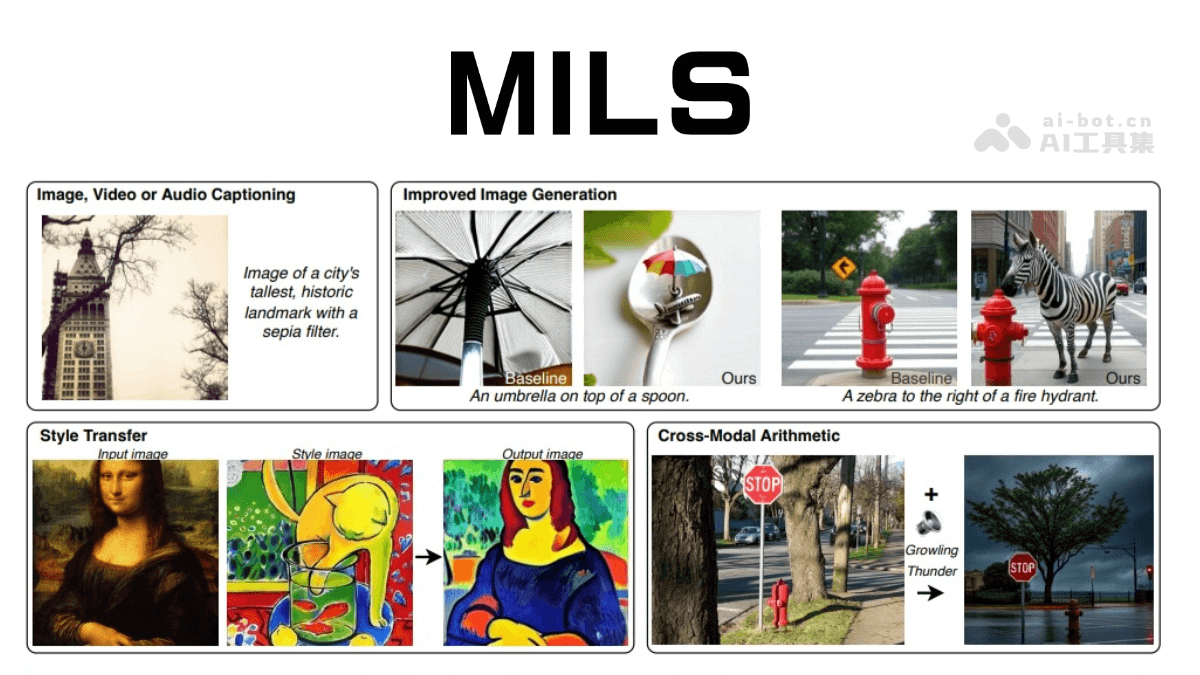
Main features of MILS
- Multimodal understanding tasks
- Image description generation: Generate accurate text descriptions for a given image.
- Video description generation: Generate descriptive text for videos, capturing the key content in the video.
- Audio description generation: Generate descriptive text for audio, capturing the key sound information in the audio.
- Cross-modal reasoning: Achieve reasoning and composition between modalities by mapping different modalities (such as images and audio) into text space.
- Multimodal generation tasks
- High-quality image generation: Improve the output quality of text-to-image (T2I) generation models by optimizing text prompts.
- Style transfer: Apply the style of one image to another image while keeping the content unchanged.
- Cross-modal generation: For example, generate images from audio, combining the semantic concepts of audio and images to generate new images.
Technical principles of MILS
- Generator: The goal is to generate candidate outputs for a given task. It receives the task description text and feedback scores from the scorer, and based on this information generates the next set of candidate solutions. It uses an LLM for modeling, can accept text input, and performs reasoning. The generator's output is not limited to text and can be used to guide subsequent models to generate other modal data (such as images).
- Scorer: The goal is to score the candidate solutions generated by the generator and evaluate how well they match the test sample. It can be implemented in many different ways, such as low-level image processing functions (comparing textures) or trained machine learning models (such as CLIP).
- Zero-shot multimodal description: MILS can generate high-quality descriptive content for images, videos, and audio without training, breaking the limitation that traditional multimodal tasks require large amounts of annotated data for training.
- Multi-step reasoning and iterative optimization: MILS is based on the multi-step reasoning capability of LLMs. It first prompts the LLM to generate multiple candidate outputs. Each candidate output is scored and continuously optimized through iterative feedback, ultimately generating the optimal task solution.
- Gradient-free optimization: As a gradient-free optimization method, MILS does not require training through backpropagation and gradually improves output results through scoring and feedback mechanisms.
- Multimodal embedding inverse mapping: MILS can inversely map multimodal embeddings into text, enabling complex applications such as cross-modal arithmetic.
MILS project address
- GitHub repository:https://github.com/facebookresearch/MILS
- arXiv technical paper:https://arxiv.org/pdf/2501.18096
Application scenarios of MILS
- Social Media Content Generation: Automatically generate image descriptions for automatic captioning on social media platforms.
- Multimodal Retrieval and Recommendation: MILS can be used in multimodal retrieval systems, for example, performing similarity retrieval through feature vectors of images, videos, or audio to achieve fast and accurate content recommendation.
- Visual Question Answering and Content Understanding: In visual question answering tasks, MILS can combine image and text information to generate accurate answers. It can be applied to intelligent assistants and automated question answering systems.
- Multimodal RAG: MILS can be combined with multimodal retrieval systems to integrate data types such as images, audio, and video into the generation process, enhancing the generation capabilities of language models.