
What is MiLoRA
MiLoRA is a parameter-efficient fine-tuning method for large language models (LLMs), which updates the minor singularcomponents of the weight component matrix to reduce computational and memory costs. The method is based on singular value decomposition (SVD) to divide the weight matrix into two parts: the primary part and the minor part. The primary part contains important knowledge, while the minor part contains noise or long-tail information. During fine-tuning, MiLoRA keeps the primary part unchanged and only optimizes the minor part, preserving the knowledge of the pre-trained model while adapting to new tasks. Experiments show that MiLoRA outperforms traditional methods on multiple benchmarks and is more efficient in training and inference.
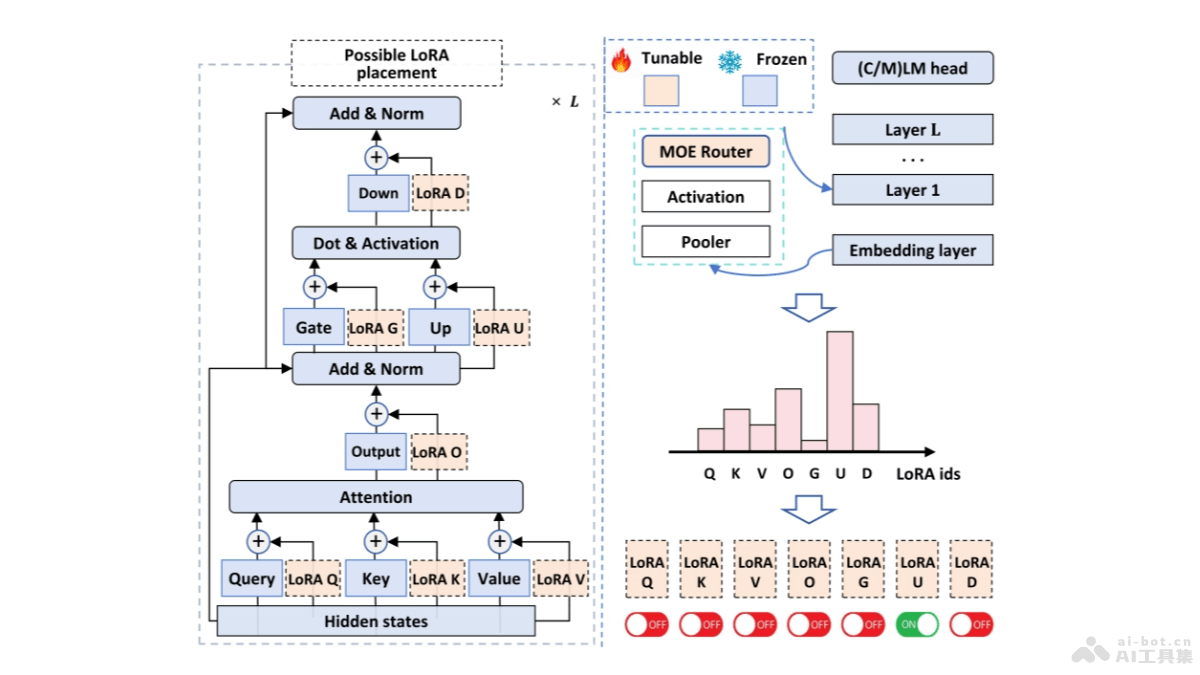
Main features of MiLoRA
- Parameter-efficient fine-tuning: MiLoRA fine-tunes large language models with fewer parameter adjustments, reducing the demand for computational resources.
- Reduced latency: Based on a prompt-based routing mechanism, MiLoRA reduces latency when generating new tokens in multi-tenant environments.
- Performance improvement: In various natural language processing tasks, MiLoRA shows better performance than traditional LoRA methods.
- Expert system: Treats each LoRA module as an expert and dynamically selects the most suitable expert for processing based on a routing mechanism.
- Adaptability: Dynamically determines which LoRA experts to activate based on the input prompt, improving the model's adaptability and flexibility.
Technical principles of MiLoRA
- LoRA modules as experts: In MiLoRA, each LoRA module is regarded as an expert responsible for handling a specific task or subset of data.
- Prompt-based routing mechanism: MiLoRA introduces a routing mechanism based on the input prompt. The routing mechanism computes the expert routing result before generating the first new token and reuses the result in subsequent token generation, avoiding the need to perform routing computation for each new token.
- Low-rank adaptation (LoRA): Reparameterizes the weights of Transformer layers based on low-rank matrices to achieve efficient parameter adjustment.
- Dynamic expert selection: At the Transformer layer level, MiLoRA dynamically selects which LoRA expert (that is, the LoRA of which Transformer module) is activated.
- Load balancing loss: To balance the use of different LoRA experts, MiLoRA adds a load balancing loss during training to ensure that the model does not overly rely on certain experts.
MiLoRA project address
- arXiv technical paper:https://arxiv.org/pdf/2410.18035
Application scenarios of MiLoRA
- Natural language processing tasks: MiLoRA is applied to various NLP tasks, such as text classification, sentiment analysis, question answering systems, machine translation, etc., to improve model performance on specific tasks.
- Multi-tenant environments: In cloud computing or service platforms, it is used to optimize resource utilization, reduce latency, and improve user experience.
- Online content generation: In applications that require real-time content generation, such as chatbots and content recommendation systems, it improves response speed and processing efficiency.
- Education and training: Used in personalized education platforms to adapt to different students' learning habits and needs based on fine-tuned models.
- Medical consultation and diagnosis: In the medical field, fine-tuned models provide more accurate medical consultation and diagnostic recommendations.