
What Is Muse
Muse is the first generative AI model launched by Microsoft for game creative generation, based on the "World and Human Action Model" (WHAM). Muse can generate game visuals and controller actions, simulating real gameplay sequences based on learned human player game data (such as images and action instructions). Its core capabilities include generating coherent and consistent game visuals, demonstrating diverse gameplay paths, and incorporating user modifications into generated content. Muse provides an interactive interface based on the WHAM Demonstrator, supporting creative exploration and iteration. Microsoft has open-sourced Muse's weights and sample data to advance research and innovation in game creative generation and support future AI-driven game development.
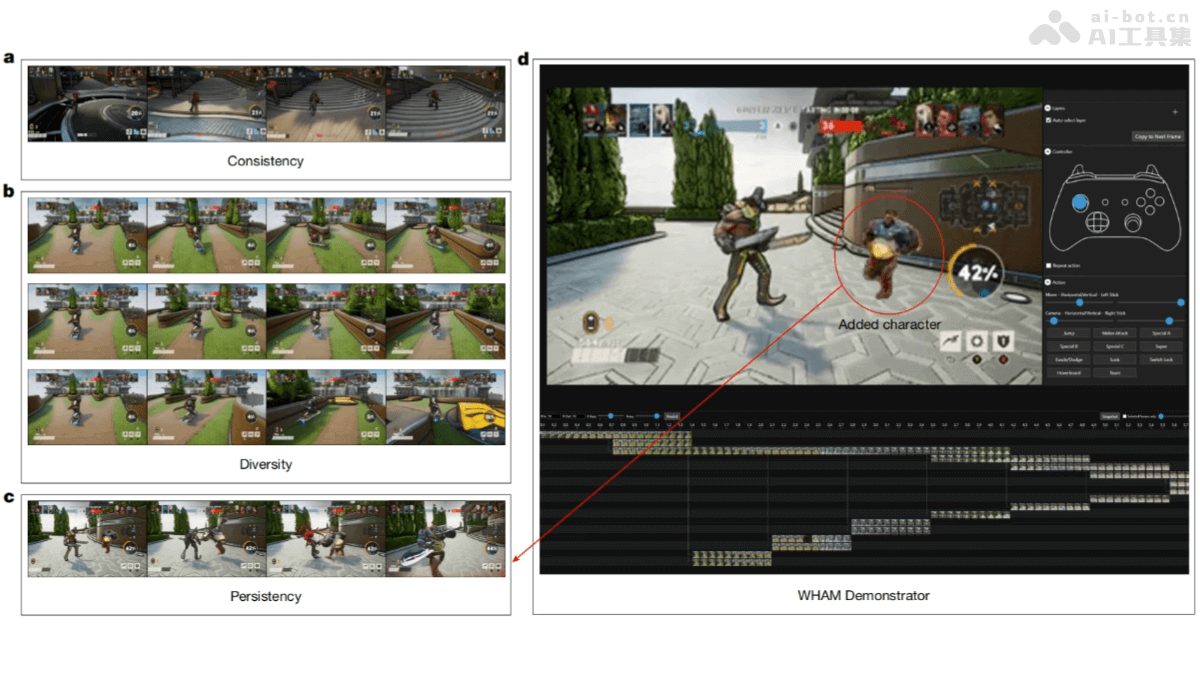
Muse's Main Features
- Generate Coherent Game Visuals and Gameplay: Based on the initial game visuals and controller actions, generate coherent gameplay sequences lasting up to several minutes, simulating real game dynamics.
- Support Diverse Gameplay Paths: Under the same initial prompt, generate a variety of different gameplay and visual effects, demonstrating rich behavioral and visual diversity.
- Persist User Modifications: Incorporate user modifications to game visuals (such as adding characters) into the generated content to generate reasonable subsequent gameplay.
- Creative Iteration Support: Based on the WHAM Demonstrator interface, users can load initial visuals, adjust generated content, and guide characters based on controller actions, enabling rapid iteration of creative ideas.
Muse's Technical Principles
- VQ-GAN: Used to encode game visuals (such as game images) into discrete representations. VQ-GAN converts images into discrete tokens based on quantization, making them easier for the model to process.
- Transformer Architecture: Serves as the model's backbone network for predicting the next token. Transformer can process discrete visual and action sequences and capture the complex relationships between them.
- Autoregressive Generation: Based on a given initial prompt (such as initial game visuals or controller actions), the model gradually generates subsequent visual and action sequences. The output of each step depends on the preceding context, ensuring that the generated sequence has coherence and consistency.
- Training Data: Muse is trained on player action and visual data from the game "Bleeding Edge." The data includes players' controller actions and the corresponding game visuals. The model generates new game sequences based on learning from this data.
Muse's Project Address
- Project Official Website:https://www.microsoft.com/en-us/research/blog/introducing-muse
- HuggingFace Model Library:https://huggingface.co/microsoft/wham
- Technical Paper:https://www.nature.com/articles/s41586-025-08600-3
Muse's Application Scenarios
- Game Creative Exploration: Rapidly generate gameplay and level designs to help developers validate new ideas.
- Automated Game Testing: Generate diverse test sequences to detect game bugs and optimize the experience.
- Content Generation: Automatically generate new levels, maps, or character actions to enrich game content.
- Player Behavior Prediction: Simulate player actions, analyze behavior patterns, and optimize game design.
- AI-Driven Experience: Develop dynamic storylines and AI opponents to enhance the personalization and immersion of games.