
What is Aurora
Aurora is a 1.3-billion-parameter atmospheric foundation model launched by Microsoft Research. It is based on extracting valuable information from massive amounts of atmospheric data and is used to predict atmospheric processes such as global weather patterns, air pollution, and ocean waves. The model uses a pretraining and fine-tuning architecture to handle data at different resolutions and pressure levels. Aurora performs excellently in multiple prediction tasks, including high-resolution weather forecasting, air pollution forecasting, and tropical cyclone track prediction, with a computational speed about 5,000 times faster than traditional numerical weather models. The model improves prediction accuracy, reduces computational costs, and provides a powerful tool for addressing climate change and extreme weather events.
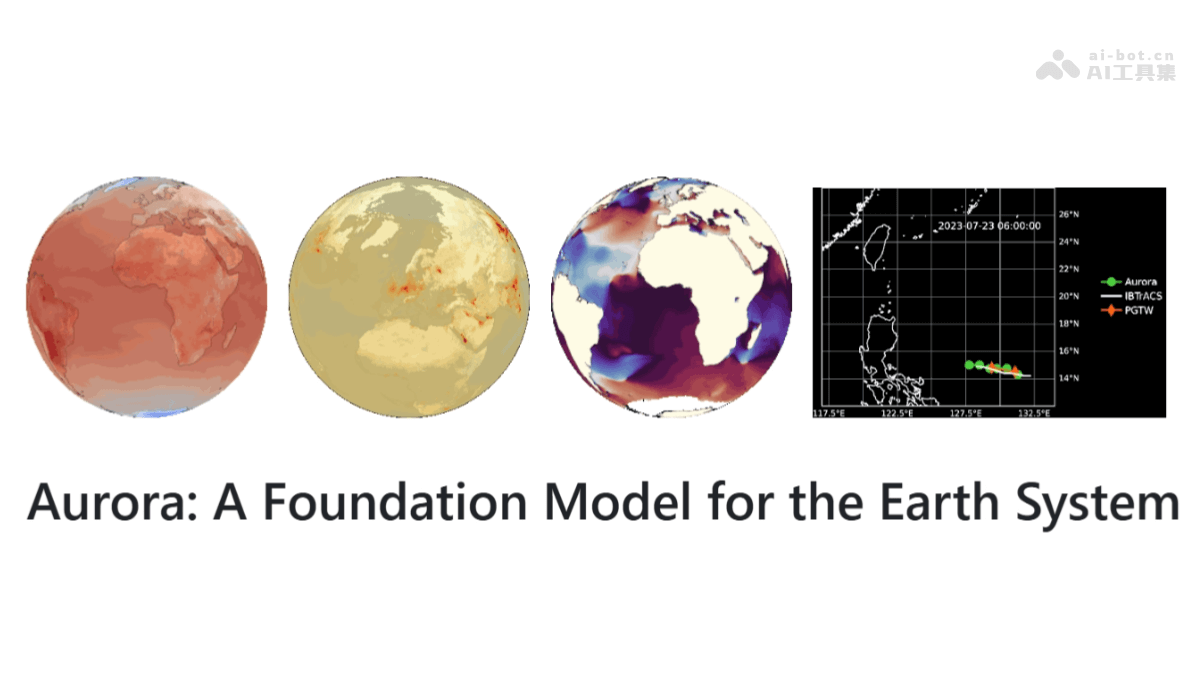
Aurora's Main Features
- High-Resolution Weather Forecasting: Aurora can generate high-resolution (e.g., 0.1°) global weather forecasts, covering meteorological variables such as temperature, wind speed, and pressure for the next 10 days.
- Air Pollution Forecasting: Aurora can predict global air pollution levels, including the concentrations of pollutants such as nitrogen dioxide (NO₂), sulfur dioxide (SO₂), ozone (O₃), and particulate matter (PM1, PM2.5, PM10).
- Ocean Wave Forecasting: Aurora can predict the height, period, and direction of ocean waves, helping fields such as shipping, coastal defense, and marine energy development.
- Tropical Cyclone Track Prediction: Aurora can accurately predict the movement tracks of tropical cyclones, providing important support for disaster prevention and mitigation.
- Extreme Weather Event Prediction: Aurora performs excellently in predicting extreme weather events (such as storms, floods, and droughts), and can issue early warnings to reduce disaster losses.
Aurora's Technical Principles
- Foundation Model Architecture: Aurora uses a two-stage training method of pretraining and fine-tuning. In the pretraining stage, the model learns general weather and climate representations from large amounts of diverse atmospheric data; in the fine-tuning stage, the model is optimized for specific tasks (such as weather forecasting or air pollution forecasting).
- 3D Swin Transformer: The core of Aurora is a flexible 3D Swin Transformer, which supports processing atmospheric variables at different spatial resolutions and pressure levels.
- Perceiver Encoder and Decoder: Perceiver-based encoders and decoders process heterogeneous inputs and generate predictions at different resolutions and fidelities.
- Data Diversity: In the pretraining stage, multiple data sources are used, including analysis data, reanalysis data, climate simulations, and operational forecast data. The diverse data inputs allow the model to learn broader patterns of atmospheric dynamics.
- Computational Efficiency: Based on an efficient model architecture and training method, computational efficiency is significantly improved, generating high-precision predictions in a short time, with a computational speed about 5,000 times faster than traditional numerical weather models.
Aurora's Project Address
- Project Website:https://microsoft.github.io/aurora
- GitHub Repository:https://github.com/microsoft/aurora
- arXiv Technical Paper:https://arxiv.org/pdf/2405.13063
Aurora's Application Scenarios
- Weather Forecasting: Provides meteorological departments and related industries with 10-day global weather forecasts at 0.1° resolution, helping optimize agriculture, flight scheduling, and disaster prevention.
- Air Pollution Forecasting: Provides environmental protection departments and public health agencies with forecasts of global air pollution levels, helping issue air quality alerts in advance and reduce public health risks.
- Ocean Wave Forecasting: Provide forecasts of wave height, period, and direction for shipping companies and coastal agencies, optimize routes, improve navigation safety, and support coastal defense and marine energy development.
- Tropical Cyclone Track Prediction: Provide accurate predictions of tropical cyclone movement tracks for meteorological and emergency management departments, issue early warnings, and reduce disaster losses in coastal communities.
- Extreme Weather Event Prediction: Provide early warnings for extreme weather events such as storms, floods, and droughts, helping governments and the public take response measures in advance and reduce the impact of disasters.