
What is MeWM
MeWM (Medical World Model) is an innovative medical model proposed by institutions such as The Hong Kong University of Science and Technology (Guangzhou), which assists clinical decision-making by simulating disease dynamics. It consists of a policy model, a dynamics model, and an inverse dynamics model. The policy model is based on a vision-language model and generates potential treatment plans according to the patient's state; the dynamics model simulates the progression or regression of the disease under different treatment conditions; the inverse dynamics model performs survival risk assessment on the simulation results and optimizes the treatment plan. MeWM takes medical images as input, constructs the initial disease state through the perception module, the dynamics model predicts future disease states, the inverse dynamics model evaluates treatment effects, and the policy model generates the optimal treatment plan, forming a closed-loop feedback optimization of intervention pathways.
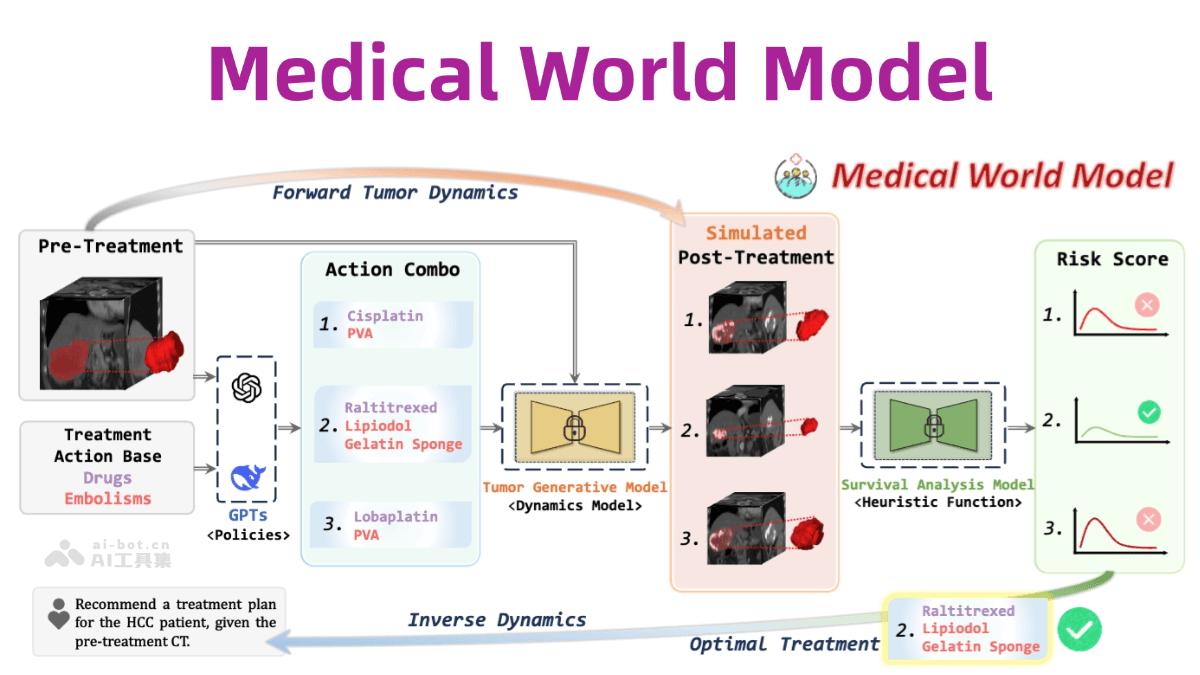
Main Functions of MeWM
-
Tumor Evolution Simulation: MeWM can use a 3D diffusion model to simulate tumor morphological evolution under different treatment plans, generating realistic postoperative tumor images to help doctors intuitively evaluate treatment effects before surgery.
-
Survival Risk Assessment: Through a survival analysis model, MeWM can predict the prognostic survival risk of patients under different treatment plans, and infer the optimal treatment plan based on inverse dynamics. The assessment results greatly surpass traditional multimodal large models in accuracy.
-
Clinical Decision Optimization: MeWM builds an automated, visualizable optimization loop from "plan generation - simulation deduction - survival assessment", supporting cancer interventional treatment planning. It can significantly enhance the clinical decision-making ability of interventional physicians, for example, increasing the F1 score by 13% in the selection of transarterial chemoembolization (TACE) treatment plans for liver cancer.
Technical Principles of MeWM
- Technical Architecture: MeWM consists of the following three core components:
-
Policy Model: Based on a vision-language model (such as GPT-4o), it generates candidate treatment plan combinations that satisfy clinical rules from CT images and treatment goals, covering various combinations of therapeutic drugs and embolic materials.
-
Dynamics Model: Using a 3D conditional diffusion model, it simulates postoperative tumor morphological changes according to different treatment plans, generating realistic postoperative tumor images.
-
Inverse Dynamics Model: It performs survival risk assessment on the simulated postoperative tumor images, calculates risk values through a heuristic function, and dynamically optimizes the treatment plan, ultimately selecting the plan with the lowest risk as the recommendation.
-
- Workflow
-
Input and Perception: Taking medical images as input, it generates the initial disease state through the perception module.
-
Simulation and Assessment: The dynamics model simulates postoperative tumor morphological changes according to different treatment plans, and the inverse dynamics model performs survival risk assessment on the simulation results.
-
Optimization and Feedback: Based on the assessment results, the policy model generates new treatment plans, forming closed-loop feedback and continuously optimizing intervention pathways.
-
- Innovations
-
Generative Model: MeWM innovatively uses "treatment behavior" as a conditional input to the generative model, simulating tumor evolution under different treatment plans.
-
Contrastive Learning: Through compositional contrastive learning (CCL), it enhances the realism and treatment sensitivity of the generated results.
-
Clinical Decision Support: In the selection of treatment plans for transarterial chemoembolization (TACE) for liver cancer, MeWM significantly improved the decision-making accuracy of interventional physicians, increasing the F1 score by 13%.
-
MeWM Project Address
- Project Official Website:https://yijun-yang.github.io/MeWM/
- Github Repository:https://github.com/scott-yjyang/MeWM
- arXiv Technical Paper:https://arxiv.org/pdf/2506.02327
Application Scenarios of MeWM
- Preoperative Planning and Treatment Plan Optimization: MeWM can provide physicians with an intelligent assistant function for preoperative planning. By generating postoperative tumor images and assessing survival risk, MeWM can help physicians optimize treatment plans and select the combination of drugs and embolic materials most suitable for the patient.
- As a "Second Reading Physician": MeWM is expected to be integrated into clinical practice as a "second reading physician". It can perform survival analysis scoring based on generated postoperative CT, forming a complete closed-loop mechanism of "treatment simulation-effect evaluation-plan screening", assisting physicians in more effectively predicting treatment outcomes before surgery.
- Personalized Treatment Support: MeWM supports individualized, data-driven treatment decisions. It can generate multiple treatment plans based on the patient's preoperative imaging and treatment goals, and select the optimal plan through simulation and evaluation, providing strong support for precision medicine.