
What is MetaStone-L1-7B
MetaStone-L1-7B is a lightweight reasoning model in the MetaStone series, designed to improve performance on complex downstream tasks. It achieves state-of-the-art (SOTA) performance among parallel models on core reasoning benchmarks such as mathematics and code, and is comparable in performance to API models such as Claude-3.5-Sonnet-1022 and GPT4o-0513. The model is trained with GRPO based on DeepSeek-R1-Distill-Qwen-7B.
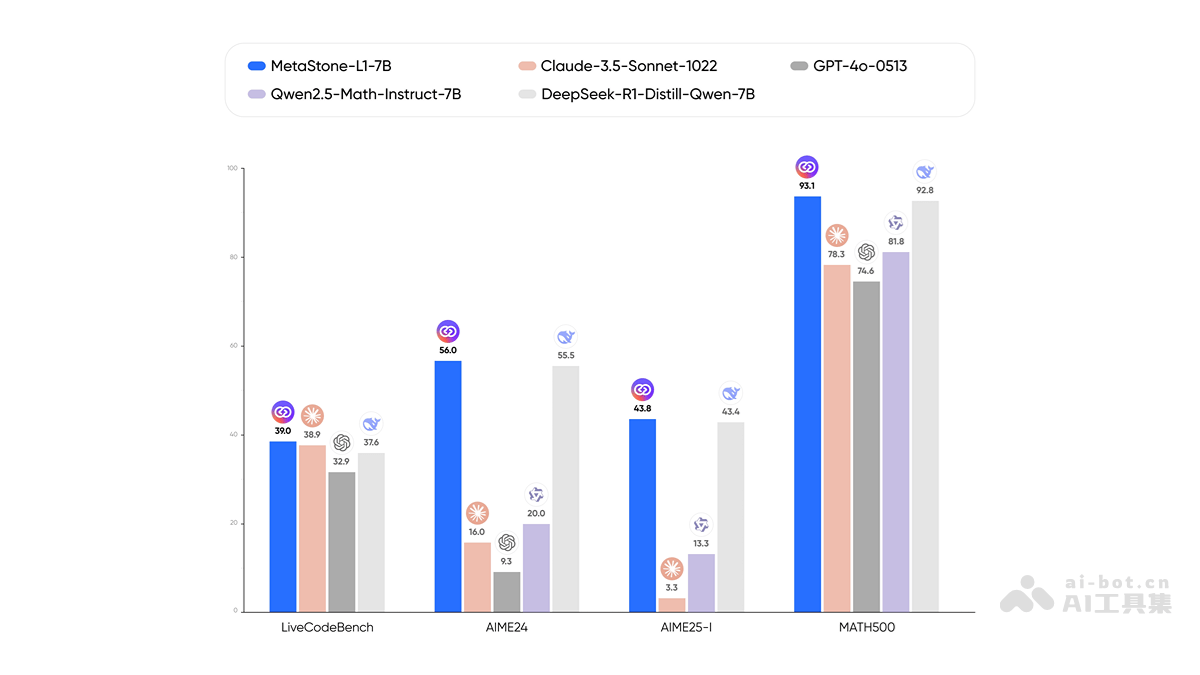
Main features of MetaStone-L1-7B
- Powerful reasoning ability: On core reasoning benchmarks such as mathematics and code, it achieves state-of-the-art (SOTA) performance among parallel models, and is comparable in performance to API models such as Claude-3.5-Sonnet-1022 and GPT4o-0513.
- Optimized training foundation: It is trained with GRPO based on DeepSeek-R1-Distill-Qwen-7B and has a solid performance foundation.
- Flexible usage settings: It is recommended to use a temperature of 0.6, top-p of 0.95, and a maximum generation length of 32k to achieve the best performance.
- Optimized prompts for specific problems: For mathematics problems, add "
Please reason step by step, and put your final answer within \\boxed{}." to the prompt; for code problems, add specific formatting requirements to the prompt, which can further improve the model's reasoning performance.
Technical principles of MetaStone-L1-7B
- Based on the technical architecture of DeepSeek-R1: MetaStone-L1-7B is trained with GRPO based on DeepSeek-R1-Distill-Qwen-7B. DeepSeek-R1 itself adopts advanced visual fine-tuning (Visual Fine-Tuning, V-FT) technology, and through innovative methods such as cross-modal contrastive learning, gradient decoupled training, and attention gating mechanisms, it significantly improves the model's visual understanding and multimodal alignment capabilities.
- Support for cross-architecture computing clusters: MetaStone AI Computing proposed a RISC-V & x86 cross-architecture computing cluster solution, which is compatible with multiple CPU chip architectures, including RISC-V and x86, through a "one cloud, multiple chips" design. This enables MetaStone-L1-7B to run efficiently on computing resources of different architectures and fully leverage the performance advantages of CPUs with different system architectures.
- Application of cloud-native technologies: MetaStone AI Computing innovatively proposed "MetaStone CloudOS" based on a cloud-native technology route, providing applications with all cloud infrastructure capabilities from containers, virtualization, storage, networking, and security. MetaStone CloudOS breaks through the resource scheduling barriers between RISC-V architecture clusters and x86/ARM architecture clusters, achieving true cross-architecture computing power flow.
- Low-parameter, high-efficiency design: MetaStone-L1-7B requires only 7B parameters to achieve the image-text understanding capability of traditional multimodal models (such as Flamingo-80B). This low-parameter design reduces the demand for computing resources, and further improves training efficiency through technologies such as mixed-precision training and gradient checkpointing.
Project address of MetaStone-L1-7B
- HuggingFace model library:https://huggingface.co/MetaStoneTec/MetaStone-L1-7B
Application scenarios of MetaStone-L1-7B
- Mathematics problem solving: It can reason step by step and solve complex mathematics problems, such as completing the square, solving equations, etc. Users only need to input the problem, and the model will reason step by step as required and give the final answer. The answer will be presented in a specific format (such as
\boxed{}), making it convenient for students to understand and learn. - Programming assistance: For programming problems, the model can generate code that meets the requirements and outputs it in the specified format. For example, the user can ask the model to read the input, solve the problem, and write the answer to the output, and the model will generate the corresponding code snippet.
- Intelligent customer service: It can quickly and accurately answer user questions, provide solutions and suggestions, and improve the efficiency and quality of customer service.
- Content creation: Help users generate text content, such as articles, stories, poems, etc., and inspire creative inspiration.
- Code generation and optimization: Generate corresponding code snippets according to user needs, help developers quickly implement functions, and improve development efficiency.