
What is MetaMorph
MetaMorph is a multimodal large model (MLLM) that achieves visual understanding and generation through instruction tuning. It proposes a method called Visual-Predictive Instruction Tuning (VPiT), which enables a pretrained large language model (LLM) to quickly transform into a unified autoregressive model capable of generating text and visual tokens. The MetaMorph model achieves competitive performance on both visual understanding and visual generation benchmarks, and can overcome common failure modes of other generative models during visual generation by leveraging the world knowledge and reasoning abilities acquired from LLM pretraining. Research shows that LLMs may possess powerful 'prior' visual abilities, which can be efficiently adapted to visual understanding and generation through a relatively simple instruction tuning process.
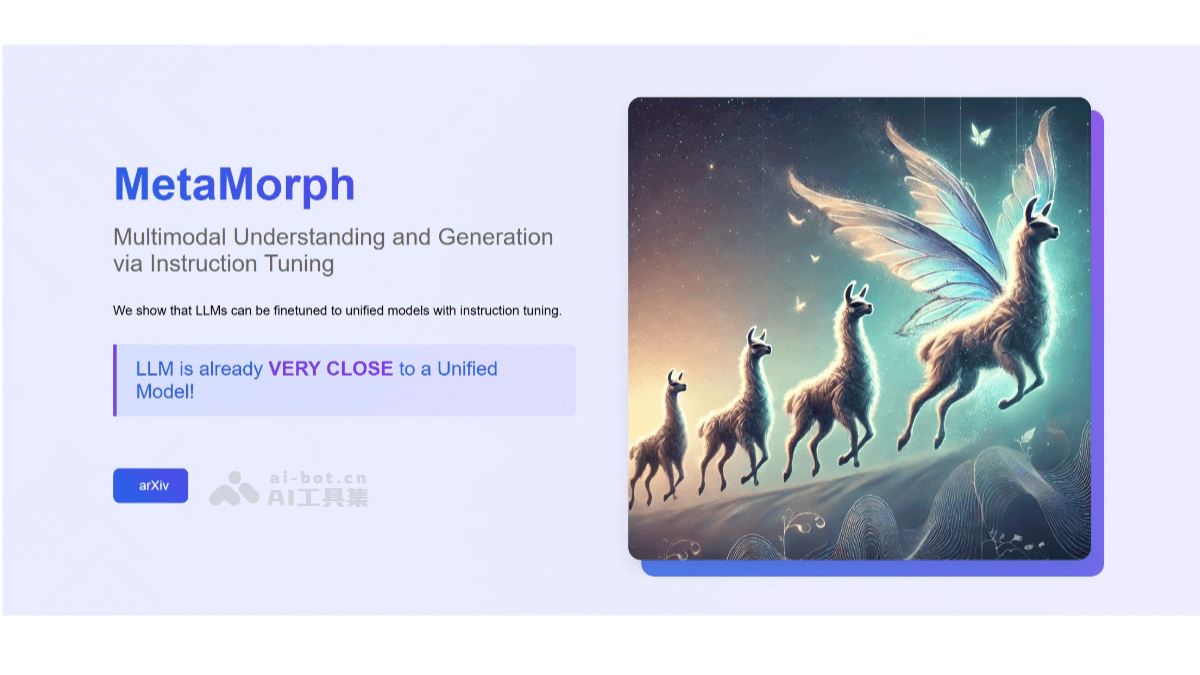
Main Features of MetaMorph
- Multimodal Understanding and Generation: Through Visual-Predictive Instruction Tuning (VPiT) technology, MetaMorph enables a pretrained large language model (LLM) to quickly transform into a unified autoregressive model capable of generating text and visual tokens, achieving multimodal understanding and generation.
- Visual Generation Capability: In visual generation, MetaMorph can leverage the world knowledge and reasoning abilities acquired from LLM pretraining to overcome common failure modes of other generative models.
- Implicit Reasoning Execution: MetaMorph can implicitly perform reasoning steps before generating visual tokens, for example, generating the corresponding image based on a prompt.
- Handling Technical Terminology: Compared with text embedding models CLIP and T5, MetaMorph handles technical terminology more effectively and generates accurate visual tokens.
- Unified Modeling Approach: MetaMorph demonstrates a unified modeling approach that allows the model to leverage the powerful capabilities of LLMs and extract knowledge from pretrained LLMs.
- Competitive Performance: MetaMorph achieves competitive performance on both visual understanding and visual generation benchmarks, outperforming other unified models.
Technical Principles of MetaMorph
- Visual-Predictive Instruction Tuning (VPiT): It is a simple yet effective visual instruction tuning method that enables a pretrained large language model (LLM) to quickly transform into a unified autoregressive model capable of generating text and visual tokens.
- Multimodal Token Prediction: VPiT teaches the LLM to predict discrete text tokens and continuous visual tokens from input sequences of image and text data organized in an instruction-following format.
- Association Between Visual Generation Capability and Visual Understanding: Research finds that visual generation capability emerges as a natural byproduct of improved visual understanding, and can be efficiently unlocked with a small amount of generation data.
- Asymmetry Between Understanding and Generation: The abilities to understand and generate visual tokens are interrelated but asymmetric. Increasing understanding data can more effectively improve visual understanding and generation performance, while increasing generation data can improve generation quality but has a smaller effect on improving visual understanding.
- Unified Model Training: Based on the above findings, the MetaMorph model uses VPiT to predict multimodal tokens and is trained on various data sources, including visual question answering datasets and pure image and video data without text annotations.
- Knowledge of Pretrained LLMs: MetaMorph can overcome failure modes common to other generative models during visual generation, based on world knowledge and reasoning abilities acquired from LLM pretraining.
MetaMorph's project address
- Project website:https://tsb0601.github.io/metamorph/
- arXiv technical paper:https://arxiv.org/pdf/2412.14164v1
MetaMorph's application scenarios
- Visual understanding and visual generation: Predicts multimodal tokens through instruction tuning (VPiT), utilizing various data sources, including visual question answering datasets and pure image and video data without text annotations.
- Knowledge extraction and visual token generation: MetaMorph can extract knowledge from pretrained large language models (LLMs) and implicitly perform reasoning steps before generating visual tokens. For example, given the input prompt "the animal after the monarch butterfly caterpillar transforms its form," MetaMorph successfully generated an image of a butterfly.
- Handling technical terms and semantic challenges: MetaMorph handles technical terms and common semantic challenges, such as negation and subjectivity, more effectively than text embedding models like CLIP and T5.
- Multimodal generative reasoning: MetaMorph can generate images based on riddle prompts, such as "the national park is located in." The prompt can be used directly without any chain-of-thought (CoT) prompt "generate a riddle image." MetaMorph can generate correct images from prompts that require multi-step reasoning.
- Solving visual riddles: MetaMorph can solve visual riddles that require implicit reasoning. For example, when answering the question "a musical instrument, this instrument is usually played by the scientist who proposed the theory of special relativity," the model needs to implicitly identify Einstein, identify that his preferred instrument is the violin, and directly generate the correct visual token.