
What is MetaGPT?
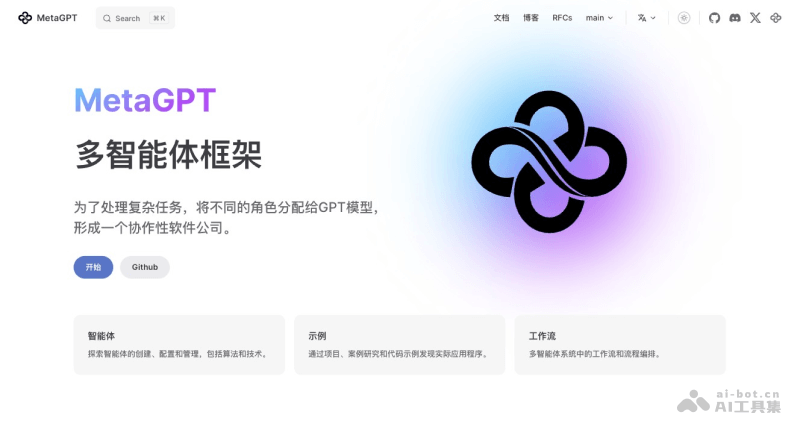
MetaGPT is an innovative meta-programming framework that combines large language models and multi-agent collaboration systems, aiming to solve complex problems by simulating human workflows. The core of this framework lies in encoding standardized operating procedures (SOPs) into prompt sequences to achieve more efficient workflows and reduce errors in multi-agent systems.
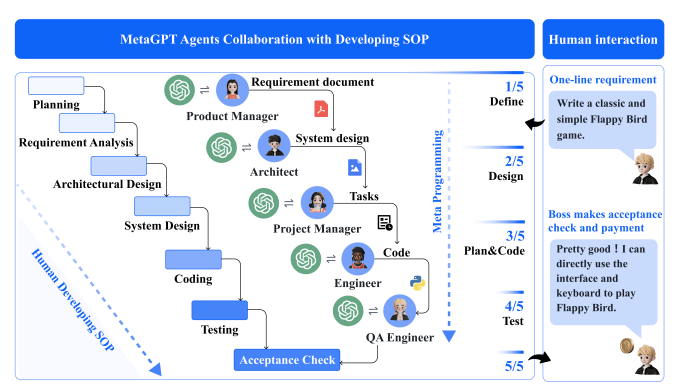
In MetaGPT, agents are assigned specific roles, such as product manager, architect, project manager, engineer, and quality assurance engineer, among others, and each role has its own unique responsibilities and expertise. These agents follow SOPs to break down tasks, ensuring that each step can be completed efficiently and accurately. For example, in the software development process, the product manager is responsible for analyzing requirements and creating a product requirements document (PRD), the architect is responsible for translating requirements into system design, the project manager is responsible for task allocation, the engineer is responsible for writing code, and the quality assurance engineer is responsible for testing and ensuring code quality.
MetaGPT Official Website Entry
- Official Project Homepage:https://www.deepwisdom.ai/
- Arxiv Research Paper:https://arxiv.org/abs/2308.00352
- GitHub Code Repository:https://github.com/geekan/MetaGPT
- Hugging Face Demo:https://huggingface.co/spaces/deepwisdom/MetaGPT
Main Features of MetaGPT
- Role Specialization and Collaborative Division of Labor: MetaGPT assigns agents in a multi-agent system to different roles, such as product manager, architect, engineer, etc., and each role has clear responsibilities and tasks. This division of labor enables complex tasks to be broken down into smaller, more specific subtasks, which are completed by agents with the corresponding expertise.
- Integration of Standardized Operating Procedures (SOPs): MetaGPT encodes SOPs into prompt sequences, and these standardized processes help agents complete tasks more effectively. SOPs are widely used in various fields in human society to ensure consistency and quality of tasks. MetaGPT draws on this concept to improve the efficiency and accuracy of agent collaboration.
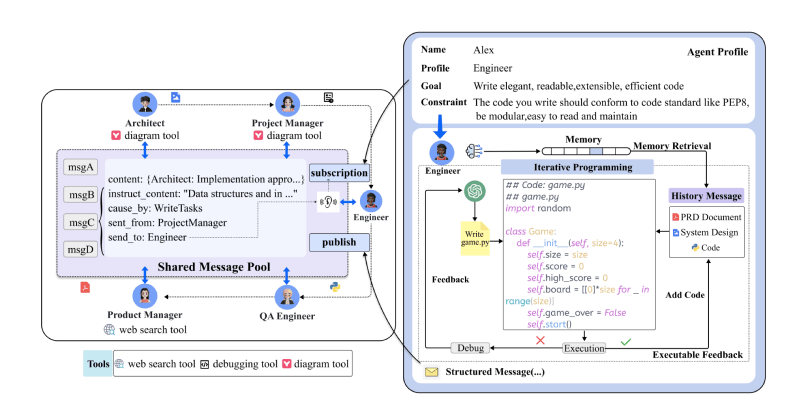
- Structured Communication: To address the limitations of pure natural language communication in complex tasks, MetaGPT adopts a structured communication approach. Agents publish and subscribe to information through a shared message pool, which ensures accurate information transfer while avoiding information overload.
- Executable Feedback Mechanism: MetaGPT introduces a self-correction mechanism that allows agents to perform iterative programming during code generation. For example, the engineer agent can generate code based on product requirements and design, then execute it and check for errors. If problems are found, it will debug based on past information and the current PRD, system design, and code files until the code passes testing.
- Simulating Real-World Team Collaboration: By simulating real-world software development teams, MetaGPT demonstrates its ability to break down complex tasks, assign specific action procedures to different roles, and promote collaboration among team members.
How MetaGPT Works
- Role Definition and Division of Labor:
- MetaGPT first defines a series of agent roles, each with specific responsibilities and tasks. For example, the product manager is responsible for analyzing user requirements, the architect is responsible for system design, the engineer is responsible for writing code, and the quality assurance engineer is responsible for testing, etc.
- These roles simulate real-world workflows, enabling each agent to focus on the area it excels in.
- Standardized Operating Procedures (SOPs):
- MetaGPT encodes SOPs into prompt sequences that guide agents on how to perform tasks. SOPs ensure consistency and quality in task execution, similar to work guidelines in human teams.
- By following these standardized processes, agents can collaborate more effectively, reduce errors, and improve the efficiency of the overall workflow.
- Structured Communication:
- To improve communication efficiency, MetaGPT adopts a structured communication approach. Agents publish and subscribe to information through a shared message pool, so that each agent can obtain the necessary information required to complete the task.
- This communication approach avoids information redundancy and omission, ensuring accurate information transmission.
- Executable Feedback Mechanism:
- In the code generation process, MetaGPT introduces an executable feedback mechanism. This means that after writing code, agents (such as engineers) execute the code and check its correctness.
- If errors are found, the agent debugs based on the feedback and then executes again until the code meets the requirements. This process is similar to the iterative process of human developers during development.
- Task Decomposition and Collaboration:
- MetaGPT decomposes complex tasks into multiple subtasks, with each subtask handled by one or more agents. This decomposition strategy enables large projects to be effectively managed and executed.
- Collaboration among agents is achieved through information exchange and task dependencies between roles, ensuring that the entire project progresses according to plan.
- Continuous Learning and Optimization:
- The design of MetaGPT allows agents to learn from past experience and optimize their behavior through self-correction and iteration. This self-improvement mechanism enables the system to become more efficient and intelligent over time.
Application Scenarios of MetaGPT
- Software Development: MetaGPT can simulate the workflow of a software development team, from requirements analysis, system design, code writing to testing and debugging, with each step handled by a specialized agent. This helps improve software development efficiency, reduce errors, and generate high-quality code.
- Project Management: In project management, MetaGPT can assist with planning, task allocation, progress monitoring, and resource allocation. By simulating the role of a project manager, it can help ensure projects are completed on time while maintaining effective communication among team members.
- Automated Testing: MetaGPT's agents can generate and execute automated test cases to ensure software stability and performance under various conditions. This helps detect and fix defects early in the software development process.
- Data Analysis and Decision Support: MetaGPT can integrate data analysis tools to help enterprises analyze data such as market trends and user behavior, providing support for decision-making. It can simulate the role of a data analyst, provide insights, and assist in formulating strategies.