
What is Meta ARE
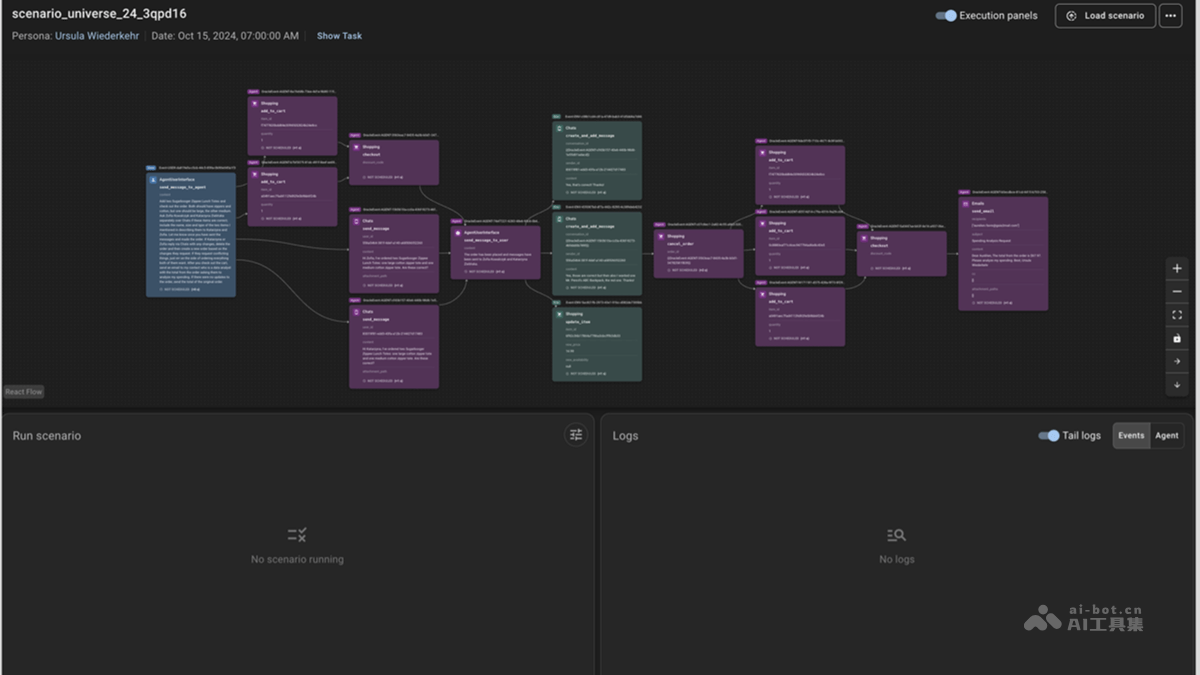
Meta ARE (Agents Research Environments) is a dynamic simulation research platform launched by Meta for training and evaluating AI Agents. The platform creates environments that evolve over time to simulate complex multi-step tasks in the real world, requiring Agents to adjust their strategies as new information emerges and conditions change. ARE runs the Gaia2 benchmark, which includes 800 scenarios across 10 domains, covering multi-step reasoning, real-world concerns, and comprehensive evaluation. The platform provides interactive applications such as email, calendar, and file systems for Agents to interact with, supports multiple models and automatic result collection, and helps the research community conduct systematic evaluations.
Main Features of Meta ARE
-
Dynamic Simulation: Supports the creation of complex scenarios that evolve over time, simulating multi-step tasks in the real world and requiring Agents to perform continuous reasoning and adaptation.
-
Agent Evaluation: Provides comprehensive benchmarking tools, such as the Gaia2 benchmark, which includes 800 scenarios covering 10 domains, used to evaluate multiple capabilities of Agents.
-
Interactive Applications: Agents can interact with real-world-like applications such as email, calendar, file systems, and messaging, which have domain-specific data and behaviors.
-
Research and Benchmarking: Supports parallel execution, multiple model support, and automatic result collection, providing the research community with systematic evaluation tools.
-
Quick Start and Ease of Use: Through quick start guides and command-line tools, users can quickly begin using ARE for Agent evaluation and scenario development.
Technical Principles of Meta ARE
-
Dynamic Environment: Introduces dynamic changes through an event system, simulating the gradual revelation of information and changing conditions in the real world. Events are time-triggered and Agent behavior-triggered, causing the environment to evolve over time.
-
Agent-Environment Interaction: Agents interact with the environment using the ReAct (Reasoning + Acting) framework, completing tasks by perceiving the environment state, reasoning, and taking actions. Agents' actions affect the environment state, which in turn triggers new events.
-
Multi-Step Tasks: Tasks are designed to require multi-step reasoning and decision-making, usually involving 10 or more steps, simulating complex real-world workflows. Agents need to maintain consistent reasoning and adaptability over long time spans.
-
Application Programming Interfaces (APIs): Provides APIs for a series of applications (such as email, calendar, etc.), enabling Agents to interact with these applications. Each application has its own specific data structures and behavior patterns.
-
Scenarios and Validation: Scenarios are complete tasks that combine applications, events, and validation logic. Validation logic is used to evaluate Agents' performance in scenarios and ensure that Agents' behavior aligns with expected goals.
-
Benchmarking and Evaluation: Through benchmarks such as Gaia2, systematically evaluates Agents' performance across multiple scenarios. Benchmarking supports comparison of multiple models and provides detailed evaluation reports and leaderboards.
Meta ARE Project Address
- Project Website:https://facebookresearch.github.io/meta-agents-research-environments/
- GitHub Repository:https://github.com/facebookresearch/meta-agents-research-environments
Application Scenarios of Meta ARE
-
AIAgents Capability Evaluation: Through 800 scenarios in the Gaia2 benchmark, comprehensively evaluate the reasoning, decision-making, and adaptability of AI Agents in complex tasks across multiple domains.
-
Multi-step task simulation: Simulate multi-step workflows in the real world, such as project management, incident response, etc., to test Agents' sustained reasoning and task completion capabilities over long time spans.
-
Human-computer interaction research: Study how Agents interact with real applications such as email and calendars, and explore more natural and efficient human-computer collaboration models.
-
Dynamic environment adaptability testing: In environments that evolve over time, test Agents' adaptability to new information and changing conditions, and improve robustness in uncertain environments.
-
Research and development support: Provide researchers with systematic evaluation tools, support parallel execution and comparison of multiple models, and accelerate the research and development process of AI Agents-related technologies.