
What is MeshPad
MeshPad is an interactive artistic mesh generation and editing tool based on sketch input. It can quickly transform simple 2D sketches into high-quality 3D mesh models, and supports real-time editing. Users can add or delete lines on the sketch to modify the 3D mesh, such as deleting regions or adding new geometric shapes. It uses a triangle sequence representation and captures complex geometric relationships through a Transformer model to generate high-quality meshes. The speculative prediction strategy can significantly reduce computational costs and accelerate the editing process. Each edit takes only a few seconds, and the quality of the generated mesh improves by 22% on Chamfer distance compared with existing methods.
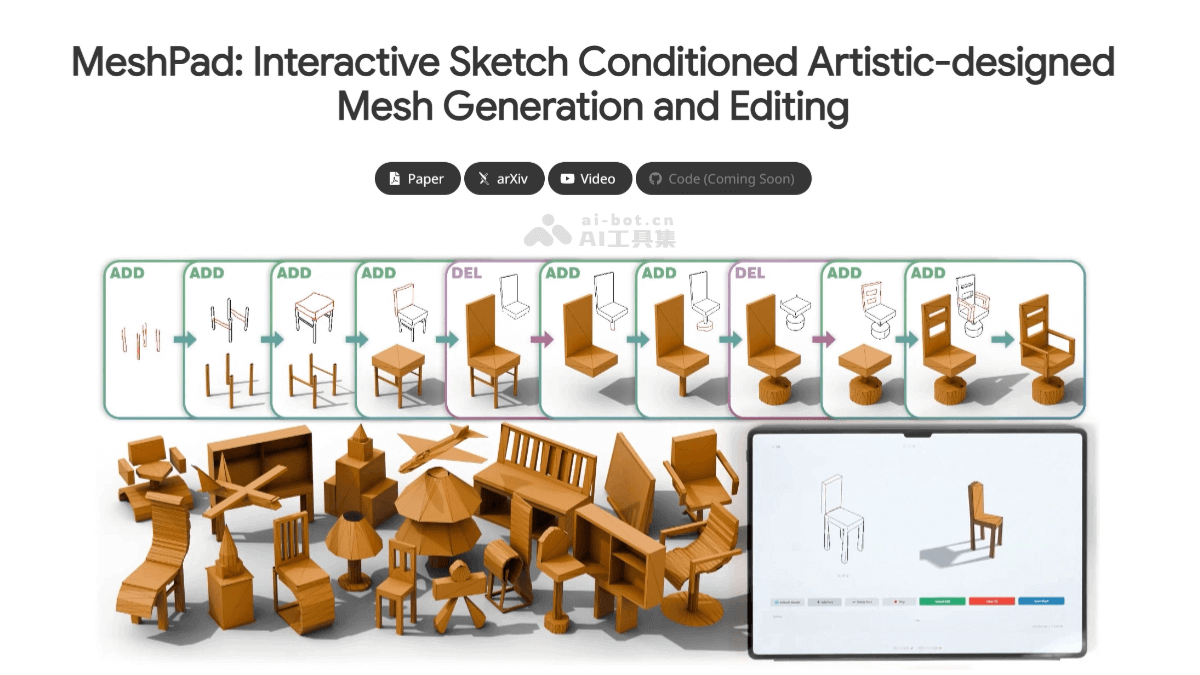
Main Features of MeshPad
- Sketch-driven 3D mesh generation: Users only need to draw simple 2D sketches, and MeshPad can automatically transform these sketches into high-quality 3D mesh models.
- Real-time interactive editing: MeshPad supports users in performing real-time editing on the generated 3D mesh. Users can add, delete, or modify lines on the sketch, and the operations are immediately reflected on the 3D mesh model.
- Efficient mesh processing: MeshPad uses a triangle sequence representation, which can efficiently handle adding and deleting operations on the mesh. The built-in Transformer model can capture complex geometric relationships and generate high-quality meshes.
- High-quality mesh output: The meshes generated by MeshPad improve by 22% on Chamfer distance compared with existing methods, and the generated 3D models are more accurate with richer details.
Technical Principles of MeshPad
- Triangle sequence representation: MeshPad uses a triangle sequence representation to efficiently handle adding and deleting operations on the mesh.
- Transformer model: MeshPad is based on a large Transformer model to capture complex geometric relationships. When handling adding and deleting operations on the mesh, the Transformer model can recursively generate new triangle meshes and seamlessly merge the newly generated mesh with the existing model.
- Add operation (Add): The Transformer uses an autoregressive model to predict the positions of newly added triangular faces, and aligns vertex coordinates through "speculative prediction" to ensure that the newly added parts blend perfectly with the original mesh.
- Delete operation (Del): A classification network analyzes vertices in the mesh and gives "delete labels" to precisely remove unwanted parts without damaging other structures.
- Speculative prediction strategy: MeshPad introduces a vertex-aligned speculative prediction strategy. By predicting multiple output tokens for vertices, it significantly reduces computational costs and accelerates the editing process. Each edit takes only a few seconds, achieving a truly real-time interactive experience.
- Real-time interaction and optimization: MeshPad's interactive design supports users in editing 3D mesh models in real time through simple sketch operations, such as adding or deleting lines.
MeshPad Project Address
- Project official website:https://derkleineli.github.io/meshpad/
- arXiv technical paper:https://arxiv.org/pdf/2503.01425
Application Scenarios of MeshPad
- Art design: Quickly transform sketches into 3D sculptures, animations, or game models.
- Architectural design: Transform hand-drawn sketches into architectural models and adjust design details in real time.
- Industrial design: Generate and modify product prototypes to accelerate the design iteration process.