
What is Mercury Coder
Mercury Coder is the first diffusion large language model (dLLM) launched by Inception Labs, and is a model in the Mercury series specifically used for code generation. Mercury Coder is based on a "coarse-to-fine" generation method, breaking through the sequential generation limitations of traditional autoregressive models, with a speed of over 1000 tokens per second, 5-10 times faster than existing optimized models. In standard programming benchmark tests, Mercury Coder's code generation quality is excellent, surpassing GPT-4o Mini and other models, while maintaining extremely high efficiency. Mercury Coder's fast and efficient characteristics perform outstandingly in resource-constrained environments, suitable for edge deployment and real-time applications.
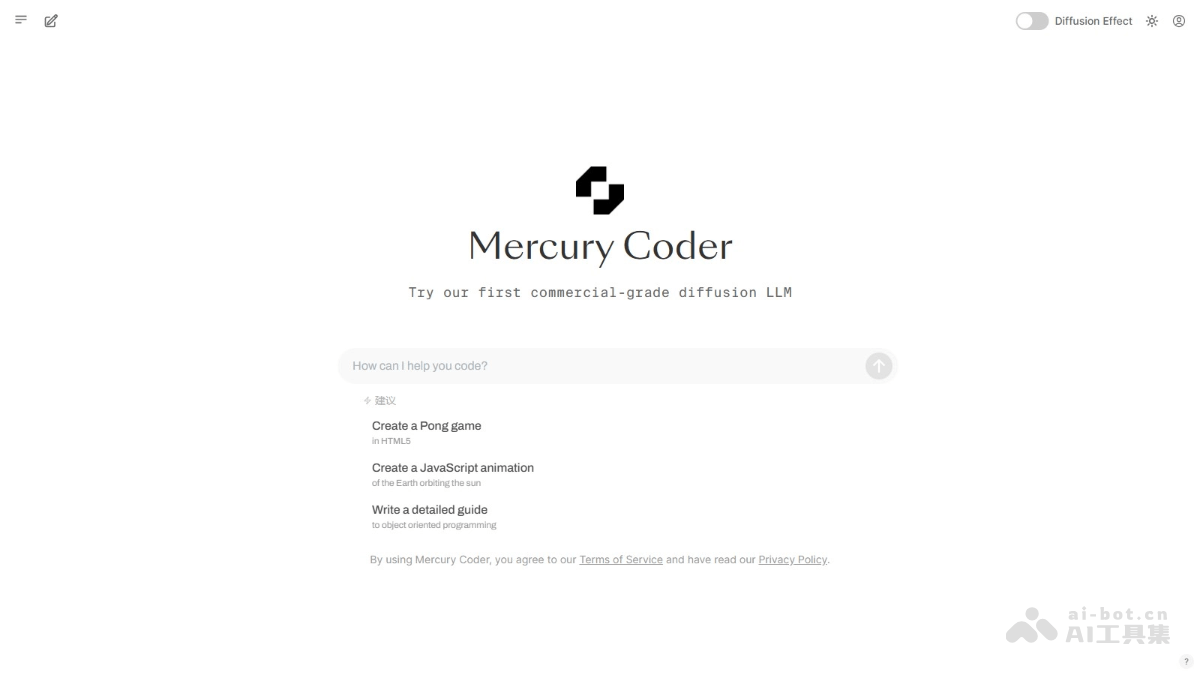
Main features of Mercury Coder
- Efficient code generation: Generate high-quality code snippets in a short time, with a speed of over 1000 tokens per second, 5-10 times faster than traditional autoregressive models.
- Code completion and optimization: Supports code completion functionality, generating accurate code snippets based on context, and optimizing existing code.
- Multi-language support: Applicable to multiple programming languages, generating code in different languages according to requirements.
- Reasoning and error correction capabilities: Based on the characteristics of diffusion models, automatically corrects errors during the generation process, reducing hallucinations and errors.
- Controllable generation: Users specify code format, style, or specific goals according to requirements, and the model can generate code that meets the requirements.
Technical principles of Mercury Coder
- Diffusion process: Diffusion models are based on gradually introducing noise into data, then gradually restoring the original data based on a "denoising" process. When generating text or code, the model starts from pure noise and gradually refines the output, ultimately generating high-quality results.
- Parallel generation: Unlike traditional autoregressive models that generate tokens one by one, diffusion models support parallel generation of multiple tokens, greatly improving generation speed.
- Transformer architecture: Mercury Coder uses a Transformer-based neural network, trained on large-scale data, optimizing the quality and accuracy of generation results.
- Global optimization: Diffusion models globally optimize generation results, not only relying on previous tokens, performing better in reasoning and error correction.
- Controllability: Based on adjusting parameters in the denoising process, users control the direction, format, and style of generated content, achieving more flexible code generation.
Mercury Coder project address
- Project official website: chat.inceptionlabs.ai/
Application scenarios of Mercury Coder
- Code generation and completion: Quickly generate high-quality code snippets, support multiple programming languages, suitable for code generation from basic templates to complex logic, helping developers reduce repetitive work and improve development efficiency.
- Development efficiency improvement: Suitable for rapid prototyping and development on resource-constrained edge devices, helping developers efficiently implement functionality.
- Education and learning assistance: Helps beginners quickly understand the syntax and logic of programming languages, is a powerful tool in programming education, and assists learners in better mastering programming skills.
- Code optimization and refactoring: Optimize existing code, improve code performance and readability, support generating code according to specific styles or specifications, ensuring code consistency and quality.
- Low-code/no-code development support: Integrated into low-code or no-code platforms to generate backend code or API interfaces for non-professional developers, lowering the development threshold and facilitating rapid application development.