
What is MemOS
MemOS is an open-source AI memory management operating system that provides long-term memory capabilities for agents and AI applications. Through a unified memory abstraction layer, MemOS supports multiple memory types (such as text memory, activation memory, and parameter memory), and features dynamic knowledge graphs, memory scheduling, and lifecycle management. MemOS enables AI systems to remember users' past information like humans do, actively recall memories in subsequent interactions, and achieve a more coherent and personalized conversation experience. MemOS's powerful memory scheduling and storage capabilities address the limitations of traditional RAG, making it suitable for various scenarios such as personalized assistants and team knowledge bases.
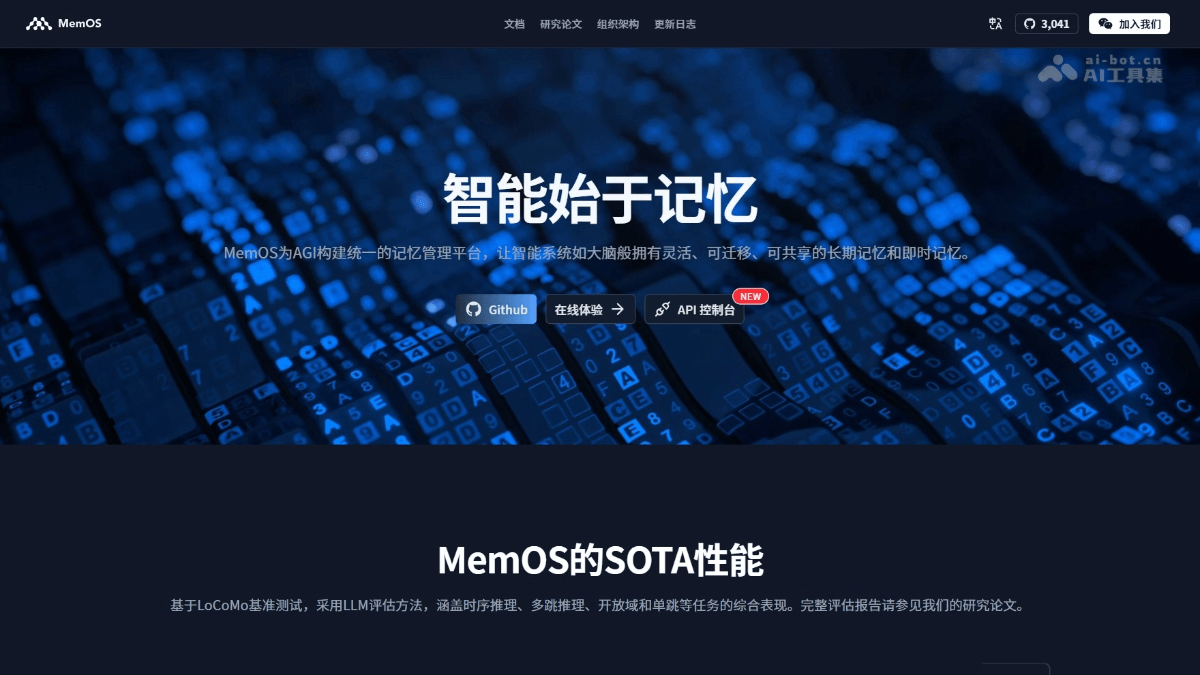
MemOS's main features
-
Long-term memory storage: MemOS provides multiple types such as text memory, activation memory, and parameter memory, combined with dynamic knowledge graphs to achieve structured memory, supporting long-term information storage and deep associations.
-
Memory scheduling and management: Through predictive scheduling, comprehensive scheduling, and asynchronous advanced retrieval, MemOS enables fast, context-aware memory access and improves response efficiency.
-
Memory lifecycle management: MemOS provides a unified interface that supports saving, updating, migrating, and rolling back memories, ensuring the continuity and consistency of memory.
-
Personalization and coherence: MemOS can remember information such as user habits and preferences, enabling personalized conversations, and maintains memory across sessions and applications to ensure interaction coherence.
-
Open extensibility: MemOS provides flexible API interfaces and supports integration with existing frameworks. Developers can customize memory modules and data sources to meet diverse needs.
-
Multi-scenario support: The tool is suitable for various scenarios such as personalized assistants, team knowledge bases, and family life assistants, and can be extended to functions such as AI calendars and intelligent writing assistants.
-
Performance optimization: Through multi-layer memory scheduling and asynchronous retrieval mechanisms, MemOS significantly improves the performance and accuracy of memory recall and reduces hallucinations.
How to use MemOS
-
Use the cloud platform API: Visit the MemOS official website https://memos.openmem.net/ , register an account to obtain an API key, and by calling the official API interfaces, quickly add memory functionality to applications without local deployment.
-
Local deployment: From the MemOS GitHub repository https://github.com/MemTensor/MemOS克隆代码,安装依赖配置环境,启动本地服务后能在本地环境中使用 all MemOS features, suitable for scenarios requiring a high degree of customization.
-
Use the Python SDK: Via
pip install MemoryOSinstall the MemOS Python SDK, and use the interfaces provided by the SDK to easily integrate memory management functionality locally or on a server for rapid development and testing. -
Use MOS: By configuring MOS (Memory Operating System), manage multiple MemCubes to achieve cross-module memory scheduling and unified management, suitable for multi-agent collaboration or complex application architectures.
-
Download sample code: Run the
memos download_examplescommand to download the official sample code and configuration files, and refer to the examples to quickly understand and practice MemOS features.
MemOS project address
- Project official website:https://memos.openmem.net/
- GitHub repository:https://github.com/MemTensor/MemOS
- arXiv technical paper:https://arxiv.org/pdf/2507.03724
MemOS application scenarios
-
Personalized assistant: By remembering the user's preferences and habits, MemOS provides users with intelligent assistant services that better fit their personal needs, enhancing the interaction experience.
-
Team Knowledge Base: Transforms team members' fragmented conversations into a structured knowledge base, facilitating multi-person collaboration and knowledge sharing.
-
Family Life Assistant: Records family members' living habits and daily schedules, provides intelligent reminders and personalized suggestions, and enhances the convenience of family life.
-
Intelligent Writing Assistant: Based on the user's writing habits and style, provides personalized writing suggestions and content generation, improving writing efficiency.
-
AI Calendar: Combined with memory functionality, automatically records and reminds of important dates and events, such as birthdays, anniversaries, etc., providing more thoughtful schedule management.