
What Is MemoraX Code
MemoraX Code is a long-term memory system designed specifically for Coding Agents, solving the pain point that Agents need to "get to know" a project anew with every new conversation. Through local code repository memory and cloud-based long-term memory, the tool enables continuous accumulation of project experience across Agents, conversations, and devices; it can automatically distill reusable engineering experience (Procedure Memory) from historical tasks. It ranks first in the AML Coding Track evaluation, can increase scores on complex long-horizon tasks by 6x, while reducing API call costs by about 23%.
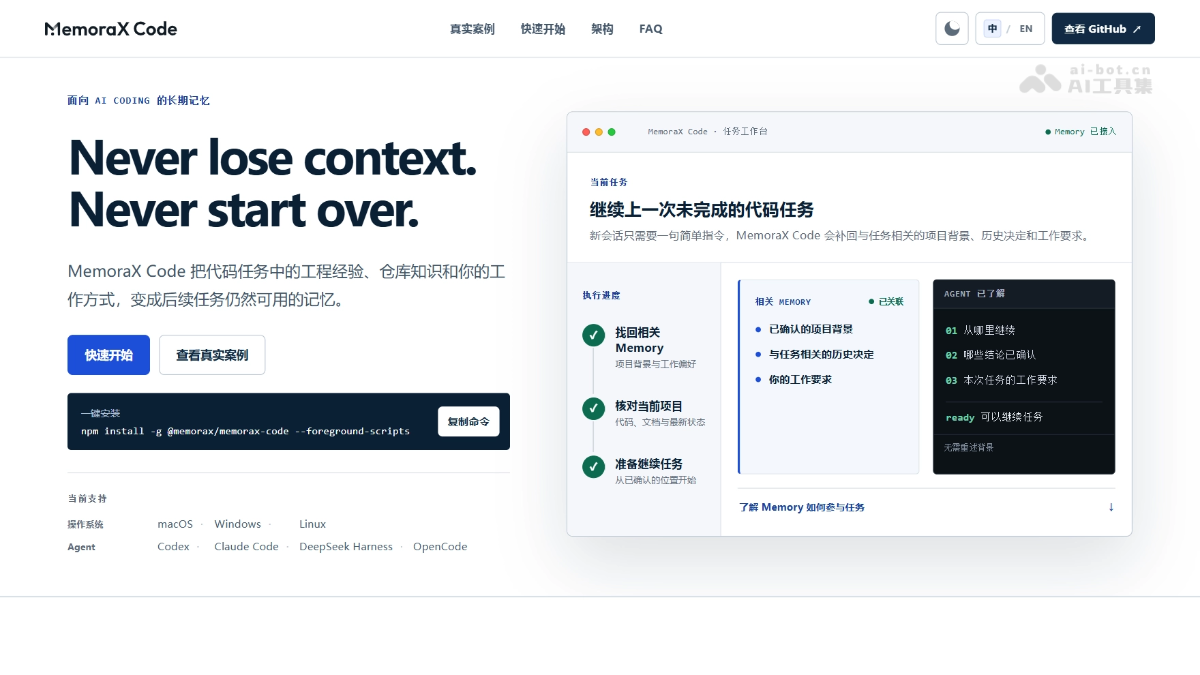
Main Features of MemoraX Code
-
Local Code Repository Memory: Quickly understand project structure, key entry points, historical PRs/Issues, architectural evolution, and important decisions, enabling "memory cold start."
-
Cloud-Based Long-Term Memory: Continuously accumulate project experience across Agents, conversations, and devices, including developer preferences, failure experience, and cross-Session cognition, so memory is not lost when switching tools.
-
Automatic Procedure Memory Distillation: Automatically identify and distill reusable engineering experience from historical Coding trajectories, accumulating it in the form of Skills for direct invocation by similar subsequent tasks.
-
Intent-Based Intelligent Retrieval: When a new task is triggered, recall the key memories truly relevant to the current task, automatically completing relevance ranking, deduplication, and trimming.
-
Learnable Memory Framework: Through training data exclusive to Coding scenarios and an RL reward mechanism, continuously optimize "what is worth remembering, when to recall, and how to update," enabling memory capabilities to self-evolve.
-
Memory Management Platform: Developers can view, modify, and delete their own Memory in the Platform, maintaining control over their memory.
-
Multi-Platform Compatibility: Already supports mainstream Coding Agents such as Codex, Claude Code, DeepSeek Harness, and OpenCode.
How to Use MemoraX Code
- Installation and Deployment: Visit the MemoraX Code official website https://code.memorax.net/ or GitHub to download and install the tool.
- Integrate with Agent: Complete the configuration and integration of MemoraX Code in supported Coding Agents such as Codex, Claude Code, DeepSeek Harness, and OpenCode.
- Daily Development: Use Coding Agent normally for programming tasks, and the system will automatically accumulate local code repository memory and cloud-based long-term memory in the background.
- Memory Reuse: When starting a new conversation or switching to a different Agent, relevant project experience will be automatically recalled and injected into the current context, with no need for repeated explanation.
- Manage Memory: Log in to the Memory Management Platform to view, edit, or delete accumulated Memory, maintaining control over your memory.
- Team Collaboration: Invite team members to join and share cross-device cloud memory, enabling experience reuse and accumulation in collaborative development.
Core Advantages of MemoraX Code
- Cross-Device Continuity: Project experience can flow seamlessly between different Agents such as Codex, Claude Code, DeepSeek Harness, and OpenCode, so switching tools does not require starting from scratch.
- Memory Cold Start: Automatically parses code repository structure, historical PRs/Issues, and architectural evolution, enabling the Agent to quickly understand the context the first time it enters a project.
- Procedure Memory: It can automatically distill reusable engineering experience from historical development trajectories and preserve it in the form of Skills, so that subsequent similar tasks benefit directly.
- Learnable framework: Through RL training, continuously optimize "what is worth remembering and when to recall it," moving memory capability from rule-driven to data- and reward-driven.
- Precise recall: Intelligently retrieve based on task intent, injecting only the key memories truly relevant to the current task into the context, avoiding interference from irrelevant information.
- Cost reduction and efficiency improvement: In complex long-horizon tasks, the score improves by about 6x, while API call costs are reduced by about 23%, cutting model consumption from repeated exploration.
MemoraX Code project address
- Project website:https://code.memorax.net/
- GitHub repository:https://github.com/memorax-ai/memorax-code
Comparison of MemoraX Code with similar competitors
| Comparison dimension | MemoraX Code | Claude Code Auto-Memory |
|---|---|---|
| Memory scope | Local code repository memory + cloud long-term memory, supporting cross-device sharing | Based on CLAUDE.md files, with three scopes: project-level/local/user-level |
| Memory generation | Automatically identifies and distills, supporting structured preservation of Procedure Memory | Automatically identifies knowledge worth retaining during a session and writes it back to CLAUDE.md |
| Cross-Agent | ✅ Supports multiple platforms such as Codex, Claude Code, DeepSeek Harness, OpenCode, etc. | ❌ Limited to the Claude Code ecosystem, unable to share with other Agents |
| Memory type | Code structure, historical PRs, architecture evolution, engineering experience (Skill), developer preferences | Build commands, coding standards, error patterns, environment configuration, architecture notes |
| Degree of automation | Intent-based retrieval, recalling only key memories relevant to the current task; the learnable framework continuously evolves | Automatically writes back to memory files, but relies on rule-driven behavior, with no continuous training optimization mechanism |
| Team sharing | ✅ Supports inviting team members to share cloud memory | ❌ Memory files are stored locally, with no native team collaboration mechanism |
| Cost-effectiveness | API costs for complex tasks are reduced by about 23%, and scores improve by 6x | Reduces repeated questions, but there is no public quantitative data on cost and effectiveness |
Application scenarios of MemoraX Code
-
Continuous development across sessions: A developer completed a permissions system overhaul with Codex yesterday. When starting a new conversation today, the Agent automatically recalls historical architectural constraints and failed approaches, with no need to repeatedly explain the project background.
-
Seamless switching across Agents: After completing the development of module A in Codex, switch to Claude Code to handle a bug in module B, and the previously accumulated project understanding and engineering experience continue to take effect.
-
Efficiency improvement for long-horizon complex tasks: During refactoring or feature development lasting more than 3 hours, automatically invoke the accumulated Procedure Memory to avoid repeatedly exploring known paths, improving the overall score by about 6x.
-
Team knowledge accumulation and reuse: Invite team members to share the cloud memory repository, turning project experience accumulated during individual development into Skills reusable by the team, reducing the information loss of "word-of-mouth transmission."
-
Fast onboarding for new team membersWhen a new member joins the project, the Agent quickly understands the code repository structure, historical decisions, and key entry points through memory cold start, shortening the time to become familiar with the codebase.