
What is MDT-A2G
MDT-A2G is an AI model jointly launched by Fudan University and Tencent YouTu, specifically designed to synchronously generate corresponding gestures based on speech content. MDT-A2G imitates the gestures naturally produced by humans during communication, enabling computers to "perform" more vividly and naturally. MDT-A2G uses multimodal information such as speech, text, and emotion for comprehensive analysis, and through techniques such as denoising and accelerated sampling, generates coherent and realistic gesture sequences.
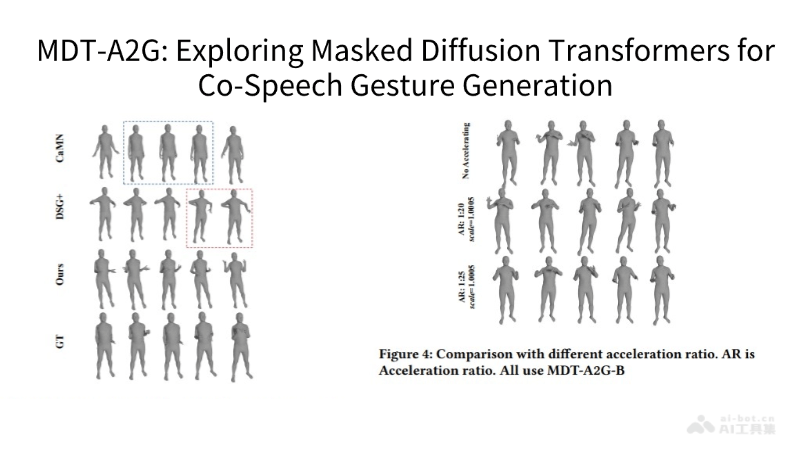
Main Features of MDT-A2G
- Multimodal information fusion: Combines multiple information sources such as speech, text, and emotion for comprehensive analysis to generate gestures synchronized with speech.
- Denoising processing: Through denoising techniques, corrects and optimizes gesture movements to ensure that the generated gestures are accurate and natural.
- Accelerated sampling: Adopts an efficient inference strategy, using previously computed results to reduce the amount of denoising computation and achieve fast generation.
- Time-aligned context reasoning: Strengthens the learning of temporal relationships between gesture sequences to produce coherent and realistic movements.
Technical Principles of MDT-A2G
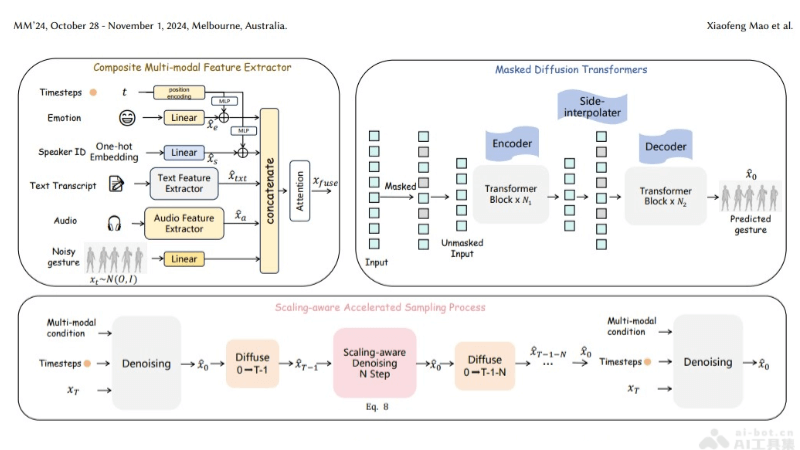
- Multimodal feature extraction: The model extracts features from multiple information sources such as speech, text, and emotion. This involves speech recognition technology to convert speech into text, as well as sentiment analysis to identify the speaker's emotional state.
- Masked diffusion transformer: MDT-A2G uses a novel masked diffusion transformer architecture. It generates the target output by introducing randomness into the data and then gradually removing this randomness, similar to a denoising process.
- Temporal alignment and context reasoning: The model needs to understand the temporal relationship between speech and gestures to ensure that gestures are synchronized with speech. This involves sequence models that can process time-series data and learn temporal dependencies.
- Accelerated sampling process: To improve generation efficiency, MDT-A2G adopts a scale-aware accelerated sampling process. The model uses previously computed results to reduce subsequent computation, thereby speeding up gesture generation.
- Feature fusion strategy: The model adopts an innovative feature fusion strategy that combines temporal embeddings with emotion and identity features, and integrates them with text, audio, and gesture features to produce comprehensive feature representations.
- Denoising process: During gesture generation, the model gradually removes noise and optimizes gesture movements to ensure that the generated gestures are both accurate and natural.
Project Address of MDT-A2G
-
GitHubRepository:https://github.com/sail-sg/MDT
-
Hugging Face Model Library:https://huggingface.co/spaces/shgao/MDT
-
arXivTechnical Paper:https://arxiv.org/pdf/2408.03312
Application Scenarios of MDT-A2G
- Enhanced interaction experience: Virtual assistants can use gestures generated by the MDT-A2G model to enhance nonverbal communication with users, making conversations more natural and human-like.
- Education and training: Virtual teachers or training assistants can use gestures to assist teaching, improving learning efficiency and participation.
- Customer service: In customer service scenarios, virtual customer service assistants can express information more clearly through gestures, improving service quality and user satisfaction.
- Assisting people with disabilities: For people with hearing or speech impairments, virtual assistants can provide more easily understood communication methods through gestures.