
What is Higress MCP
Higress MCP is the MCP marketplace launched by Jinri Investment, supporting the rapid conversion of Jinri Investment's rich financial data legacy APIs into MCP (Model Calling Protocol) services. Based on simple configuration, the platform converts REST APIs into MCP Servers without writing code, greatly simplifying the development process. The platform has powerful enterprise-grade capabilities, including unified authentication and authorization, fine-grained traffic control, full-link observability, etc., meeting enterprises' needs for security, stability, and performance. The platform provides hosted services, supports elastic scaling and canary releases, and reduces operations and maintenance costs. Higress MCP helps enterprises and developers quickly enter the MCP era and accelerate the development and deployment of AI applications.
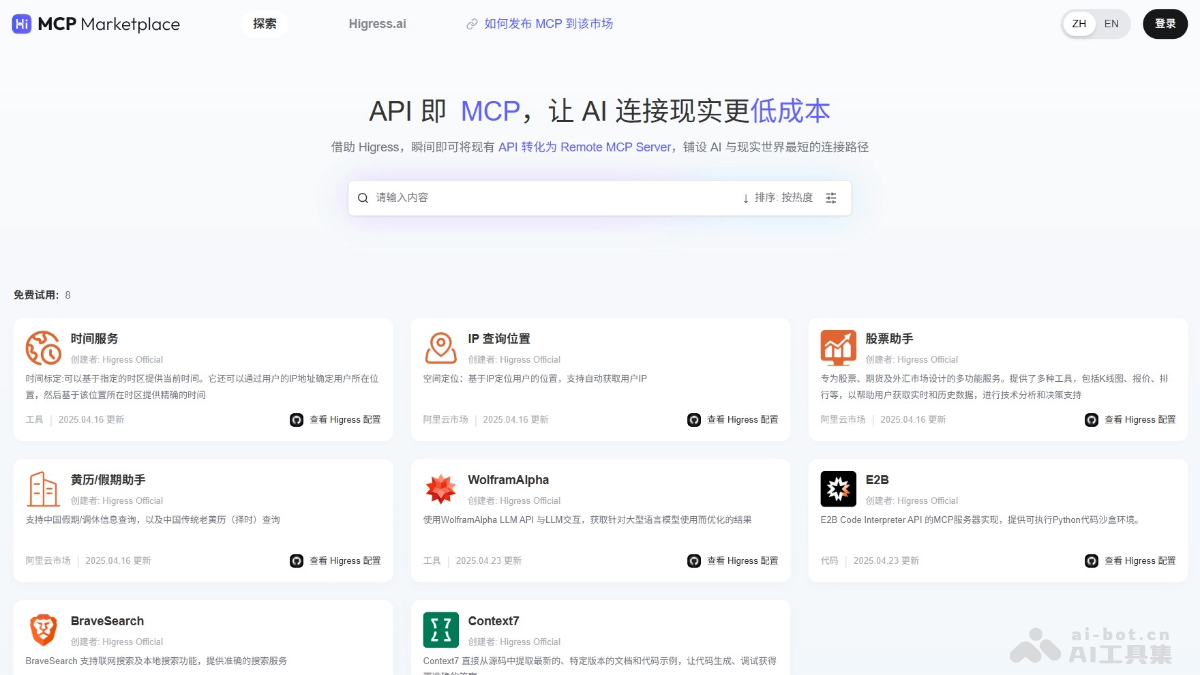
Main features of Higress MCP
-
Legacy API conversion: Based on simple configuration, quickly convert existing REST APIs into MCP Servers without writing code, reducing development costs.
-
Enterprise-grade capabilities: Provides unified authentication and authorization, fine-grained traffic control, full-link observability, etc., meeting enterprises' security and stability needs.
-
Hosted services: Supports elastic scaling, canary releases, and high-performance processing, reducing operations and maintenance costs and improving service availability.
-
Protocol offloading: Supports multiple versions of the MCP protocol, so there is no need to worry about maintenance issues caused by protocol upgrades.
-
Fine-grained optimization: Supports fine-grained processing of request and response templates, improving user experience and optimizing data interaction.
-
Multi-client support: Compatible with a variety of clients, such as Tongyi Lingma, Cline, Cherry Studio, etc., meeting different development needs.
How to use Higress MCP
- Visit MCP Marketplace: Open the Higress MCP official website:https://mcp.higress.ai/。
- Register or log in: Complete registration and login as prompted.
- Select the MCP Server you need: In Higress MCP, browse the available MCP Servers.
- Get the access URL: After logging in, enter the page of the selected MCP Server. The page provides an automatically generated URL (supporting SSE or Streamable HTTP access points).
- Configure the client: Configure the URL according to the client used (such as Cherry Studio, Tongyi Lingma, etc.). For example, in Cherry Studio, open settings, add a new MCP Server, and paste the URL obtained from Higress MCP Marketplace.
- Test and use: Call the tools or services provided by the MCP Server in the client. If the trial usage limit is reached, apply for an API Key, configure it in the client, and continue using it.
- Advanced usage (optional): If you have your own existing API and want to convert it into an MCP Server, use the openapi-to-mcp tool provided by Higress to convert the OpenAPI JSON file into an MCP Server configuration. Submit the generated configuration file to Higress MCP, or deploy the Higress gateway locally and load the configuration.
Application scenarios of Higress MCP
- Financial data analysis: Quickly obtain real-time market quotes, historical data, research reports, and other information, and use it for market trend analysis, risk assessment, and investment decision support.
- E-commerce intelligent recommendations: Implement functions such as product search optimization, personalized recommendations, and inventory management to improve user experience and operational efficiency.
- Enterprise-grade API management: Transform internal REST APIs into MCP Servers for unified management, with support for enterprise-grade features such as authentication, authorization, and rate limiting.
- AI application development: Quickly build and deploy AI applications, such as intelligent assistants and automation tools, with support for seamless integration with multiple clients and large models.
- IoT data processing: Quickly connect IoT device data to enable data collection, preprocessing, and analysis, with support for intelligent monitoring and predictive maintenance.