
What Is MCA-Ctrl
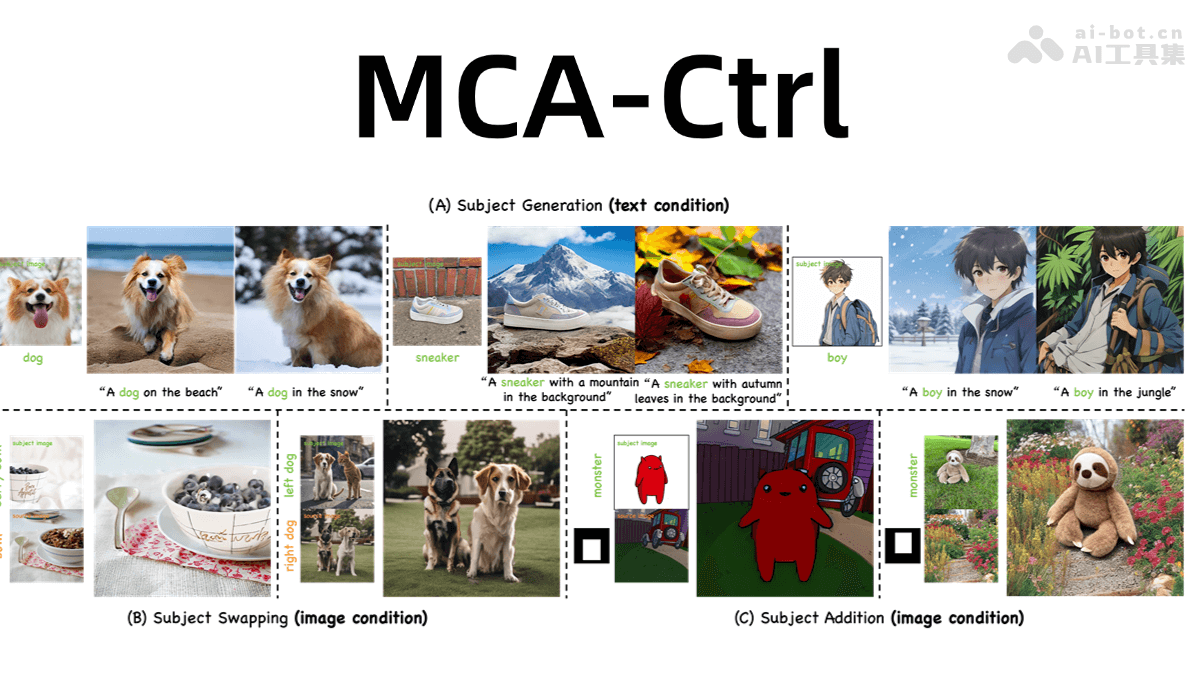
MCA-Ctrl (Multi-party Collaborative Attention Control) is an image customization generation framework introduced by the Institute of Computing Technology, Chinese Academy of Sciences, and the University of Chinese Academy of Sciences. It achieves high-quality image generation based on text and complex visual conditions.Image Generation. MCA-Ctrl introduces two attention control strategies, Self-Attention Global Injection (SAGI) and Self-Attention Local Query (SALQ), as well as a Subject Localization Module (SLM), to solve problems such as background inconsistency and subject confusion. MCA-Ctrl outperforms existing methods in zero-shot image customization and can effectively maintain consistency of subject features and condition information.
Main Features of MCA-Ctrl
- High-Quality Image Customization: Generates high-quality customized images under text or image conditions while maintaining semantic consistency with the condition input.
- Subject Feature Preservation: In complex visual scenes, accurately captures the appearance and content of a specific subject while avoiding subject leakage and confusion problems.
- Background Consistency: Maintains background consistency in image condition generation.
- Zero-Shot Generation: Supports directly generating high-quality images under zero-shot conditions.
- Support for Multiple Tasks: Supports a variety of image customization tasks, including subject generation, subject replacement, and subject addition.
Technical Principles of MCA-Ctrl
- Multi-Subject Collaborative Diffusion Process: Based on three parallel diffusion processes: the subject diffusion process (Bsub), the condition diffusion process (Bcon), and the target diffusion process (Btgt). The subject diffusion process handles the subject image, the condition diffusion process handles the condition image or text, and the target diffusion process generates the final customized image.
- Self-Attention Layer Operations: Self-Attention Global Injection (SAGI) injects the global self-attention features of the subject and condition images into the target diffusion process, enhancing the detail realism and content consistency of the target image. The SAGI operation helps correct feature confusion caused by local queries. The target diffusion process obtains the subject's appearance and background content based on the local features of the query subject and condition images. The SALQ operation ensures that the generated image maintains high consistency with the condition image in both subject and background.
- Subject Localization Module (SLM): To accurately identify and locate subjects in complex visual scenes, a subject localization module is introduced. SLM combines target detection models (such as DINO) and segmentation models (such as SAM), processes multimodal instructions, and outputs precise subject image layers and editable image layers, reducing feature confusion and artifacts.
- Tuning-Free Framework: MCA-Ctrl does not require separate fine-tuning training for each subject. Based on attention control strategies and the subject localization module, it achieves high-quality image customization under zero-shot conditions.
MCA-Ctrl Project Address
- GitHub Repository:https://github.com/yanghan-yh/MCA-Ctrl
- arXiv Technical Paper:https://arxiv.org/pdf/2505.01428
Application Scenarios of MCA-Ctrl
- Digital Content Creation: Quickly generates characters and scenes in games and animations.
- Advertising and Marketing: Produces personalized advertising images and brand promotion materials.
- Entertainment and Social Media: Generates personalized avatars, images, and social media content.
- Education and Training: Assists in the production of teaching materials and creates virtual laboratory scenes.
- Art and Design: Provides artistic inspiration and assists with interior design previews.