
What is MatterGen
MatterGen is an innovative generative model launched by Microsoft, specifically used for designing inorganic materials. Based on a unique diffusion process, it progressively refines atomic types, coordinates, and periodic lattices to generate stable, diverse inorganic materials spanning the periodic table. MatterGen can be fine-tuned to satisfy a wide range of performance constraints, such as chemical composition, symmetry, magnetic, electronic, and mechanical properties. Compared with previous material generation models, MatterGen performs excellently in generating stable, unique, and novel materials, and its generated structures are closer to DFT local energy minima. Within a given DFT property calculation budget, MatterGen can find more materials that satisfy extreme performance constraints.
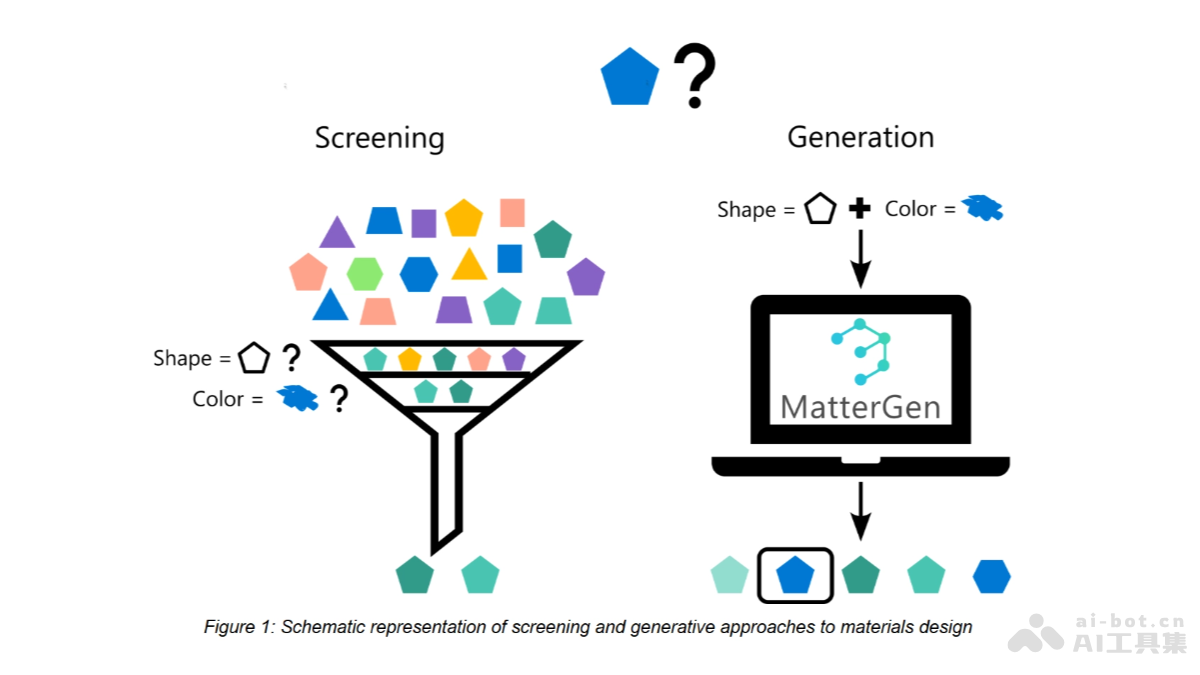
Main features of MatterGen
- Generate stable, diverse inorganic materials: Generate a variety of inorganic materials spanning the periodic table, and the generated materials have high stability, uniqueness, and novelty.
- Satisfy a wide range of performance constraints: Based on fine-tuning, generate materials that satisfy constraint conditions such as specific chemical composition, symmetry, magnetic, electronic, and mechanical properties, such as magnetic materials with high magnetic density, semiconductor materials with specific band gaps, superhard materials with high bulk modulus, etc.
- Inverse material design: Directly generate material structures according to target performance constraints, breaking through the limitations of traditional methods based on screening known materials, and greatly improving the efficiency of finding new materials.
Technical principles of MatterGen
- Diffusion model: Generate crystalline materials based on a diffusion model. The diffusion model generates samples based on reversing a fixed corruption process, which is implemented with a learned score network. For crystalline materials, define a customized diffusion process that considers their unique periodic structure and symmetry, separately corrupting and denoising atomic types, coordinates, and periodic lattices.
- Score network: Pretrain an equivariant score network to jointly denoise atomic types, coordinates, and lattices on a large dataset of stable material structures. The score network outputs equivariant scores, which are used to remove noise without needing to learn symmetry from the data.
- Adapter module: Introduce an adapter module to fine-tune the score model on additional datasets with performance labels. The adapter module is an adjustable component injected into each layer of the base model. It can change the model output according to a given performance label, enabling guided generation toward target performance constraints.
- Dataset: Pretrain with the large and diverse dataset Alex-MP-20, which contains 607,683 stable structures recomputed from the Materials Project and Alexandria datasets.
MatterGen project address
- Project official website:https://www.microsoft.com/en-us/research/blog/mattergen
- Technical paper:https://www.nature.com/articles/s41586-025-08628-5
Application scenarios of MatterGen
- Energy storage: Used to design new battery materials, such as high-specific-capacity lithium-ion battery cathode materials and high-performance solid electrolytes, improving the energy density and power density of batteries.
- Catalysis: Develop highly selective catalysts for the synthesis of specific chemicals in petrochemical and fine chemical industries, as well as for automotive exhaust treatment in environmental catalysis, improving reaction efficiency and environmental friendliness.
- Carbon capture: Design materials that efficiently adsorb carbon dioxide and catalytic materials that convert carbon dioxide into useful chemicals, realizing carbon recycling and helping environmental protection.
- Electronic materials: Research and develop new semiconductor materials and high-performance magnetic materials for use in manufacturing high-performance electronic devices, promoting the development of electronic technology.
- Superhard Materials: Develop superhard materials for use in cutting tools and wear-resistant coatings, improving the wear resistance and corrosion resistance of mechanical components, with applications in aerospace, automotive, and other fields.