
What is MATRIX-Gen
MATRIX-Gen is a multi-agent simulation system launched by a research team from Shanghai Jiao Tong University and the University of Oxford. It is based on simulating a society composed of more than 1,000 AI agents with independent identities and personalities to generate diverse and high-quality training instruction data. The training instruction data is used for post-training of large language models (LLMs) to improve the models' ability to follow human instructions, demonstrating excellent performance across multiple tasks. MATRIX-Gen synthesizes instructions according to different needs, including general and domain-specific datasets, driving the self-evolution and performance improvement of large models.
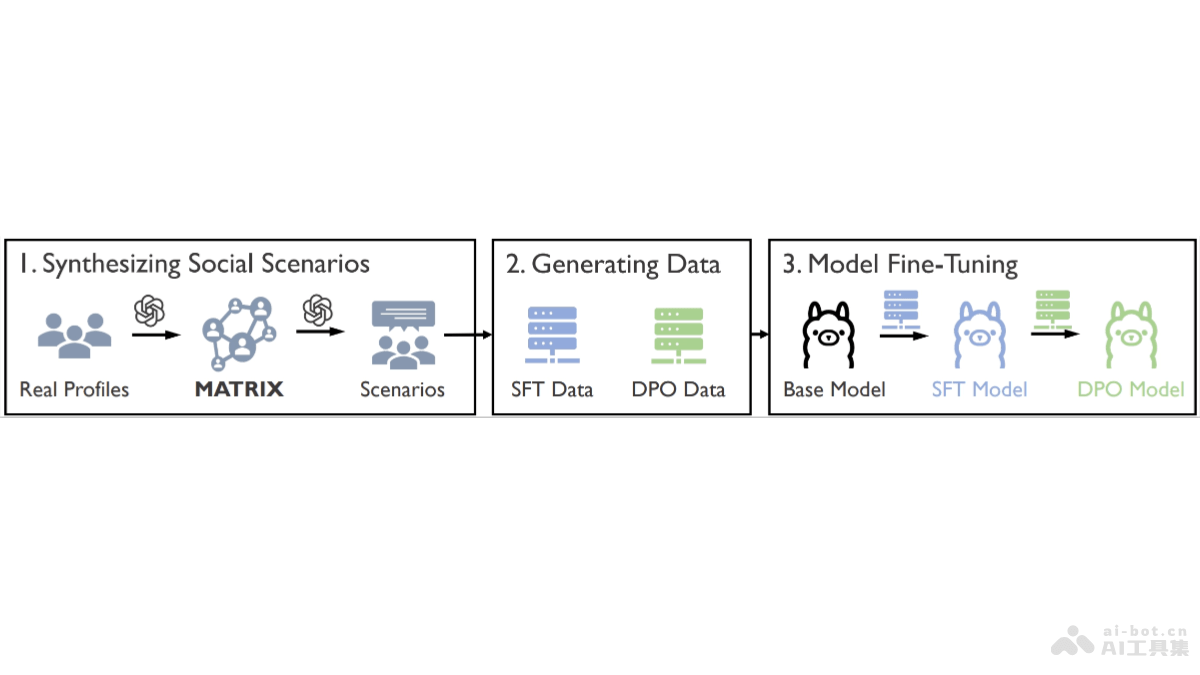
Main Features of MATRIX-Gen
- Data Synthesis: MATRIX-Gen synthesizes diverse and high-quality training instruction data according to specific needs, for use in post-training of large language models (LLMs).
- Scenario Simulation: Based on simulating the social interactions of more than 1,000 AI agents, MATRIX-Gen generates realistic and rich scenarios covering a wide range of domains from software development to business activities.
- Instruction Generation: Based on the simulated scenarios, MATRIX-Gen can generate instructions that conform to human intent, ensuring the authenticity and controllability of the synthesized instructions.
- Performance Improvement: The data synthesized by MATRIX-Gen can improve the performance of LLMs in multiple domains, including code generation, multi-turn dialogue, and safety tasks.
- Self-Evolution: With data synthesized by MATRIX-Gen, LLMs can achieve self-evolution and surpass traditional training methods even with a smaller amount of data.
Technical Principles of MATRIX-Gen
- Multi-Agent Simulation: MATRIX-Gen is based on multi-agent simulation technology to create an AI society simulator (MATRIX) containing more than 1,000 agents, each with a unique identity and personality based on real human profiles.
- Real-World Profile Initialization: Agents are initialized based on anonymized real human profiles. A large language model (LLM) generates their personalities and life goals, and the goals are decomposed into executable steps to form the agents' action plans.
- Structured Communication Mechanism: MATRIX-Gen is based on a structured communication mechanism, using grouping and modulation modulators to manage communication among agents, improving the scalability and authenticity of the simulation.
- Scenario Generation: Based on agent interactions, MATRIX-Gen generates large-scale realistic scenarios, which are used as the basis for post-training data synthesis.
- Instruction Generator: MATRIX-Gen serves as a scenario-driven instruction generator, synthesizing post-training data according to simulated scenarios and specific user needs, including supervised fine-tuning (SFT) datasets, preference tuning (DPO) datasets, and domain-specific SFT datasets.
Project Address of MATRIX-Gen
- GitHub Repository:https://github.com/ShuoTang123/MATRIX-Gen
- arXiv Technical Paper:https://arxiv.org/pdf/2410.14251
Application Scenarios of MATRIX-Gen
- Software Development: Generate instruction data for code generation, code review, debugging, and testing, to train and optimize the performance of LLMs in software development tasks.
- Business Activities: Simulate scenarios such as business decision-making, market analysis, and customer service, and generate data to improve the application capabilities of LLMs in business intelligence and strategic planning.
- Medical Diagnosis: Create instruction data related to medical diagnosis, case analysis, and treatment plan discussions, to improve the auxiliary decision-making capabilities of LLMs in the medical field.
- Education and Training: Instruction data for generating teaching content, course design, and learning path planning, improving the application of LLMs in personalized education and online learning platforms.
- Customer Service: Simulate scenarios of customer inquiries, problem-solving, and service process optimization, generating data to improve the effectiveness of LLMs in automated customer service systems.