
What is Matrix-Game 2.0
Matrix-Game 2.0 is a self-developed world model released by Kunlun Wanwei SkyWork AI. It is the industry's first open-source general-scene real-time long-sequence interactive generation model, fully open-source, driving the development of the interactive world model field. The model adopts a vision-driven interaction scheme, using a 3D causal variational autoencoder and a multimodal diffusion Transformer architecture to achieve low-latency, high-frame-rate long-sequence interaction performance, capable of generating continuous video content at 25 FPS, supporting minute-level generation duration. It has precise physical laws and scene semantic understanding capabilities, supports users to freely control the virtual environment through simple commands, and is suitable for scenarios such as game development, virtual reality, and film and television production.
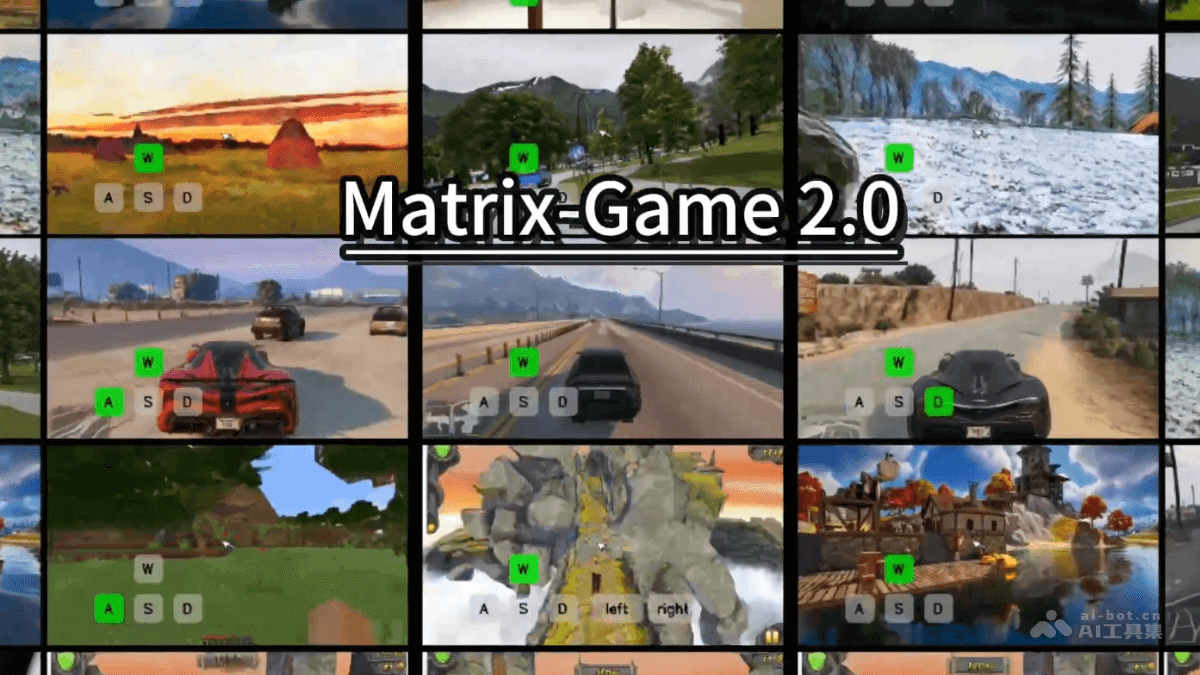
Main Features of Matrix-Game 2.0
-
Real-time long-sequence generation: Capable of stably generating continuous video content at 25 FPS in various complex scenes, with generation duration extendable to minute-level, significantly improving coherence and practicality.
-
Precise interactive control: Supports users to freely explore and control the virtual environment through simple commands (such as keyboard arrow keys, mouse operations), precisely responding to user interaction operations.
-
Vision-driven modeling: Adopts a vision-driven interactive world modeling scheme, focusing on building virtual worlds through visual understanding and physical law learning, avoiding semantic bias brought by language priors.
-
Multi-scene generalization capability: Has excellent cross-domain adaptability, supporting simulation of multiple styles and environments, including spatial types such as cities and wilderness, as well as visual styles such as realistic and oil painting.
-
Enhanced physical consistency: Characters can exhibit motion behaviors consistent with physical logic when facing complex terrain such as steps and obstacles, enhancing immersion and controllability.
Technical Principles of Matrix-Game 2.0
-
Vision-driven interactive world modeling: Matrix-Game 2.0 adopts an image-centric perception and generation mechanism, focusing on building virtual worlds through visual understanding and physical law learning, avoiding the traditional generation mode relying on language prompts, and understanding and generating virtual worlds more realistically and accurately.
-
3D Causal Variational Autoencoder (3D Causal VAE): Achieves efficient compression in spatial and temporal dimensions through a three-dimensional causal variational autoencoder, improving modeling efficiency and generation capability. It encodes and decodes the spatiotemporal features of videos, compressing videos into a low-dimensional latent space, reducing computational complexity while retaining key spatiotemporal information.
-
Multimodal Diffusion Transformer (DiT): Combines visual encoders with user action instructions to generate physically reasonable dynamic visual sequences frame by frame, decoding them into complete videos through 3D VAE.
-
Autoregressive diffusion generation mechanism: Based on the Self-Forcing training strategy, it overcomes the latency and error accumulation problems of traditional bidirectional diffusion models through an innovative autoregressive diffusion generation mechanism. It generates the current frame conditioned on historical frames, reducing temporal latency caused by dependence on future frames.
-
Distribution Matching Distillation (DMD): By minimizing the distribution difference with the base model, it guides the student model to learn to generate high-quality video frames, aligning the distributions of the training and inference stages, and significantly alleviating the problem of error accumulation.
-
KV cache mechanism: Introduces a key-value cache mechanism (KV-Cache), significantly improving the efficiency and consistency of long video generation. By maintaining a fixed-length attention context, it enables seamless rolling generation and supports video output of unlimited duration.
Matrix-Game 2.0 Project Address
-
Project Website:https://matrix-game-v2.github.io/
-
GitHub Repository:https://github.com/SkyworkAI/Matrix-Game
-
HuggingFace Model Library:https://huggingface.co/Skywork/Matrix-Game-2.0
-
Technical Report:https://github.com/SkyworkAI/Matrix-Game/blob/main/Matrix-Game-2/assets/pdf/report.pdf
Application Scenarios of Matrix-Game 2.0
-
Game Development: Matrix-Game 2.0 can generate more realistic, physically logical interactive videos in a variety of game scenarios, supporting dynamic character behavior and scene interaction, for example, simulating vehicle operation or character movement in game scenarios such as GTA and Minecraft.
-
Virtual Reality: The model can generate high-quality virtual environments in real time, supporting users to freely explore and manipulate the virtual world through simple instructions, providing strong technical support for virtual reality applications.
-
Film and Television Production: Matrix-Game 2.0 can quickly generate high-quality virtual scenes and dynamic content, helping film and television production teams efficiently create complex visual effects and animated scenes.
-
Embodied Intelligence: Matrix-Game 2.0 provides technical support for embodied intelligent agent training and data generation, offering an efficient solution for training and testing agents in virtual environments.
-
Virtual Humans and Intelligent Interactive Systems: Matrix-Game 2.0's real-time interaction capabilities and understanding of physical rules make it an ideal solution for virtual humans and intelligent interactive systems, capable of generating natural and smooth actions and responses.