
What is Matrix-3D
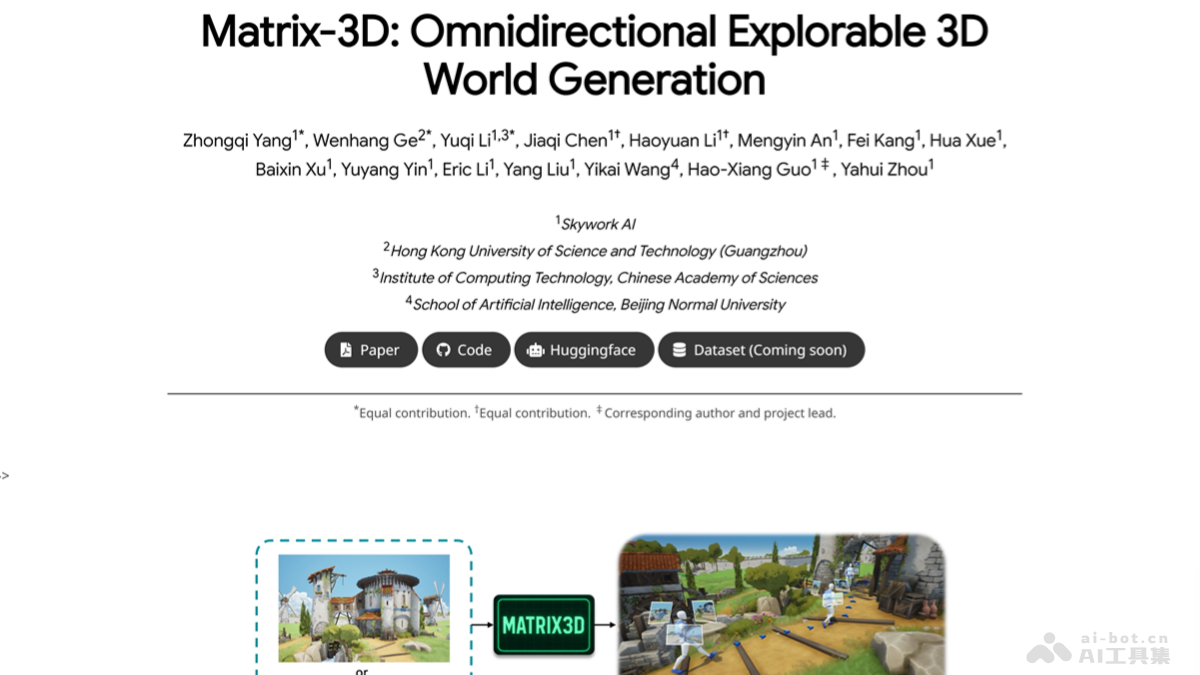
Matrix-3D is a framework launched by Kunlun Wanwei's Skywork AI team for generating explorable panoramic 3D worlds. The framework combines panoramic video generation with 3D reconstruction, generating high-quality, omnidirectionally explorable 3D scenes from a single image or text prompt. Based on a trajectory-guided panoramic video diffusion model and two 3D reconstruction methods (a fast feedforward network and a high-quality optimization method), Matrix-3D achieves large-scale, highly consistent 3D scene generation, supports text and image inputs, and offers high efficiency and strong generalization capability. The accompanying Matrix-Pano dataset provides strong support for research.
Matrix-3D's Main Features
- Panoramic Video Generation: Generates high-quality panoramic videos from a single image or text prompt, and supports user-defined camera trajectories.
- 3D Scene Reconstruction: Provides two 3D reconstruction approaches, a fast feedforward network and a high-quality optimization method, to meet different needs.
- Multiple Input Support: Supports text and image inputs, allowing users to choose according to their needs and generate the corresponding 3D scenes.
- Large-Scale Scene Generation: The generated 3D scenes are large in scale, support free 360° exploration, and offer a larger exploration range than other methods.
- High Controllability: Users can customize the generation trajectory and can infinitely continue and extend based on an already generated scene.
Matrix-3D's Technical Principles
- Trajectory-Guided Panoramic Video Generation: Uses scene mesh (Mesh) renderings as conditional input to train a video diffusion model. The model generates panoramic videos according to user-defined camera trajectories, ensuring the spatial consistency and geometric accuracy of the generated content.
- Conversion from Panoramic Video to 3D Scene: Based on the Transformer architecture, it directly predicts 3D geometric attributes from the latent features of the generated panoramic video. It enables fast 3D scene reconstruction and is suitable for real-time applications.
- Optimization-based Method: Performs super-resolution processing and 3D Gaussian Splatting optimization on the generated panoramic video. It generates high-quality, detail-rich 3D scenes and is suitable for scenarios with high visual quality requirements.
- Matrix-Pano Dataset: To address the scarcity of existing 3D scene data, Matrix-3D provides a large-scale synthetic dataset. It contains 116,759 high-quality static panoramic video sequences, each with camera trajectories and annotations. The diversity and high quality of the dataset provide strong support for model training.
- Panoramic Representation: Uses panoramas as an intermediate representation, covering a 360° horizontal field of view and a 180° vertical field of view. Panoramic videos are generated by stitching together panoramas from multiple positions, containing all the information needed for 3D world generation.
Matrix-3D's Project Address
- Project Website:https://matrix-3d.github.io/
- GitHub Repository:https://github.com/SkyworkAI/Matrix-3D
- HuggingFace Model Library:https://huggingface.co/Skywork/Matrix-3D
- Technical Paper:https://github.com/SkyworkAI/Matrix-3D/blob/main/asset/report.pdf
Matrix-3D's Application Scenarios
- Game Development: Rapidly generates high-quality 3D game scenes, shortens development cycles, and enhances personalized player experiences.
- Film and Television Production: Generates realistic virtual scenes and special effects, reduces shooting costs, and assists with storyboard design and scene previews.
- Virtual Reality (VR) and Augmented Reality (AR): The panoramic 3D scenes generated by Matrix-3D support free 360° exploration and can be used in virtual tourism and AR applications to enhance immersion.
- Robot Navigation and Autonomous Driving: Generate complex 3D environments for training and testing robot navigation and autonomous driving systems, improving decision-making safety.
- Education and Training: Generate virtual laboratories and realistic training scenarios for education and skills training, improving effectiveness.