
What Is MAS-Zero
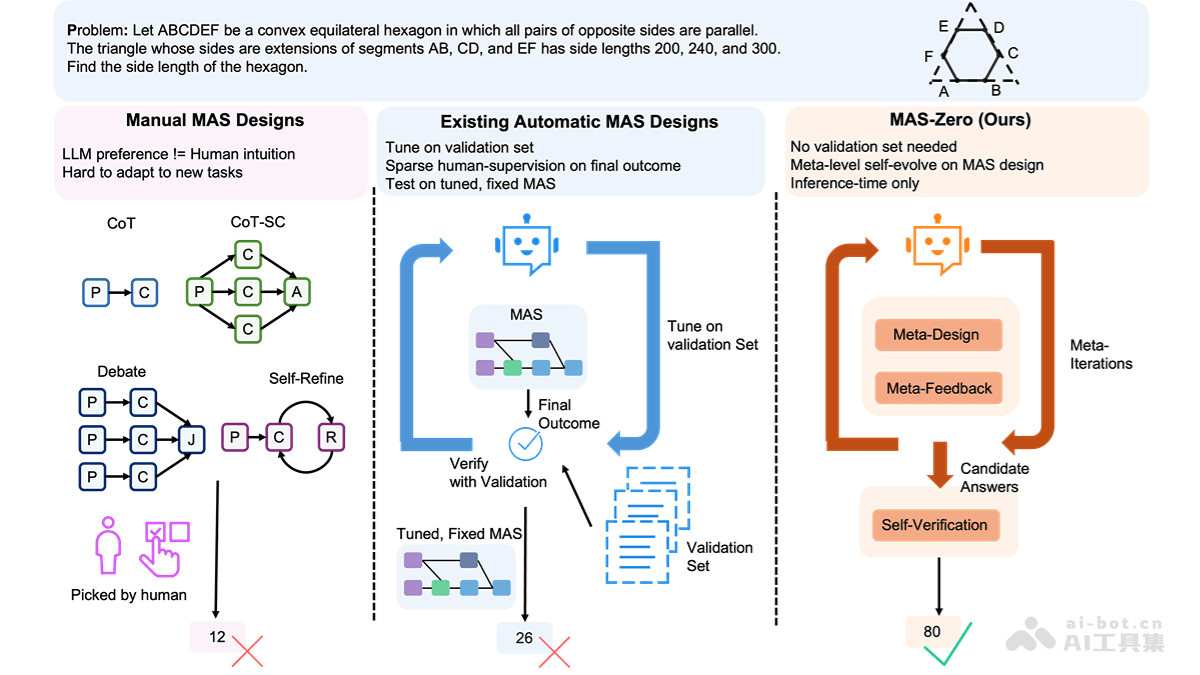
MAS-Zero is a multi-agent system (MAS) design framework introduced by Salesforce that can automatically design and optimize MAS without human supervision. The framework is based on meta-level design, dynamically generating, evaluating, and improving MAS configurations for each problem instance at inference time. The core of MAS-Zero lies in the meta-iteration process, including task decomposition, generating the corresponding MAS implementation, and meta-level feedback based on solvability and completeness. Based on self-verification, the most appropriate result is selected from all candidate solutions. MAS-Zero performs excellently in mathematical reasoning, graduate-level question answering, and code benchmarks, and does not rely on any external supervision.
Main Features of MAS-Zero
- Automatic design of multi-agent systems (MAS): It eliminates the need for humans to manually design agent roles and communication protocols, automatically generating a suitable MAS structure based on the specific problem, thereby improving the system's adaptability and performance on new tasks.
- Dynamic adaptation to problems: At the inference stage, it performs dynamic agent composition and problem decomposition for each problem instance, enabling MAS to better handle complex and changing tasks.
- No validation set supervision required: It does not rely on a pre-labeled validation set to adjust and optimize MAS configurations, reducing the demand for data and improving the system's flexibility and practicality.
- Performance optimization: Based on meta-level design and a self-verification mechanism, it continuously iterates and improves the MAS design, enhancing the system's accuracy and efficiency on complex tasks while maintaining cost-effectiveness.
- Self-evolution capability: During the inference process, jiyu self-feedback and evaluation, it automatically learns and evolves, gradually optimizing the design and performance of MAS without external supervision signals.
Technical Principles of MAS-Zero
- Meta-Iterations:
- Task decomposition and MAS generation: It decomposes complex problems into multiple subtasks and generates the corresponding MAS implementation for each subtask (in the form of executable code). It treats MAS design as a code generation problem and dynamically adjusts task decomposition and MAS configuration based on a meta-agent.
- Meta-level feedback: It evaluates the solvability and completeness of the generated MAS design, obtains intermediate outputs by executing the MAS code, and analyzes the outputs to determine whether the current MAS can effectively solve the problem. Based on the evaluation results, it generates feedback to guide subsequent iterative improvements.
- Self-Verification: After multiple meta-iterations, it selects the most appropriate result from all candidate solutions. It compares candidate answers produced by different iterations and, combined with certain verification strategies (such as majority voting and excluding invalid answers), determines the final output answer.
- LLM-based meta-agent: It uses a large language model (LLM) as the meta-agent, giving it the ability to understand and generate natural language instructions. During the meta-iteration process, the meta-agent is responsible for task decomposition, MAS generation, feedback generation, and verification of the final result, and its interaction with the LLM enables optimization and improvement of the MAS design.
- Self-supervised learning: The entire process does not rely on an external validation set or human supervision, and performs self-supervised learning based on the system's own execution results and feedback signals. The meta-agent adjusts the MAS design according to the solvability and completeness of the intermediate outputs, gradually improving the system's performance and adaptability.
Project Address of MAS-Zero
- Project official website:https://mas-design.github.io/
- GitHub repository:https://github.com/SalesforceAIResearch/MAS-Zero
- arXiv technical paper:https://arxiv.org/pdf/2505.14996
Application Scenarios of MAS-Zero
- Complex Problem Solving: In fields such as mathematics and scientific computing, decompose complex problems into multiple subtasks to improve solving efficiency and accuracy.
- Natural Language Processing: Used in advanced question-answering systems and text generation and editing to produce high-quality natural language processing results.
- Software Engineering: In code generation, optimization, and software testing, decompose tasks into multiple subtasks to improve the efficiency and quality of software development and testing.
- Healthcare: Applied in disease diagnosis and treatment plan formulation to improve the accuracy and personalization level of medical decisions.
- Education: Used in personalized learning and intelligent tutoring, decomposing learning tasks according to student needs, with different agents providing customized learning paths and tutoring content to enhance learning outcomes.