
What is markmap
markmap is a tool that converts Markdown text into mind maps. Based on Markdown's syntax structure, it generates visual mind maps in real time, helping users organize and present information intuitively. markmap is lightweight and powerful, supports integration with various code editors such as VS Code, Vim/Neovim, and Emacs, enabling real-time rendering and a high degree of customizability. markmap supports plugins, enhancing embedding and interaction capabilities, and is suitable for scenarios such as project planning, document organization, and academic research. markmap is developed based on TypeScript, follows the MIT license, and supports free use and distribution.
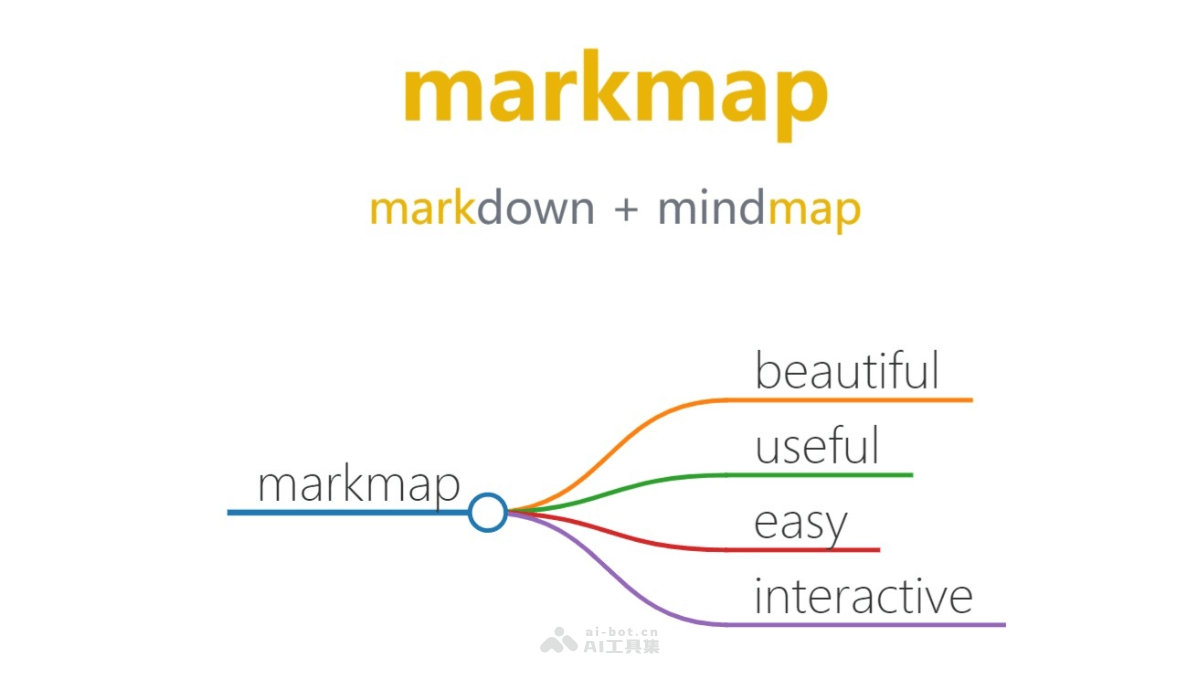
markmap's main features
- Markdown parsing: Markmap can parse standard Markdown syntax, including headings, lists, links, etc., and convert them into mind map nodes.
- Real-time rendering: When users edit Markdown text, Markmap updates the mind map in real time, reflecting changes to the text.
- Interactive mind maps: The generated mind maps support user interaction, such as clicking nodes to expand or collapse child nodes, dragging nodes to rearrange the layout, etc.
- Customizability: Users can customize the style of the mind map, including colors, fonts, layout, etc.
- Integrated development environments: Markmap provides integration with popular code editors, such as VS Code, allowing developers to create and view mind maps while writing documentation.
- Plugin support: Supports plugin extensions, allowing developers to add new features or improve existing features.
markmap's technical principles
- Text parsing: Markmap uses a text parser to analyze Markdown text and convert it into an abstract syntax tree (AST), which is the foundation for building mind maps.
- Data structure: Based on the parsed AST, Markmap builds a tree-like data structure, where each node represents a Markdown element, such as a heading or list item.
- Layout algorithm: Markmap uses layout algorithms to determine the positions of nodes in the mind map. Common layouts include tree layouts, radial layouts, etc.
- Visualization: Based on web technologies (such as SVG or Canvas), it renders the tree-like data structure into a graphical interface, providing an intuitive visual presentation.
- Responsive design: Markmap is based on responsive design, ensuring that the mind map displays well on different devices and screen sizes.
markmap's project addresses
- Project website:markmap.js.org
- GitHub repository:https://github.com/markmap/markmap
markmap's application scenarios
- Document organization: Convert complex document content into mind maps, helping users quickly understand and remember the document structure.
- Project planning: In project management, Markmap can be used to plan project structures, track task progress, and display project milestones.
- Academic research: Researchers can organize research materials, build knowledge systems, and present the structure of research papers.
- Teaching demonstrations: Teachers can use Markmap to create course outlines, organize teaching content, or use it as an auxiliary teaching tool.
- Meeting notes: In meetings, use Markmap to record discussion points and decision-making processes, facilitating subsequent review and execution.
- Book notes: Readers use Markmap to organize a book's chapter structure, extract key concepts, and create reading notes.