
What is MakeAnything
MakeAnything is a multi-domain procedural sequence generation framework based on Diffusion Transformer, launched by the Show Lab team at the National University of Singapore. It generates high-quality step-by-step tutorials based on text descriptions or image inputs. MakeAnything balances generalization ability and task-specific performance based on asymmetric low-rank adaptation (LoRA) technology, and introduces the ReCraft model to achieve reverse generation from images to processes. MakeAnything has built a large-scale dataset covering 21 domains (such as painting, crafts, cooking, etc.), containing more than 24,000 annotated sequences. The MakeAnything framework can generate logically coherent and visually consistent tutorials, supports generation paradigms from text to process and from image to process, and demonstrates excellent performance and generalization ability in a variety of tasks.
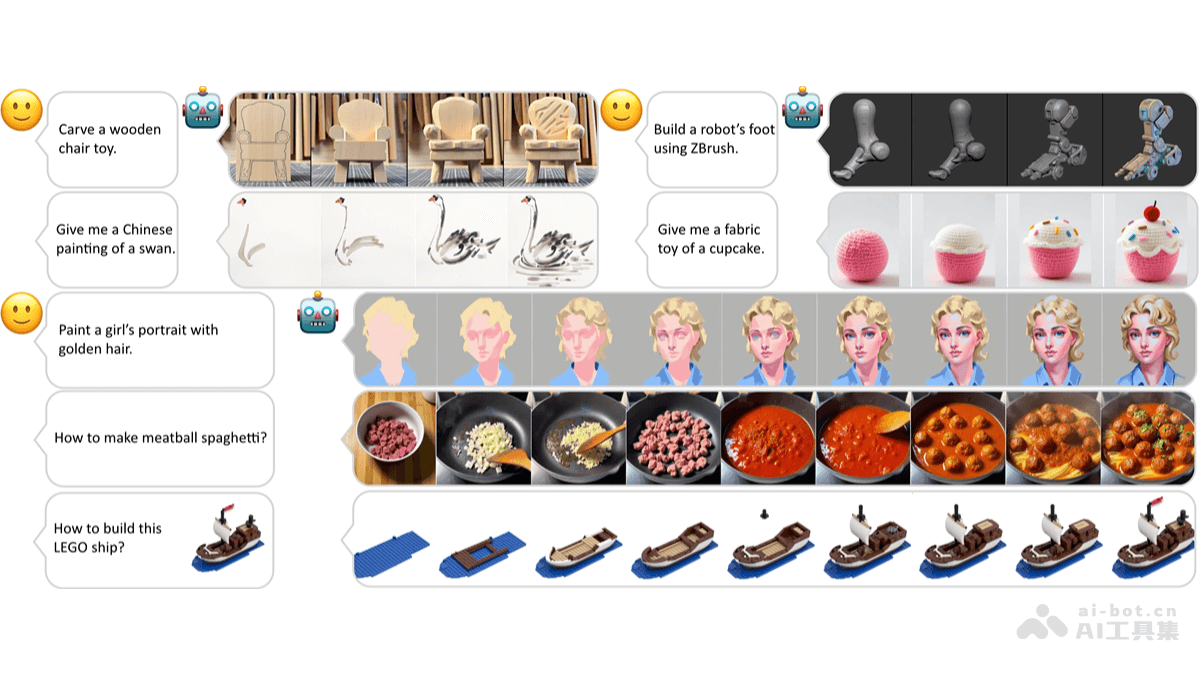
Main Features of MakeAnything
- Generate Tutorials from Text: Based on the text description provided by the user (such as "how to paint an oil painting" or "how to build a LEGO model"), it automatically generates detailed step-by-step tutorials to help users complete complex creative tasks step by step.
- Generate Tutorials from Images: Users upload an image of a finished product (such as a painting or a handmade item), and MakeAnything can reverse-generate the creation process of that work, showing the steps from nothing to something.
- Cross-Domain Generation Capability: Supports multiple domains (such as painting, crafts, cooking, 3D modeling, etc.), and generates logically coherent and visually consistent tutorials according to different tasks.
- High-Quality Tutorial Output: The generated tutorials are logically clear and maintain a high degree of consistency with the input text or image.
Technical Principles of MakeAnything
- Diffusion Transformer: Uses the core idea of diffusion models to generate image sequences based on gradually removing noise. Combined with the Transformer architecture, it processes complex visual and textual information and generates high-quality procedural sequences.
- Asymmetric Low-Rank Adaptation: Based on freezing the pretrained encoder parameters and fine-tuning only the decoder, it balances the model's generalization ability and task-specific performance. It is suitable for tasks with scarce data or imbalanced distribution and effectively avoids overfitting.
- ReCraft Model: Based on decomposing a static image into a step-by-step creation process, it achieves reverse generation from image to process. Using a multimodal attention mechanism, it incorporates image condition information into the generation process to ensure that the generated sequence is highly consistent with the input image.
- Multi-Domain Dataset: Builds a large-scale dataset containing 21 domains and more than 24,000 annotated sequences, providing rich data support for model training.
- Conditional Flow Matching Loss: Optimizes the conditional vector field in the noise removal process to ensure that the generated sequence remains logically and visually consistent with the input conditions (text or image).
Project Address of MakeAnything
- GitHub Repository:https://github.com/showlab/MakeAnything
- HuggingFace Model Library:
- arXiv Technical Paper:https://arxiv.org/pdf/2502.01572
Application Scenarios of MakeAnything
- Education: Provides students with step-by-step tutorials for painting, crafts, cooking, etc., to assist learning.
- Artistic Creation: Helps artists generate the creative process from idea to finished product, inspiring inspiration.
- Craft Heritage: Reverse-generates production steps based on finished product images, helping the recording and inheritance of traditional crafts.
- Product Development: Quickly generate production processes based on design concepts to optimize development efficiency.
- Content Creation: Generate interesting tutorials or videos for use on social media and entertainment.