
What is MAI-Voice-2
MAI-Voice-2 is Microsoft's new-generationtext-to-speech(TTS) model, and is Microsoft's most expressive and natural-sounding speech synthesis model to date. Compared withthe previous generationit achieves comprehensive improvements in fidelity, language coverage, speaker consistency, and emotional range, supports 15+ languages, and offers fine-grained emotional control, zero-shot voice cloning, and code-switching capabilities.
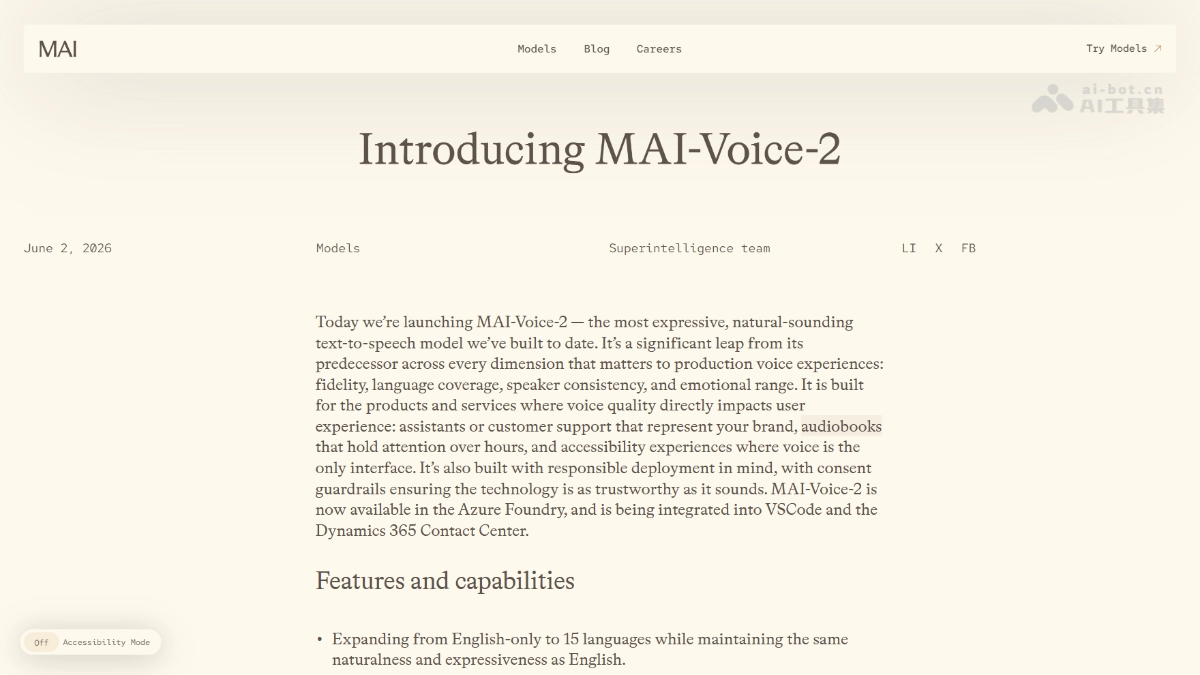
Main features of MAI-Voice-2
-
Multilingual natural synthesis: expanded from English-only to 15+ languages while maintaining the same level of naturalness and expressiveness.
-
Fine-grained emotional control: precisely regulate speech emotion through emotion tags such as sadness, whisper, excitement, confusion, and more.
-
Zero-shot voice cloning: clone a target voice with only 5-60 seconds of reference audio, supporting all languages.
-
Stable speaker identity: maintain consistent speaker characteristics across long content including audiobooks, podcasts, and lectures.
-
Natural code-switching: supports natural mixed speech for language pairs such as Hindi-English and Spanish-English without losing prosody or identity consistency.
-
Character style role-play: supports specific character styles such as motivational coach and sports commentator.
Technical principles of MAI-Voice-2
- In-house speech foundation model architecture: MAI-Voice-2 is built on Microsoft's internally developed speech foundation model and adopts an end-to-end neural speech synthesis architecture. The model can holistically understand input text and automatically adapt intonation, emotion, and speaking style, generating human-like speech without requiring developers to perform extensive manual parameter tuning. The architecture is similar to Azure Neural HD voices and achieves generational improvements in expressiveness, language coverage, and speaker consistency.
- Unified multilingual modeling: MAI-Voice-2 expands from MAI-Voice-1's English-only monolingual model into a unified multilingual speech synthesis system supporting 15+ languages. The model is deeply optimized for different phonological systems such as tonal languages, pitch-accent languages, stress-timed languages, and syllable-timed languages, ensuring that each language achieves output quality equivalent to English in naturalness and expressiveness.
- Zero-shot voice cloning (Voice Prompting): the model supports zero-shot voice cloning, requiring only 5-60 seconds of reference audio to extract speaker identity features and transfer them to a target language, without fine-tuning or retraining for a specific speaker. It is implemented based on Voice Prompting technology, where the system extracts speaker embeddings through a reference audio encoder and maintains consistency in timbre, intonation, and prosodic features during synthesis.
How to use MAI-Voice-2
-
Azure Foundry access: directly call the MAI-Voice-2 API through the Azure Foundry platform.
-
Custom brand voice: upload 5-60 seconds of reference audio to create a custom voice without retraining or fine-tuning.
-
Emotion tag control: add emotion tags in requests to regulate the emotional style of the output speech.
-
Authorization application: voice cloning requires authorization, and the system only supports licensed voices for production environments.
Core advantages of MAI-Voice-2
-
Leading audio quality: preferred by users over the previous generation MAI-Voice-1 in 72% of blind tests.
-
Indistinguishable from real: speaker similarity is extremely high, making synthesized speech difficult to distinguish from real human recordings.
-
Safety and compliance: system-level mandatory consent mechanism; in production environments, only authorized voice cloning is allowed, preventing unauthorized abuse.
-
Stable for long texts: maintains consistent speaker identity and audio quality across hours of long content.
-
Low-barrier cloning: no professional recording studio or large amounts of training data required; a few seconds of audio can replicate a voice.
MAI-Voice-2 project address
- Project official website:https://microsoft.ai/news/mai-voice-2expressive-speech-in-10-languages/
Comparison of MAI-Voice-2 with similar competitors
| Comparison dimension | MAI-Voice-2 | Gemini 3.1 Flash TTS |
|---|---|---|
| Developer | Microsoft (Microsoft AI) | Google DeepMind |
| Release date | June 2026 | April 2026 (Public Preview) |
| Language support | 15+ languages, including code-switching (Hindi-English, Spanish-English) | 70+ languages, broader coverage |
| Preset voices | Number not explicitly announced; focus on brand customization | 30 named voices (Kore, Puck, Charon, etc.) |
| Emotion control | Fine-grained SSML tags (sadness, whisper, excitement, confusion, etc.) | 200+ inline audio tags ([sigh]、[laughing]、[whispering] , etc.), supports natural language prompts |
| Voice cloning | ✅ 5–60 seconds zero-shot, supported across all languages | ❌ Not supported |
| Multi-speaker | Support not explicitly stated | ✅ Native support for 2-person dialogue in a single API call |
| Long-text stability | Optimized for audiobooks, podcasts, and lectures; speaker remains highly stable | Quality may drift after a few minutes or more; chunked processing recommended |
| Security and compliance | System-level mandatory consent; unauthorized voices cannot be produced or used | All output carries a SynthID watermark and relies on terms of service |
| Audio quality ranking | 72% preference over MAI-Voice-1, difficult to distinguish from real people | Artificial Analysis TTS leaderboard Elo 1211 (second place) |
Application scenarios of MAI-Voice-2
-
Intelligent assistants: provides brand-exclusive voices for Copilot, apps, devices, and customer service centers.
-
Entertainment content: creates character voices and narration for games, podcasts, audiobooks, and AR/VR.
-
Accessibility assistance: provides text reading for visually impaired users and voice alternatives for people with speech impairments.
-
Education and training: provides instructor and virtual character voices for online courses and simulated scenarios.
-
Content creation: creators can turn text into audio content in their personal style without a recording studio.