
What is MAI-Image-2-Efficient
MAI-Image-2-Efficient is a self-developed text-to-image model from Microsofttext-to-imagemodel, a lightweight and efficient version ofMAI-Image-2, focused on cost-effective commercial mass production. While maintaining photo-level realistic image quality, it achieves a 41% cost reduction, 22% faster generation speed, and 4x GPU efficiency. The model excels at product photography, UI prototypes, and marketing asset generation, and can stably render short text within images. It provides API services through Azure AI Foundry and MAI Playground, adopts a token-based billing model, and is positioned as an economical solution for enterprise-level high-frequency visual content production.
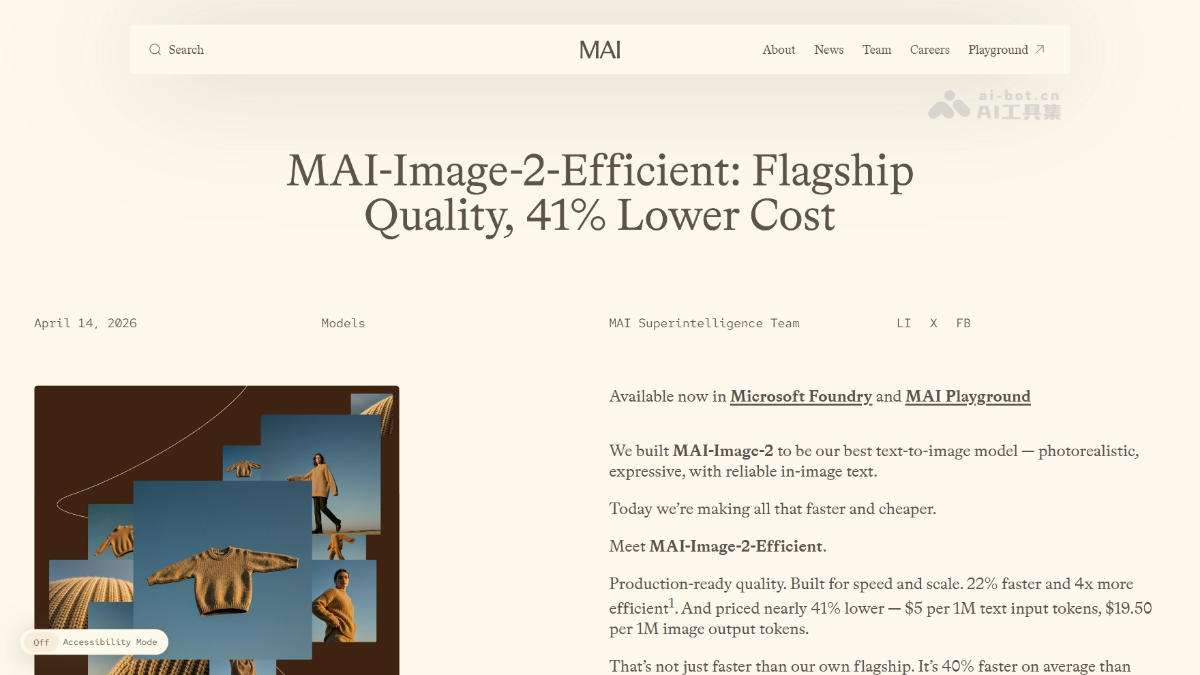
Main features of MAI-Image-2-Efficient
- High-fidelity image generation: The model can generate photo-level realistic images and excels at commercial visual content creation such as product photography, UI prototypes, and marketing assets.
- In-image text rendering: Supports stable rendering of short text within images, including clear generation of text content such as titles, labels, and button copy.
- Batch asynchronous processing: Supports batch asynchronous generation tasks to meet high-throughput, automated enterprise-level production needs.
- OpenAI-compatible API : Provides an OpenAI-compatible REST API, making it easy for developers to seamlessly integrate and migrate existing code.
- Enterprise-grade security assurance: Integrates Azure enterprise-grade security and compliance systems, supports private endpoints and VNET network isolation to ensure data security.
How to use MAI-Image-2-Efficient
- Access entry point: Log in to Microsoft Foundry (formerly Azure AI Studio) or MAI Playground to directly call the model without applying for a waitlist.
- API calls: Use the Azure AI Inference SDK (such as the @azure-rest/ai-inference package) to send requests. The interface specification is compatible with OpenAI DALL-E 3, making it easy to seamlessly migrate existing projects.
- Developer integration : In Python, Next.js, or other environments that support REST APIs, send a text prompt through a standard HTTP request and set the resolution parameter (currently only 1024×1024 is supported) to obtain the generated result.
- Enterprise deployment: If enhanced security is needed, configure Azure Private Link endpoints and VNET network isolation to ensure data does not leave the enterprise network boundary.
Key information and usage requirements of MAI-Image-2-Efficient
- Release date and positioning: The model was released on April 14, 2026. It is a lightweight and efficient version of MAI-Image-2 in Microsoft's self-developed MAI series, designed specifically for high-frequency commercial mass production scenarios.
- Access channels: Users can call it directly through Microsoft Foundry (formerly Azure AI Studio) or MAI Playground without applying for a waitlist, and it will be integrated into Copilot and Bing.
- Pricing model: It uses token-based billing, charging $5 per million tokens for text input and $19.50 per million tokens for image output, reducing costs by 41% compared with the flagship version.
- Technical specifications: The model is benchmarked on NVIDIA H100 GPUs. Currently, it only supports 1024×1024 1:1 square resolution output, and image-to-image functionality is not yet available.
- Usage threshold: A valid Azure account with prepaid credits is required to call the API. The Playground interface has a daily generation limit to prevent abuse.
- Enterprise security requirements: Supports enterprise-grade deployment through Azure Private Endpoints (Private Link) and VNET network isolation, meeting compliance audit requirements such as SOC 2, ISO 27001, and GDPR.
Core advantages of MAI-Image-2-Efficient
- Ultimate cost-effectiveness: Achieves close to the flagship MAI-Image-2 image quality with a 41% reduction in cost, designed specifically for large-scale commercial deployment.
- Leading speed: In NVIDIA H100 benchmarks, p50 latency is on average 40% faster than mainstream vendor models such as Google Gemini 3.1 Flash, with generation speed improved by 22%.
- Stable text rendering: Demonstrates better consistency and clarity than DALL-E 3 in generating short text within images (titles, labels, button copy).
- Enterprise-grade compliance: Native support for Azure SOC 2, ISO 27001, GDPR and other security audit requirements, providing private endpoints and VNET network isolation to meet deployment standards for sensitive industries such as finance and healthcare.
Project address for MAI-Image-2-Efficient
- Project official website:https://microsoft.ai/news/mai-image-2-efficient/
Comparison of MAI-Image-2-Efficient with similar competitors
| Comparison dimension | MAI-Image-2-Efficient | DALL·E 3 | Stable Diffusion 3.5 |
|---|---|---|---|
| Positioning | Microsoft's mass-production flagship model, focused on high-throughput commercial scenarios | OpenAI's flagship creative model, emphasizing artistic expression | Open-source general-purpose model, rich community ecosystem |
| Cost | Output $19.50/1M tokens, 41% lower cost | About $0.04-0.12/image, billed per image | Self-hosted hardware cost, no token billing |
| Speed | 40% faster than Gemini 3.1 Flash, lowest latency | Moderate generation speed, prioritizing quality | Depends on local GPU, speed varies by configuration |
| Text within images | Good at short text (titles, labels), clear and stable | Stronger performance on long text and complex layouts | Requires optimization with plugins such as ControlNet |
| Deployment method | Azure cloud hosting only, deeply tied to the ecosystem | OpenAI API or Azure, flexible choice | Fully open source, supports local and multi-cloud deployment |
| Content safety | Enterprise-grade filtering, somewhat conservative (may flag creative prompts by mistake) | Moderate strictness | Relies on third-party filtering solutions |
Application scenarios of MAI-Image-2-Efficient
- E-commerce product visuals: Batch-generate product main images, detail page assets, and multi-angle display images, replacing traditional studio photography to reduce operating costs.
- UI/UX design: Quickly render wireframes into high-fidelity interface prototypes, accelerating design review iterations and improving the visualization of proposals.
- Marketing Content Production: Automatically generate social media graphics, advertising banners, and brand promotional materials to meet high-frequency content update needs.
- Real-Time Interactive Applications: Provide instant visual feedback for scenarios such as online configurators, supporting instant image generation based on user-customized parameters.
- Mixed Text-and-Image Materials: The model can generate marketing posters and interface screenshots containing clear titles, labels, and button copy, ensuring the readability of text within images.