
What Is MAI-Image-2.6-Flash
MAI-Image-2.6-Flash is a high-speedimage generationmodel launched by Microsoft. It complements the flagship MAI-Image-2.6 and focuses on low-latency, high-throughput production scenarios. The model generates images about 2.8 times faster than GPT-Image-2-Medium and improves GPU efficiency by 72%, while maintaining visual quality close to the flagship version. MAI-Image-2.6-Flash supports multiple reference images, Web Grounding, and dynamic aspect ratios, with a maximum resolution of 1.5K.
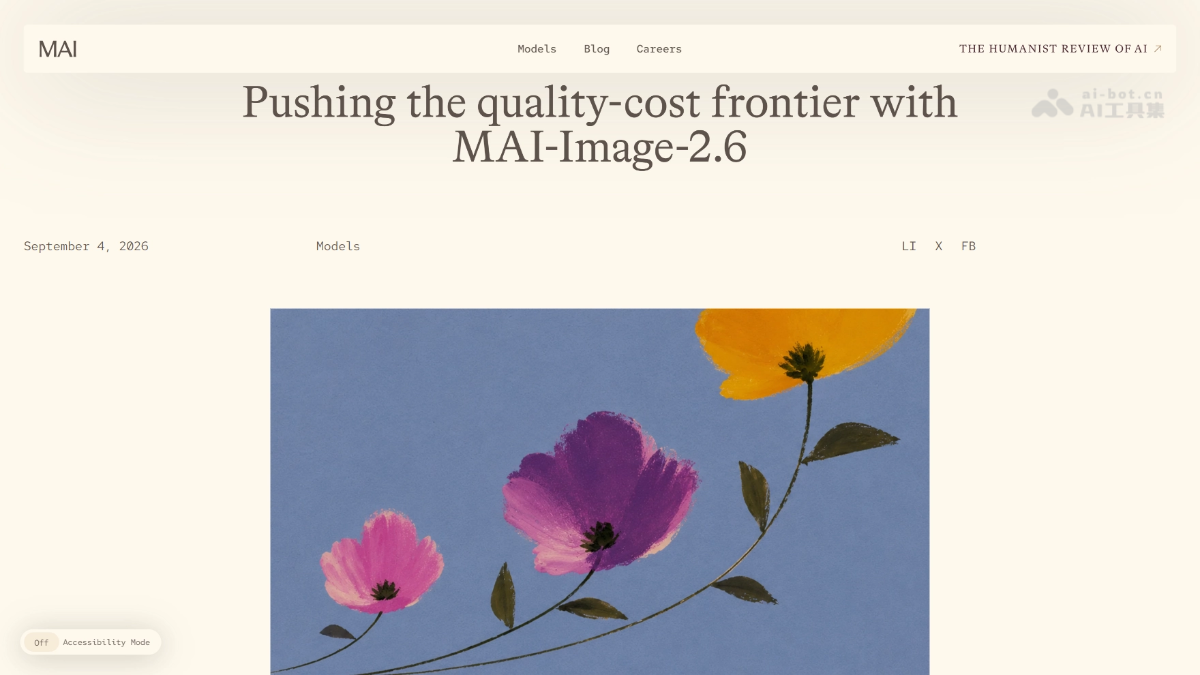
Main Features of MAI-Image-2.6-Flash
- Ultra-Fast Generation: Generation speed is about 2.8 times faster than GPT-Image-2-Medium, with GPU efficiency improved by 72%, enabling low-latency responses.
- Flagship Image Quality: While greatly improving speed, it maintains visual quality and core editing capabilities close to the flagship MAI-Image-2.6.
- Multi-Reference Image Editing: Supports simultaneously inputting multiple reference images such as people, products, styles, and scenes, and generates or edits by combining multiple visual conditions.
- Web Grounding: Can combine real-time information from the web to provide accurate information anchoring for visual content involving real-world products, news events, and more.
- Dynamic Aspect Ratio and High Resolution: Automatically selects the optimal aspect ratio based on the scene and supports output at up to 1.5K resolution.
- Production at Scale: Designed for high-throughput, cost-sensitive large-scale commercial asset production, with API pricing 50%-69% lower than the flagship version.
Technical Principles of MAI-Image-2.6-Flash
- Flow Matching Diffusion Architecture: The model is based on a Diffusion architecture and is trained with Flow Matching Loss, learning a continuous straight-line path from noise to image. It can generate clear images with very few inference steps, which is the fundamental mathematical basis for the 2.8x speed improvement while maintaining image quality.
- 20B Parameters and 32K Context: The model has 20 billion non-embedding parameters and a 32K Token context window, supports understanding complex long prompts and multi-image inputs, and has a maximum output resolution of about 1536x1536, providing sufficient model capacity for high-quality generation and multi-reference image editing.
- Inference Engineering Optimization: The Flash version is not a distilled or compressed model. Instead, on the same 20B parameter base, it uses coordinated algorithm and engineering optimization to compress single-image inference time to the millisecond to 1-2 second level, while freeing up 72% of idle GPU capacity to achieve high-concurrency production-grade throughput.
- Multimodal Editing Rebuilt: Editing capabilities are rebuilt from scratch. The model has visual context reasoning abilities across objects, scene structure, lighting, scale, and spatial position. It can maintain consistent editing results when facing ambiguous prompts and supports complex operations such as object replacement, attribute modification, and text updates.
How to Use MAI-Image-2.6-Flash
-
MAI Playground: The official online experience platform provided by Microsoft https://playground.microsoft.ai/chat,可直接测试文生图、图生图及多参考图编辑功能,适合快速体验模型效果。
-
Microsoft Foundry: A public preview access channel for developers. After registering and obtaining an API key, the model can be integrated into your own applications or workflows, supporting calls at scale.
Core Advantages of MAI-Image-2.6-Flash
-
Ultra-Fast Generation: Generation speed is about 2.8 times faster than GPT-Image-2-Medium, with GPU efficiency improved by 72%, enabling low-latency responses.
-
Flagship Image Quality: While greatly increasing speed, it maintains visual quality and core editing capabilities close to MAI-Image-2.6.
-
Extreme Cost-Effectiveness: API pricing is 50%-69% lower than the flagship version, and it is officially claimed to have the world's best price-per-Elo performance.
-
Multi-reference image fusion: Supports passing in multiple reference images such as people, products, styles, and scenes at the same time, generating based on comprehensive multi-dimensional visual conditions.
-
Web Grounding: Combines real-time online information to provide precise information anchoring for visual content such as real-world products and news events.
-
Dynamic aspect ratio and high resolution: Automatically selects the optimal aspect ratio based on the scene, and supports output at up to 1.5K resolution.
Project address of MAI-Image-2.6-Flash
- Project official website:https://microsoft.ai/news/pushing-the-quality-cost-frontier-with-mai-image-2-6/
Comparison of MAI-Image-2.6-Flash with similar competitors
| Comparison dimension | MAI-Image-2.6-Flash | Nano Banana 2 |
|---|---|---|
| Developer | Microsoft AI | |
| Model positioning | High-speed production version (low latency, high throughput) | Cost-optimized high-speed image generation |
| Underlying architecture | Flow Matching diffusion model (20B parameters) | Gemini 3.1 Flash Image architecture |
| Generation speed | 2.8 times faster than GPT-Image-2-Medium 2.8 times | Fast, positioned at the same level as Flash |
| Maximum resolution | 1.5K(about 1536×1536) | 4K(up to $0.15/image) |
| Reference image support | Up to 5 images | Supports multi-turn editing and style guidance |
| Text rendering | Supported | Supported |
| Web Grounding | ✅ Native support | ❌ No native support |
| Dynamic aspect ratio | ✅ Automatic adaptationoptimal ratio | Supports multiple fixed ratios |
Application scenarios of MAI-Image-2.6-Flash
-
Batch e-commerce material generation: Quickly generate massive product main images, detail page illustrations, and marketing posters, reducing the API cost per image.
-
Real-time interaction and dynamic advertising: Achieve millisecond-level image responses in chatbots, AI assistants, or dynamic advertising systems to improve user experience.
-
Social media content factory: Provides content creators and MCN agencies with high-throughput batch image and text production capabilities, supporting workflows at the level of a hundred images per day.
-
AI Agent visual pipeline: As an image generation node in automated workflows, its low-latency characteristics ensure that the overall efficiency of the Agent pipeline is not blocked.
-
Rapid prototyping and sketch iteration: Designers quickly generate multiple concept versions in the early product stage, lock in the style through the multi-reference image feature, and then refine it.