
What is MAI-Code-1-Flash
MAI-Code-1-Flash is a lightweight code generation model launched by Microsoft specifically for developer workflows, deeply integrated with GitHub Copilot. The model uses adaptive output length control technology, which can reduce token consumption by up to 60% while maintaining high accuracy, significantly reducing latency and cost. The model is trained end-to-end based on the real production environment Copilot toolchain and comprehensively surpasses Claude Haiku 4.5。
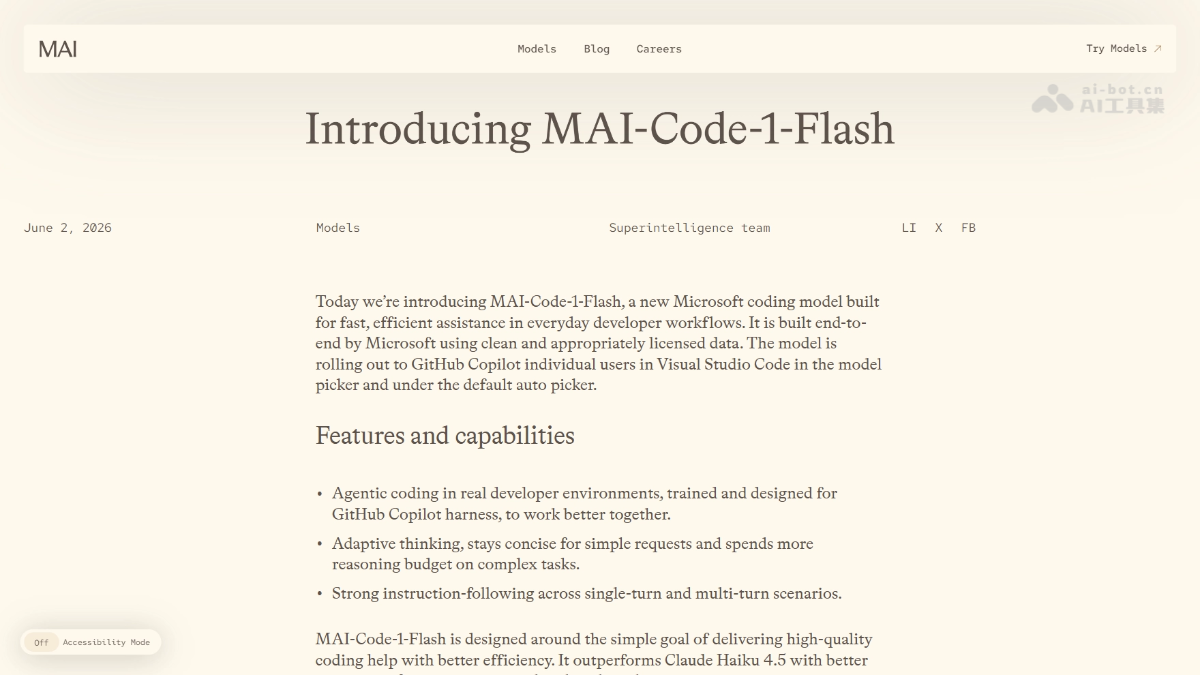
Main features of MAI-Code-1-Flash
-
Agentic code generation: Executes end-to-end development tasks in real code repositories, automatically invoking the toolchain to complete coding.
-
Adaptive output control: Dynamically adjusts reasoning depth according to task complexity, giving concise answers to simple requests and in-depth analysis to complex problems.
-
Repository Q&A: Answers questions about project structure, function logic, and more based on codebase context.
-
Code refactoring: Automatically identifies and optimizes code structure, improving readability and performance.
-
Multi-turn instruction following: Supports both single-turn and multi-turn dialogue scenarios, maintaining context consistency.
-
Tool calling: Deeply integrated with the VS Code editor and the Copilot ecosystem to enable tool-level interaction.
- MAI-Code-1.1-Flash:
-
Intelligent code generation: Deeply optimized for GitHub Copilot, with code capability improved by 22% on Terminal-Bench 2.1 and by 15% on .NET tasks.
-
Native visual understanding: Adds image content understanding capability, supporting image-based programming assistance.
-
Efficient token processing: Generation speed increased by 25%, while token consumption reduced by 25%.
-
Multi-platform integration: Already covers mainstream platforms such as VS Code, Visual Studio, JetBrains, Copilot CLI, and GitHub Mobile.
-
Technical principles of MAI-Code-1-Flash
- Architecture inheritance and foundation: MAI-Code-1-Flash continues development based on the intermediate training checkpoint of MAI-Thinking-1, inheriting its MoE sparse architecture and 128K context window, and is lightweighted and efficiency-optimized for code scenarios.
- Five-stage training pipeline: The model goes through a complete process of pretraining, intermediate training, lightweight SFT, "Mid2" progressive training, and large-scale RL.
- Adaptive solution length control: During training, the model learns to dynamically adjust output depth according to task complexity: concise answers for simple requests and more reasoning budget allocated to complex tasks, reducing token consumption by up to 60% on SWE-Bench Verified and achieving triple optimization of latency, cost, and quality.
- Synthetic data and process supervision: Training applies techniques such as prompt rewriting, rubric synthesis, process supervision =, and repository-level data synthesis to ensure the learnability of highly difficult Agentic tasks while avoiding dependence on low-quality or unverifiable data.
- Native alignment with production environments: Training, evaluation, and deployment all use the same set of GitHub Copilot production-grade toolchains. Evaluation includes real repository context, tool calls, and verification processes, ensuring that offline improvements directly translate into improvements in the real developer experience.
- Joint optimization of safety and quality: Pre-training filters harmful content, and safety alignment techniques are applied during the SFT and RL stages. Evaluated through cybersecurity benchmarks such as CyberBench, CyberSecEval, and SecRepo to ensure the model does not introduce security vulnerabilities and complies with secure coding standards.
How to use MAI-Code-1-Flash
- Prerequisites: Ensure that GitHub Copilot。
- Enable the model: Open the GitHub Copilot chat panel. The model is automatically routed via Auto, or you can directly select MAI-Code-1-Flash in the model selector.
- Everyday coding: Directly type a natural language description of your requirements in the editor, and the model automatically generates the corresponding code snippet or complete file.
- Agentic tasks: Use Copilot's Agent mode to let the model perform complex tasks such as cross-file modifications, debugging, and refactoring in a real repository environment.
- Result review: All AI-generated code suggestions must be manually reviewed, tested, and verified before being merged into the production environment.
Core advantages of MAI-Code-1-Flash
-
Native training for production environments: Trained and evaluated directly using GitHub Copilot's production-grade toolchain, with offline metrics highly consistent with real developer experience.
-
Ultimate token efficiency optimization: Through adaptive length control, saves up to 60% tokens on SWE-Bench Verified, achieving lower latency and higher cost-effectiveness.
-
Leading benchmark performance: Comprehensively surpasses Claude Haiku 4.5 on SWE-Bench Pro (51.2% vs 35.2%), SWE-Bench Verified, SWE-Bench Multilingual, and Terminal Bench 2.
-
End-to-end security hardening: Filters harmful content across the entire training pipeline and is evaluated through security benchmarks such as CyberBench, CyberSecEval, and SecRepo to reduce the risk of introducing vulnerabilities.
-
Deep Copilot integration: No additional configuration required; use it seamlessly directly in VS Code, the environment developers use most.
Project address of MAI-Code-1-Flash
- Project official website:https://microsoft.ai/news/introducingmai-code-1-flash/
- Technical paper:https://microsoft.ai/pdf/MAI-Code-1-Flash-Model-Card.PDF
Comparison of MAI-Code-1-Flash with similar competing products
| Dimension | MAI-Code-1-Flash | Claude Haiku 4.5 | GPT-4o |
|---|---|---|---|
| Developer | Microsoft (Microsoft AI) | Anthropic | OpenAI |
| Positioning | Lightweight production-grade code Agent model | Lightweight general-purpose multimodal model | Flagship general-purpose multimodal model |
| Training objective | End-to-end optimization for the GitHub Copilot production toolchain | General reasoning and multimodal understanding | General reasoning, code, multimodal |
| SWE-Bench Pro | 51.2% | 35.2% | About 40-50% (varies due to different evaluation environments) |
| Token efficiency | Saves up to 60%, adaptive length control | Standard output length | Standard output length |
| Integration depth | Natively embedded in VS Code Copilot, Auto routing | Requires integration via API or third-party plugins | Requires integration via API or Copilot |
| Latency performance | Optimized for low-latency interaction | Lightweight but not specifically optimized for code | Heavier, with relatively higher latency |
| Security evaluation | CyberBench / CyberSecEval / SecRepo | Standard safety alignment | Standard Safety Alignment |
| Currently Available Channels | VS Code GitHub Copilot (gradual rollout) | Claude API / Claude.ai | ChatGPT / API / Copilot |
| Pricing Model | Included in Copilot subscription (TBD) | Billed by token | Billed by token |
Application Scenarios of MAI-Code-1-Flash
-
Everyday Code Completion: Provides intelligent completion and context-aware suggestions when writing functions, classes, and unit tests.
-
Cross-File Refactoring: Automatically identifies dependencies based on repository-level context, performing large-scale code refactoring and architecture optimization.
-
Bug Fixing: Locates root causes based on error descriptions, logs, or test failure information and generates fix patches.
-
Code Review Assistance: Explains complex code logic and identifies potential performance bottlenecks, security risks, or style issues.
-
New Feature Development: Automatically generates runnable feature code and accompanying tests from natural language requirement descriptions.