
What is Mahilo
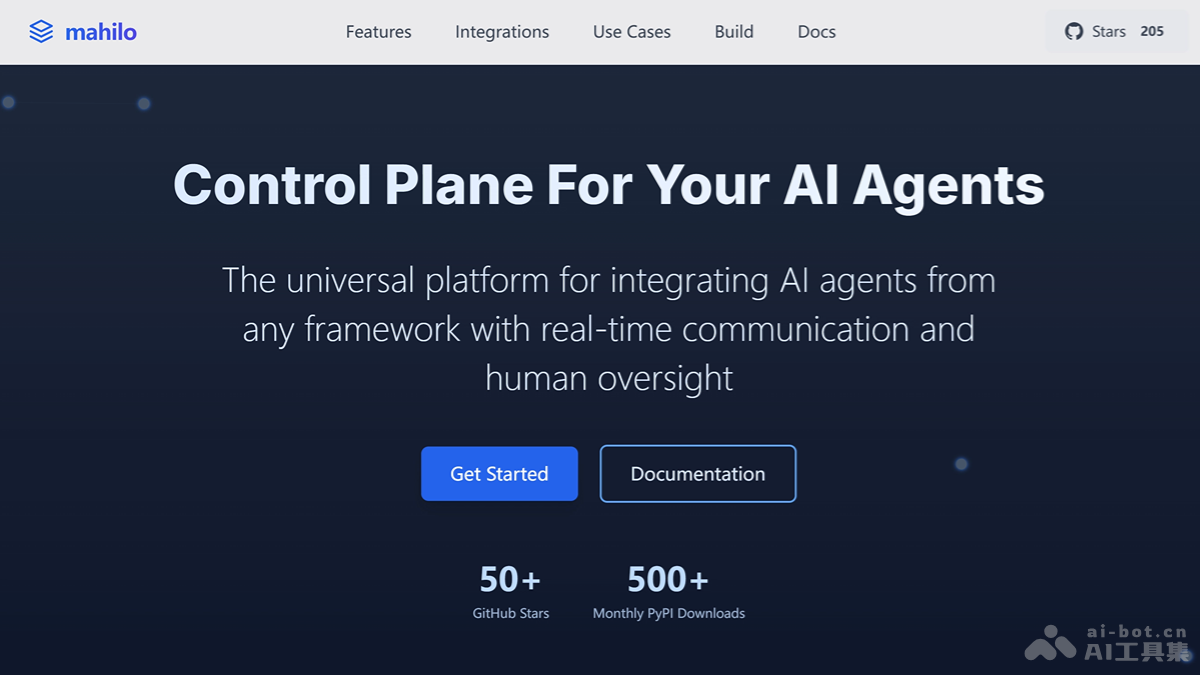
Mahilo is a flexible multi-agent framework that supports creating multi-agent systems that interact with humans. Mahilo supports real-time voice and text communication, and agents can autonomously share context and information with each other, maintaining human oversight and control over interactions. Mahilo provides powerful organization-level policy management capabilities to ensure consistent behavior and security across all agents. Mahilo supports complex multi-agent architectures and is suitable for a variety of application scenarios from customer service to emergency response. Based on a simple and easy-to-use development interface and real-time communication capabilities, Mahilo supports efficiently coordinating interactions among multiple agents and human users, improving collaboration efficiency and decision-making capabilities.
Main features of Mahilo
- Multi-agent integration: Supports integrating agents from different frameworks (such as LangGraph, Pydantic AI, etc.).
- Real-time communication: Provides text and voice chat capabilities, supporting multiple users interacting with agents simultaneously.
- Shared context: Agents can automatically share context information with each other, enhancing collaboration capabilities.
- Human oversight: Supports real-time human participation, providing decision support or correcting agent behavior.
- Flexible communication modes: Supports point-to-point and hierarchical communication modes, adapting to different scenarios.
- Session management: Supports persistent conversations, ensuring session continuity.
- Message tracking and monitoring: Supports message lifecycle tracking, message signing, and retry mechanisms.
- Voice interaction: Supports OpenAI's Realtime API, providing smooth voice interaction.
Technical principles of Mahilo
- Agent Manager (AgentManager): As the "team" of agents, it is responsible for managing communication and context sharing among agents.
- Real-time communication: Provides real-time communication support based on WebSocket, ensuring instant interaction between agents and users.
- Message protocol and message agents: Introduces a standardized message protocol, supporting message signing, tracking, and persistent storage.
- Human integration: Based on the WebSocket real-time chat interface, human experts can intervene in the agents' decision-making process when needed.
- Flexible communication modes: Supports point-to-point and hierarchical communication modes, adapting to different scenarios from complex collaboration to centralized control.
- Context sharing and intelligent information retrieval: Agents can access the conversation history of other agents and request specific information based on the chat_with_agent function.
- Extensibility: Provides the BaseAgent class, making it convenient for developers to create custom agents and supporting integration with multiple frameworks.
Project address of Mahilo
- Project official website:https://mahilo.wjayesh.com
- GitHub repository:https://github.com/wjayesh/mahilo
Application scenarios of Mahilo
- Collaborative content creation: Used for multi-person collaborative content creation, interacting with agents to jointly create stories.
- Emergency response coordination: In 911 emergency response scenarios, coordinates multiple response agents, such as medical, logistics, and communication agents, ensuring rapid and effective resource deployment in emergency situations.
- Real estate matching: Real estate rental matching, where buyer and seller agents share context and real-time communication to optimize the rental process.
- Team Collaboration and Project Management: Supports real-time interaction between multiple people and agents, suitable for team collaboration scenarios, such as in multi-person development projects, where agents provide guidance for each developer while maintaining overall project consistency.
- Healthcare and Health Coordination: In healthcare scenarios, connect agents such as medical consultants, logistics coordinators, and public communication specialists to achieve information sharing and collaborative decision-making, improving the efficiency of healthcare services.