
What is MagicTailor
MagicTailor is a new framework specifically designed for component-controllable personalization, enabling precise control of T2I models during the personalization process. MagicTailor is based on two key technologies, Dynamic Masked Degradation (DM-Deg) and Dual-Stream Balancing (DS-Bal), to address the challenges of semantic pollution and semantic imbalance. DM-Deg dynamically disturbs unwanted visual semantics, while DS-Bal balances the learning of concepts and components, improving the quality and controllability of personalized image generation. MagicTailor has achieved technical breakthroughs and demonstrates broad application potential in practical scenarios, such as decoupled generation and control of multiple components.
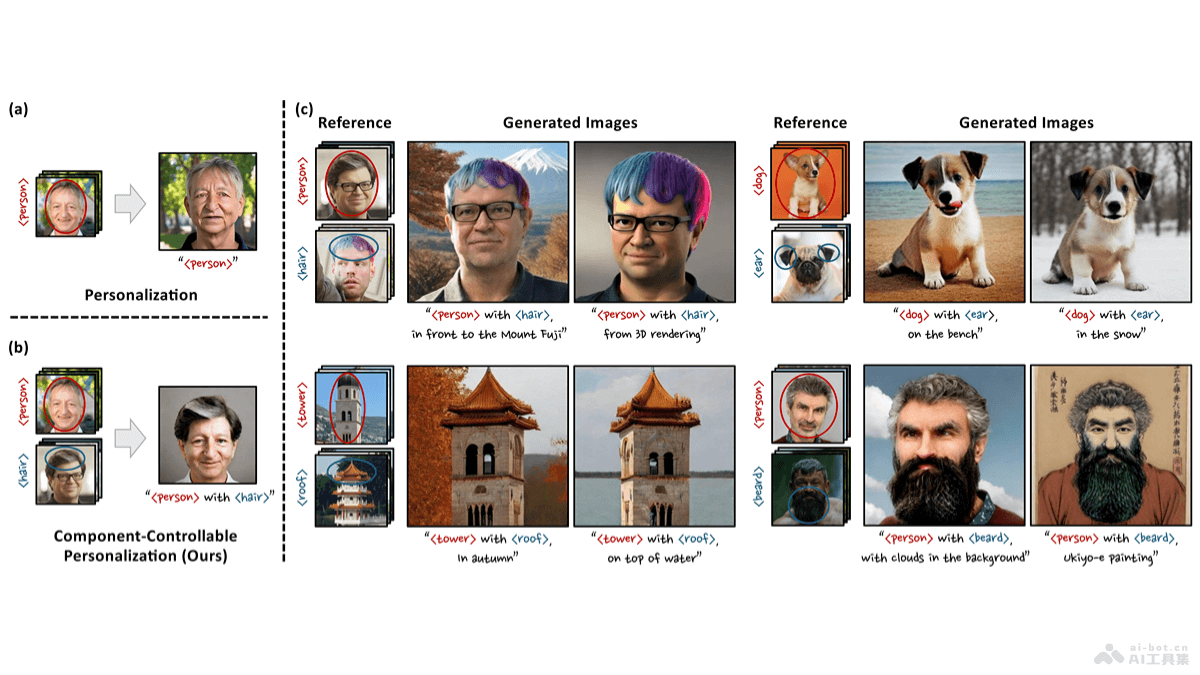
MagicTailor Main Features
- Component-Controllable Personalization: MagicTailor supports users in reconfiguring specific components when personalizing visual concepts, providing fine-grained control over each part of the image generation process.
- Dynamic Masked Degradation (DM-Deg): Based on dynamically disturbing unwanted visual semantics, it reduces semantic pollution and improves the quality of generated images.
- Dual-Stream Balancing (DS-Bal): It balances the visual semantic learning of concepts and components, addressing the semantic imbalance problem and ensuring the accuracy and consistency of generated images.
- Decoupled Generation: MagicTailor generates the target concept and components separately, providing more flexible combinations for different application scenarios.
- Control Multiple Components: The framework demonstrates the potential to handle one concept and multiple components, providing more possibilities for complex image generation.
- Collaboration with Other Generation Tools: MagicTailor can be combined with other generation tools focused on different tasks to provide additional control capabilities, such as collaboration with tools like ControlNet, CSGO, and InstantMesh.
MagicTailor Technical Principles
- Dynamic Masked Degradation (DM-Deg): Based on applying dynamically degraded noise to the area outside the mask of the reference image at each training step, it disturbs unwanted visual semantics. Dynamic intensity adjustment is used to prevent the model from gradually memorizing the noise and reduce semantic pollution.
- Dual-Stream Balancing (DS-Bal): It includes an online denoising U-Net and a momentum denoising U-Net. The online denoising U-Net performs min-max optimization on the hardest-to-learn samples, while the momentum denoising U-Net applies selective preservation regularization to other samples, ensuring balanced learning and better personalization performance.
- Low-Rank Adaptation (LoRA): MagicTailor uses LoRA to fine-tune the T2I diffusion model, learning the target concepts and components while keeping other parts unchanged, achieving efficient personalization.
- Masked Diffusion Loss and Cross-Attention Loss: To facilitate the learning of desired visual semantics, MagicTailor uses masked diffusion loss and cross-attention loss to strengthen the association between the desired visual semantics and their corresponding pseudo-words.
MagicTailor Project Address
- Project Official Website:correr-zhou.github.io/MagicTailor
- GitHub Repository:https://github.com/correr-zhou/MagicTailor
- arXiv Technical Paper:https://arxiv.org/pdf/2410.13370
MagicTailor Application Scenarios
- Personalized Image Generation: Users customize images according to personal preferences, for example, adding specific visual elements (such as hairstyles, clothing, accessories, etc.) to character images, creating unique personalized pictures.
- Advertising and Marketing: In the advertising industry, generating images with specific styles or elements to attract target audiences, or showcasing how products look in different visual concepts.
- Games and entertainment: In game design, generate images of game characters and scenes to enhance the visual experience of the game. In the entertainment industry, create unique visual effects or promotional materials.
- Film and animation production: In film and animation production, help designers and animators quickly generate or modify concept art for characters and scenes, accelerating the creative process.
- Virtual reality and augmented reality: In the fields of VR and AR, generate or modify objects and scenes in virtual environments to provide more personalized and immersive experiences.