
What is MagicDriveDiT
MagicDriveDiT is a novel video generation method based on the DiT architecture, jointly launched by The Chinese University of Hong Kong, The Hong Kong University of Science and Technology, Huawei Cloud, and Huawei Noah's Ark Lab. It is specifically designed for autonomous driving applications, achieving high-resolution and long video generation. Based on flow matching to enhance the model's scalability, it uses a progressive training strategy to handle complex scenarios. MagicDriveDiT achieves precise control over spatiotemporal latent variables based on spatiotemporal conditional encoding, significantly improving video generation quality and control capabilities, and expanding its applications in the autonomous driving field.
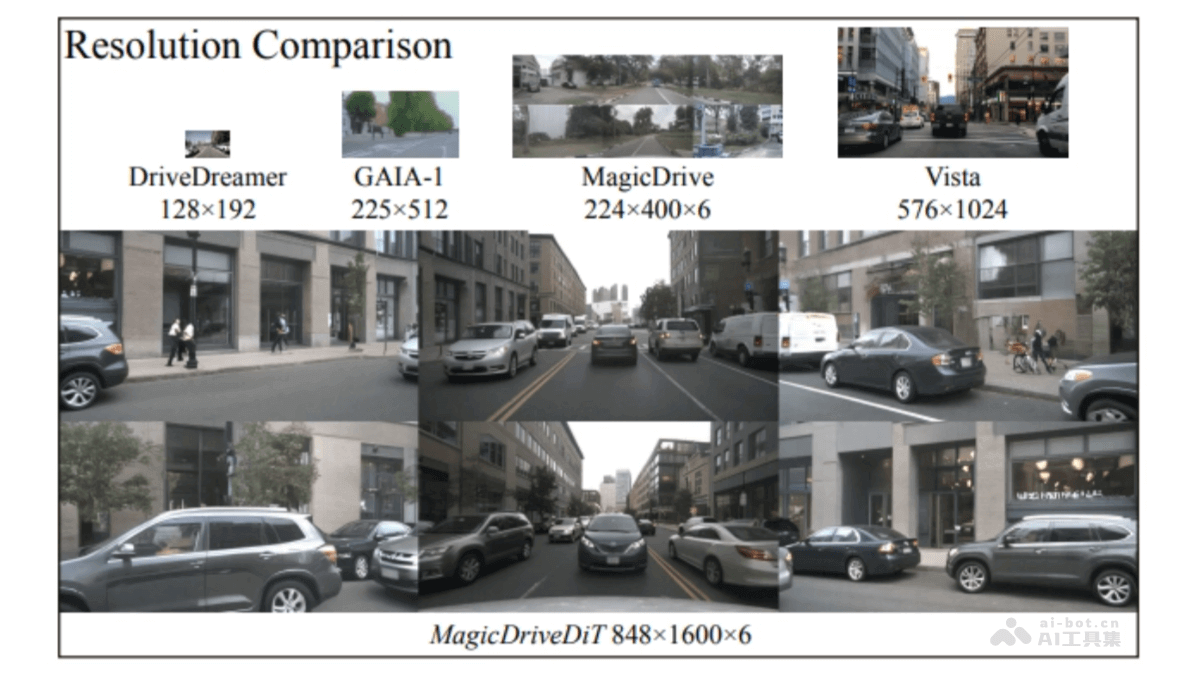
Main Features of MagicDriveDiT
- High-Resolution Long Video Generation: MagicDriveDiT can generate high-resolution long videos, which is crucial for data simulation and algorithm testing in autonomous driving technology.
- Adaptive Control: MagicDriveDiT provides precise control over video content, including object positions, road semantics, and camera trajectories, allowing the generated videos to meet specific simulation needs.
- Multi-View Video Synthesis: Supports generating videos from multiple camera viewpoints, which is very useful for simulating complex traffic scenarios and improving the reliability of autonomous driving systems.
- Fine-Grained Geometric Control: Precise control over the category, size, and trajectory of individual objects in videos.
- Spatiotemporal Conditional Encoding: Based on spatiotemporal encoding technology, MagicDriveDiT can process and integrate condition information related to time and space, generating videos that meet specific scenario requirements.
- Mixed Data Configuration Training: Uses video data of different resolutions and durations during training to enhance the model's generalization ability.
Technical Principles of MagicDriveDiT
- DiT Architecture: Based on the efficiency and scalability of the DiT (Denoising Iterative Transform) architecture to handle high-resolution and long video data.
- Flow Matching: Based on flow matching technology, the model processes large-scale data more effectively, improving the quality and consistency of generated videos.
- Progressive Training Strategy: A progressive training method from low-resolution images to high-resolution long videos, allowing the model to gradually learn and master complex video generation tasks.
- Spatiotemporal Conditional Encoding: Introduces spatiotemporal conditional encoding, allowing the model to precisely control spatiotemporal latent variables in videos and achieve precise control over video content.
- 3D VAE (Variational Autoencoder): Uses 3D VAE to compress video data, reducing sequence length and memory consumption based on spatiotemporal downsampling while maintaining the quality of video content.
Project Address of MagicDriveDiT
- Project Official Website:com/magicdrivedit
- GitHub Repository:https://github.com/flymin/MagicDriveDiT(to be open-sourced soon)
- arXiv Technical Paper:https://arxiv.org/pdf/2411.13807
Application Scenarios of MagicDriveDiT
- Autonomous Driving System Testing and Validation: Simulates various traffic scenarios based on generated videos, used for testing and validating the perception, decision-making, and control algorithms of autonomous driving systems.
- Perception Model Training: Provides high-resolution and long video data, used for training and optimizing perception models of autonomous vehicles, such as object detection, semantic segmentation, and depth estimation.
- Scene Reconstruction and Simulation: Generate detailed street view videos based on real road data, used to build virtual environments for simulated training and evaluation of autonomous driving systems.
- Data augmentation: Expand and enrich real-world datasets, based on generating traffic scene videos under various conditions, increase data diversity, and improve the model's generalization ability.
- Safety analysis: Simulate extreme or dangerous driving scenarios, used to analyze the safety and robustness of autonomous driving systems.