
What is MagicColor
MagicColor is a multi-instance line art coloring framework introduced by the Hong Kong University of Science and Technology, supporting efficient colorization of line art. MagicColor is based on a self-supervised training strategy and an instance guidance module, addressing the problem of insufficient multi-instance data and achieving precise instance-level color control. Compared with traditional methods, MagicColor can complete the coloring of multi-instance line art in a single forward pass, greatly improving coloring efficiency, and is suitable for fields such as animation production and digital art creation.
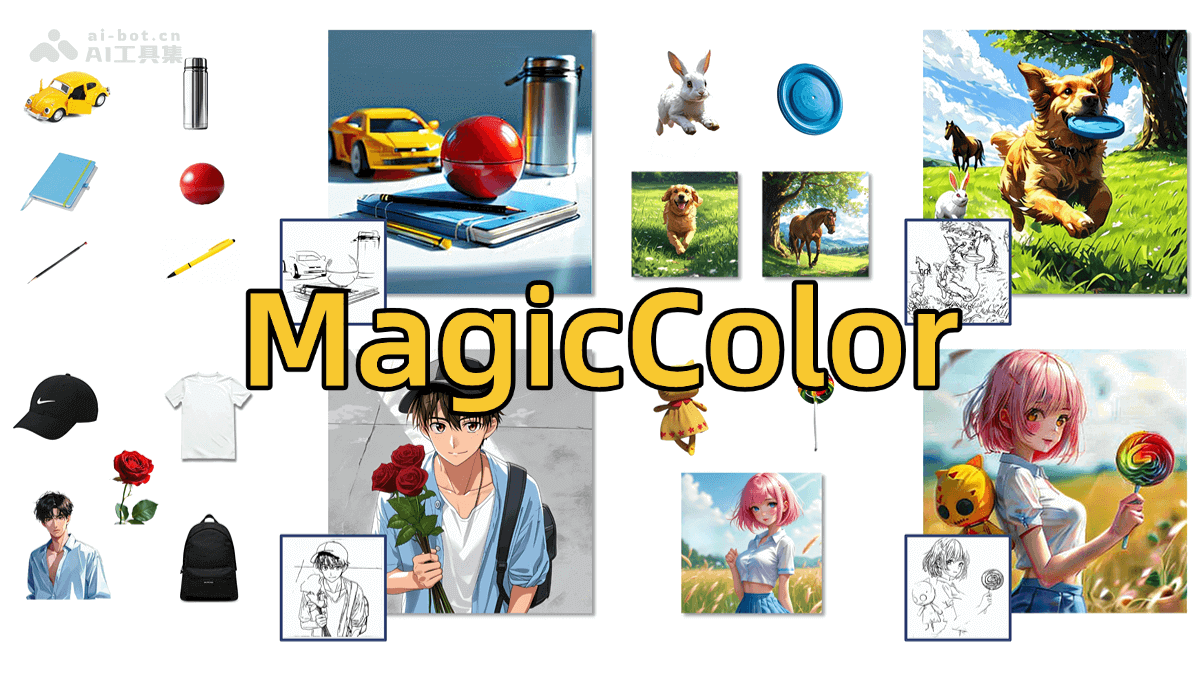
MagicColor's Main Features
- Multi-Instance Line Art Coloring: MagicColor can simultaneously handle the sketch coloring task for multiple instances, assigning accurate colors to each instance.
- Automated Coloring: Automatically converts line art into richly colored images.
- Reference Image Driven: The user provides a reference image, and MagicColor colors the sketch according to the colors and style of the reference image, ensuring that the output image remains visually consistent with the reference image.
- Instance-Level Control: Precisely controls the color of each instance, maintaining the accuracy of details and colors in complex multi-instance scenes.
- Edge Enhancement: The model focuses on the edges and high-frequency regions of the image during coloring, improving the accuracy and visual quality of the coloring.
MagicColor's Technical Principles
- Diffusion Model Foundation: MagicColor is based on a pretrained diffusion model. Leveraging the diffusion model's powerful generation capability and ability to maintain semantic consistency, it converts sketches into color images.
- Self-Supervised Training Strategy: To address the problem of insufficient multi-instance training data, MagicColor uses a two-stage self-supervised training strategy. In the first stage, it trains with a single reference image. In the second stage, it generates multi-instance data based on operations such as random fusion and scaling, further optimizing the model's multi-instance coloring capability.
- Instance Guidance Module: The module extracts instance features from the reference image and aligns them with the sketch, achieving precise instance-level color control. It uses features extracted by DINOv2 and ROI alignment technology to ensure that the color of each instance is accurately transferred to the target sketch.
- Edge Loss and Color Matching: To improve the visual quality of coloring, MagicColor introduces an edge loss function, making the model focus on the edges and structural details of the image. Based on color matching technology, the model establishes pixel-level correspondences between the reference image and the target sketch, ensuring accurate color transfer.
- Dual UNet Architecture: MagicColor combines two UNet architectures, one used for processing the reference image and the other used for generating the final color image. This allows the model to better fuse the color information of the reference image and the structural information of the sketch, generating high-quality coloring results.
MagicColor's Project Address
- Project Official Website:https://yinhan-zhang.github.io/color/
- GitHub Repository:https://github.com/YinHan-Zhang/MagicColor
- arXiv Technical Paper:https://arxiv.org/pdf/2503.16948
MagicColor's Application Scenarios
- Animation Production: Quickly color multi-character sketches, improving production efficiency and maintaining consistent color style.
- Digital Art Creation: Quickly realize sketch colorization, inspire creativity, and generate multiple color versions.
- Game Development: Quickly generate color versions of characters and scenes, improving development efficiency and generating stylized assets.
- Education and Training: As a teaching tool, it helps students quickly understand color theory and improve their color application skills.
- Advertising and Media: Quickly generate high-quality color sketches to meet advertising design needs, enhancing visual appeal and brand consistency.