
What is MagicClay
MagicClay is a 3D modeling tool launched by Adobe that combines mesh and signed distance field (SDF) technology to support artists in sculpting specific parts of a 3D model based on text prompts while keeping other areas of the model unchanged. MagicClay supports generating 3D models with textures and can non-destructively edit local meshes, allowing artists to perform more intuitive and refined edits on 3D models based on text prompts. MagicClay transforms text-to-image generation capabilities into a practical modeling tool used by artists in iterative workflows.
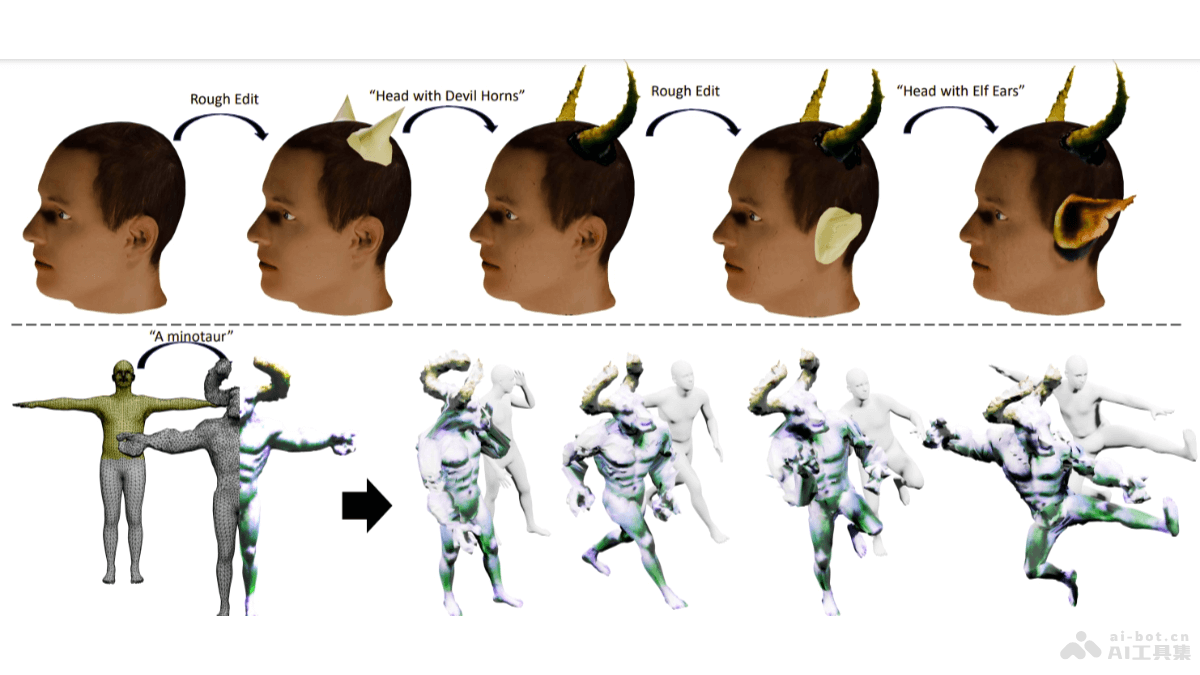
Main features of MagicClay
- Text-guided 3D sculpting: MagicClay supports users in entering text prompts to guide the sculpting of specific areas of a 3D model, enabling local editing.
- Hybrid representation: Combines mesh and signed distance field (SDF) representations, using the advantages of both for 3D modeling.
- Non-destructive editing: Users can edit selected areas without affecting other parts of the model, preserving the integrity of the original model.
- Sequential editing: Supports multiple edits to the same mesh, allowing artists to gradually refine the model.
- Preserve original attributes: During editing, preserves the attributes of the original triangulation, such as vertex groups, facilitating animation and other subsequent processing.
- High-resolution rendering: Efficiently renders SDF based on mesh representation, achieving high-resolution volumetric rendering.
Technical principles of MagicClay
- Hybrid mesh-SDF representation: Uses a hybrid representation, including a triangular mesh and SDF. The hybrid representation supports intuitive control of the mesh and the topological flexibility of SDF.
- Consistency maintenance: During optimization, maintains consistency between the mesh and SDF, synchronizing the two with multi-view consistency loss and adaptive reconstruction.
- Differentiable rendering: Uses differentiable rendering technology to render the mesh and SDF from different angles, requiring them to remain consistent in RGB rendering, opacity, and normal maps.
- Localization and freezing loss: Based on localization loss and freezing loss, ensures that edits occur only in user-selected areas, while unselected areas remain unchanged.
- Dynamic mesh reconstruction: Uses differentiable mesh reconstruction techniques, such as ROAR, to dynamically update mesh topology, including face splitting, edge collapsing, and edge flipping.
- Surface smoothing and regularization: Defines smoothing terms based on explicit mesh representation, using Laplacian vectors to encode local curvature changes, encouraging mesh smoothness.
- SDF regularization: Uses Eikonal loss and other SDF-specific losses to encourage SDF to learn effective distance field representations.
MagicClay project address
- Project official website:amirbarda.github.io/MagicClay.github.io
- GitHub repository:https://github.com/amirbarda/MagicClay
- arXiv technical paper:https://arxiv.org/pdf/2403.02460
Application scenarios of MagicClay
- 3D art creation: Artists perform 3D sculpting and model creation, using text prompts to quickly realize creative concepts without complex 3D modeling skills.
- Game development: Game designers quickly prototype and iterate game characters, props, and environments, improving development efficiency.
- Animation production: In animated film and television production, create and modify complex 3D characters and scenes while preserving the vertex weights and rigging required for animation.
- Virtual Reality (VR) and Augmented Reality (AR): In VR and AR applications, design and optimize virtual objects and environments to provide a richer and more dynamic user experience.
- Education and Training: In the field of education, as a teaching tool, help students understand the basic concepts of 3D modeling and learn 3D design through practice.