
What is MagicArticulate
MagicArticulate is a framework launched by Nanyang Technological University and ByteDance Seed Lab that automatically converts static 3D models into animatable assets. MagicArticulate generates skeletons based on autoregression and predicts skinning weights, enabling the model to support realistic animation. MagicArticulate introduces the Articulation-XL dataset, which contains over 33,000 3D models with high-quality joint annotations, and presents an autoregressive Transformer-based skeleton generation method that naturally handles variations in the number of bones and dependencies across different models. MagicArticulate significantly outperforms existing methods across diverse object categories, providing an efficient and high-quality solution for animating 3D models.
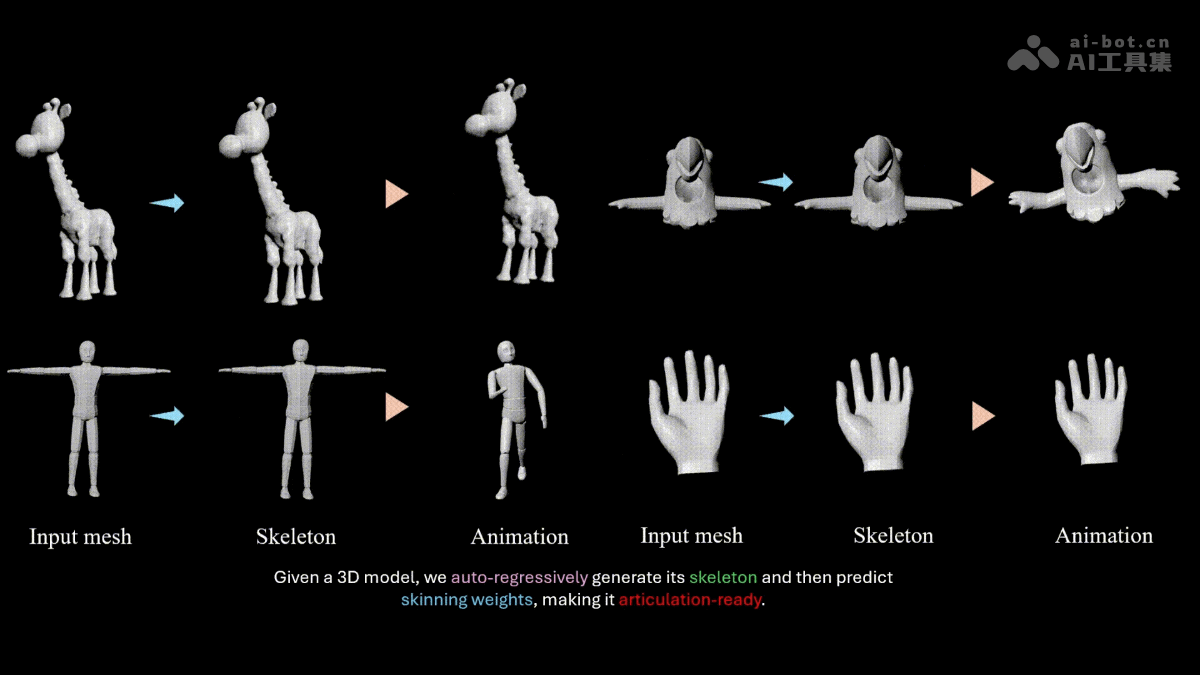
Main features of MagicArticulate
- Automatic skeleton generation: Automatically generates skeleton structures suitable for models, supporting different numbers of bones and joint dependencies across different models.
- Skinning weight prediction: Based on predicting the skinning weights between vertices and joints, it binds the model surface to the skeleton.
- High-quality animation: The generated skeletons and skinning weights support realistic animation effects and are suitable for a variety of 3D models and application scenarios.
- Large-scale data support: Introduces the Articulation-XL dataset, which contains over 33,000 3D models with high-quality annotations, advancing the development and validation of related technologies.
Technical principles of MagicArticulate
- Autoregressive skeleton generation:
- Point cloud sampling and encoding: Samples a point cloud from the surface of the input 3D model and encodes the points into fixed-length shape tokens, capturing the model's geometric features and topological structure.
- Skeleton sequence modeling: Appends shape tokens to the beginning of skeleton tokens and gradually generates the skeleton sequence based on an autoregressive Transformer. The autoregressive model generates one bone or joint at each step, using previously generated content as contextual information, naturally handling variations in the number of bones and dependencies across different models.
- Advantages of Transformer: The Transformer's parallel processing capability and attention mechanism can efficiently capture global dependencies, while the autoregressive generation approach flexibly adapts to skeleton structures of varying complexity.
- Skinning weight prediction: Gradually optimizes the distribution of skinning weights based on a diffusion model. The diffusion process starts from noise and gradually recovers the weight relationships between vertices and joints, similar to a denoising process. When predicting skinning weights, the volumetric geodesic distance between vertices and joints is introduced as prior information. The diffusion model is trained on a large amount of annotated data, such as the Articulation-XL dataset, to learn the distribution patterns of skinning weights across different 3D models.
- Large-scale dataset support: The dataset contains over 33,000 3D models with high-quality joint annotations. The data provides rich supervisory information for model training, enabling the skeleton generation and skinning weight prediction modules to learn general patterns across different models and perform excellently in diverse scenarios.
MagicArticulate project address
- Project official website:https://chaoyuesong.github.io/MagicArticulate/
- GitHub repository:https://github.com/Seed3D/MagicArticulate
- arXiv technical paper:https://arxiv.org/pdf/2502.12135
Application scenarios of MagicArticulate
- 3D animation production: Quickly converts static models into animatable assets, reducing the workload of manually rigging skeletons and skinning, and improving animation production efficiency.
- Game Development: Generate skeletons and skinning weights for game characters and props, support real-time animation rendering, and improve game development efficiency and animation effects.
- VR/AR: Generate interactive dynamic 3D models to enhance immersion and interactive experience in virtual environments.
- Industrial Design and 3D Printing: Help designers quickly generate movable joint models, optimize product motion functions, and reduce design costs.
- Artificial Intelligence and Robotics: Used for robot motion simulation and AI model training, optimizing joint motion and algorithm development.