
What is MagicAgent
MagicAgent is an agent foundation model jointly launched by Honor and Fudan University, achieving the strongest performance within tens of billions of parameters through a 32B dense architecture and a 30B-A3B MoE architecture. The model covers five major scenarios, including task decomposition, tool planning, and multi-constraint scheduling, through a lightweight synthetic data framework. It adopts a two-stage training approach of "SFT + multi-objective reinforcement learning" to resolve multi-task conflicts, and innovatively proposes the χPO algorithm to balance exploration and exploitation. The model surpasses on benchmarks such as Worfbench and BFCL-v3GPT-5.2、Kimi-K2and other hundred-billion-level models, making it the industry's first agent model supporting full-scenario generalized planning, and it has been deployed on Honor Magic series phones.
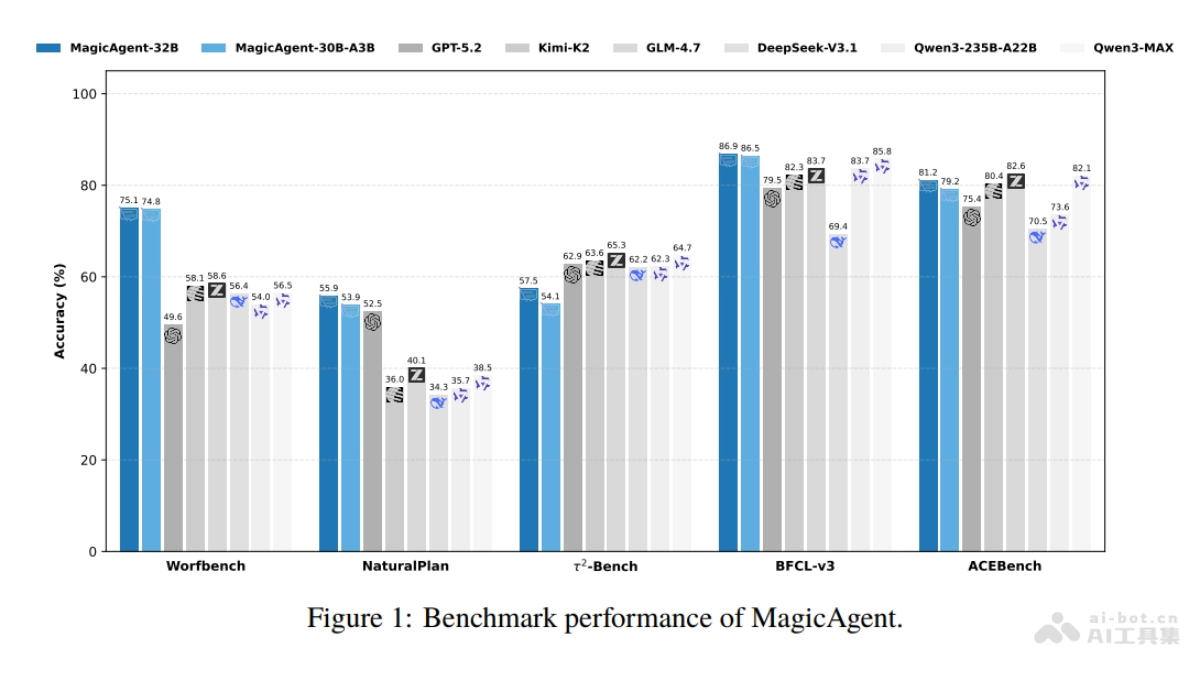
Main features of MagicAgent
-
Hierarchical task decomposition: The model can break down complex user instructions into executable subtask sequences, supporting multi-step dependencies and parallel execution.
-
Tool-augmented planning: Dynamically invokes external APIs and tools, completing tasks that require real-time information or external capabilities through a reasoning-action loop.
-
Multi-constraint scheduling: Handles plan formulation with multiple constraints such as time, space, and resources, such as itinerary planning and meeting scheduling.
-
Program logic orchestration: The model can understand and execute workflows with conditional branches and loop structures, maintaining complex dependencies between tasks.
-
Long-horizon tool execution: Maintains state tracking across dozens of interaction rounds, stably completing long-term tasks that require multi-tool chained calls.
Technical principles of MagicAgent
- Synthetic data generation: MagicAgent builds tool dependency graphs and parameter sharing graphs, defines atomic plans as the smallest semantic units, and synthesizes complex trajectories through operations such as concatenation, aggregation, and grouping, replacing high-cost sandbox simulation to ensure rigorous data logic and coverage of diverse scenarios.
- Two-stage training paradigm: The first stage adopts supervised fine-tuning based on novelty sampling to balance multi-task data distribution; the second stage introduces a unified multi-objective reward function that combines format correctness with task semantic accuracy, gradually improving generalization ability through offline GRPO and online χPO reinforcement learning.
- χPO algorithm: The algorithm designs a three-layer mechanism for sparse reward environments—token-level entropy regularization promotes lexical diversity exploration, thought-action separation entropy smoothing allows high uncertainty in the reasoning stage while constraining the decision stage, and the information bottleneck compresses redundant reasoning to retain key decision information, achieving a dynamic balance between exploration and exploitation.
- MoE load balancing: Adopts global batch statistics instead of micro-batch constraints, supporting natural expert differentiation along the task dimension; combined with z-loss to suppress extreme routing logits values, it solves expert collapse and parameter idling issues in multi-task training, maintaining decoupling between inference efficiency and model capacity.
MagicAgent project address
- arXiv technical paper:https://arxiv.org/pdf/2602.19000
Application scenarios of MagicAgent
-
Smart device control: Users use natural language instructions to control phones to complete complex operations, such as "book a hotel by West Lake on Meituan and find nearby high-rated restaurants," and the model automatically decomposes the task and calls the corresponding App interfaces for execution.
-
Enterprise process automation: Handles cross-system business in customer service scenarios, such as automatically checking inventory status, verifying payment information, initiating a refund process, and synchronously notifying the user based on the order number and refund reason provided by the user.
-
Personalized travel planning: Combining the user's time window, budget constraints, and preference tags, automatically generate a complete itinerary plan that satisfies multiple constraints such as "direct flights, a specific number of days stayed in a city, and a continuous itinerary."
-
Multi-agent task orchestration: It can serve as a central node to parse high-level intent, break down "preparing a product launch event" into parallel subtasks such as venue, materials, and guests, distribute them to specialized agents for execution, and integrate the results.
-
Long-horizon interactive decision-making: The model can continuously track state across dozens of rounds of dialogue, handle chained dependency tasks such as "first check flights, then book a hotel, and finally rent a car," and dynamically adjust subsequent plans based on intermediate results.