
What Is Magic 1-For-1
Magic 1-For-1 is an efficientvideo generationmodel introduced by Peking University, Hedra Inc., and Nvidia. It rapidly generates high-quality video clips by optimizing memory consumption and inference latency. The model decomposes the complex text-to-video generation task into two simpler subtasks:text-to-image generationand image-to-video generation. Based on this approach, Magic 1-For-1 uses diffusion step distillation technology to significantly accelerate the model's convergence speed, and further improves the quality and semantic consistency of generated videos based on multimodal input (combining text and visual information). Magic 1-For-1 uses model quantization technology to compress the model size from 32GB to 16GB, enabling efficient operation on consumer-grade GPUs.
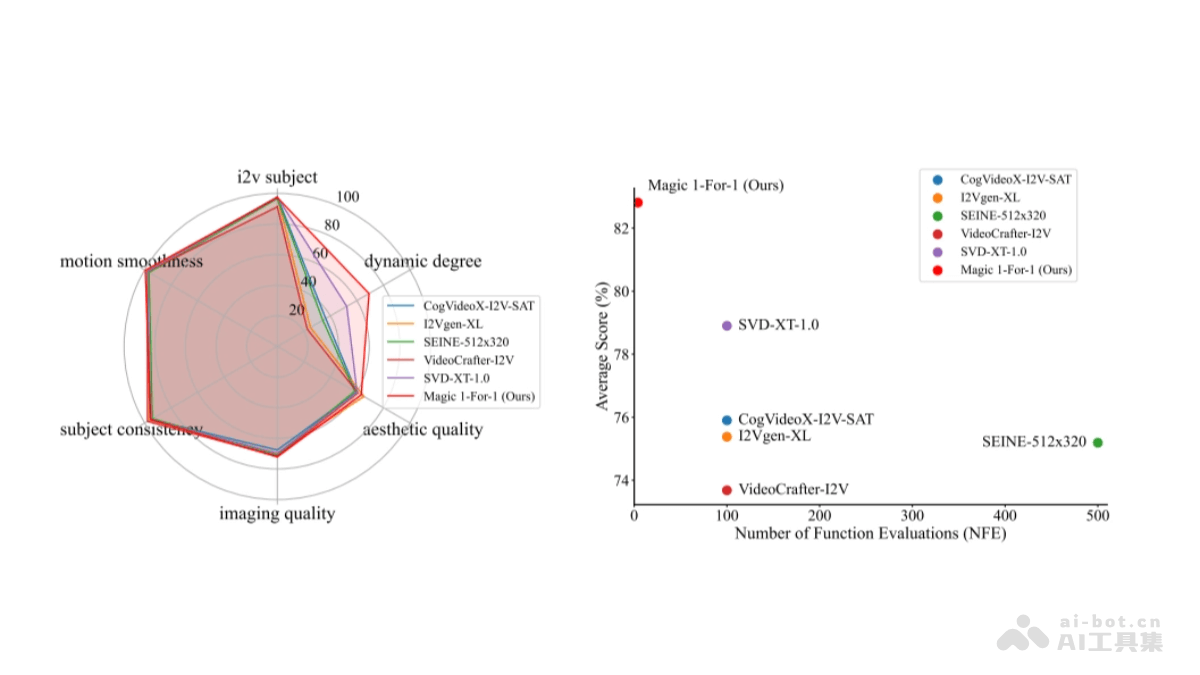
Main Features of Magic 1-For-1
- Efficient generation: Generates high-quality video clips in a short time. For example, generating a 5-second video takes only 3 seconds, and generating a 1-minute video can be completed within 1 minute.
- High-quality video generation: Based on optimized diffusion steps and multimodal input, the generated videos perform excellently in visual quality, motion coherence, and semantic consistency.
- Low resource consumption: Based on model quantization technology, the model's memory usage is reduced from 32GB to 16GB, enabling it to run efficiently on consumer-grade GPUs.
- High flexibility: Supports multiple input methods, including text-to-image generation and image-to-video generation, generating diverse video content according to user needs.
Technical Principles of Magic 1-For-1
- Task decomposition: Decomposes the complex text-to-video generation task into two simpler subtasks: text-to-image generation (T2I) and image-to-video generation (I2V). This simplifies the generation process and makes the model easier to train and optimize.
- Diffusion models and diffusion step distillation: Performs video generation based on diffusion models, and uses diffusion step distillation (such as the DMD2 algorithm) to reduce the number of steps required for generation.
- Multimodal input: Combines text and visual input (such as reference images) as conditional signals to enhance the model's semantic understanding and generation capabilities. This enables the generated videos to better capture the semantic information of text descriptions and reference images.
- Model optimization and quantization: Uses model quantization technology (such as int8 quantization) to reduce the model's memory usage, and uses optimized training strategies (such as CFG distillation) to improve the model's inference efficiency.
- Sliding window technology: When generating long videos, uses sliding window technology to gradually generate video clips, improving the quality and coherence of the overall video while maintaining efficiency.
Magic 1-For-1 Project Address
- Project official website:https://magic-141.github.io/Magic-1-For-1/
- GitHub repository:https://github.com/DA-Group-PKU/Magic-1-For-1
- arXiv technical paper:https://arxiv.org/pdf/2502.07701
Application Scenarios of Magic 1-For-1
- Content creation and video editing: Video creators, bloggers, and content production companies can quickly generate high-quality video clips for producing short videos, advertisements, promotional videos, and more.
- Film and television production and special effects generation: Film and television production companies can generate preliminary special effects shots or background videos, providing creative materials for the production of movies, TV series, and animations.
- Education and training: Educational institutions can generate teaching videos, such as science experiments, historical event reenactments, or language learning scenarios.
- Virtual Reality (VR) and Augmented Reality (AR): VR and AR developers generate video content of virtual scenes for games, virtual tourism, or training simulations.
- Social Media and Advertising: Brands and advertisers generate personalized advertising videos for promotion on social media platforms.