
What is Magentic-One
Magentic-One is a general-purpose multi-agent system launched by Microsoft that solves complex web and file tasks across domains. The system is based on a multi-agent architecture, led by the Orchestrator agent, which coordinates four specialized agents: WebSurfer, FileSurfer, Coder, and ComputerTerminal to execute tasks. Magentic-One is implemented based on Microsoft's AutoGen framework, supporting modularity and flexibility, and is easy to extend and adapt to new tasks.
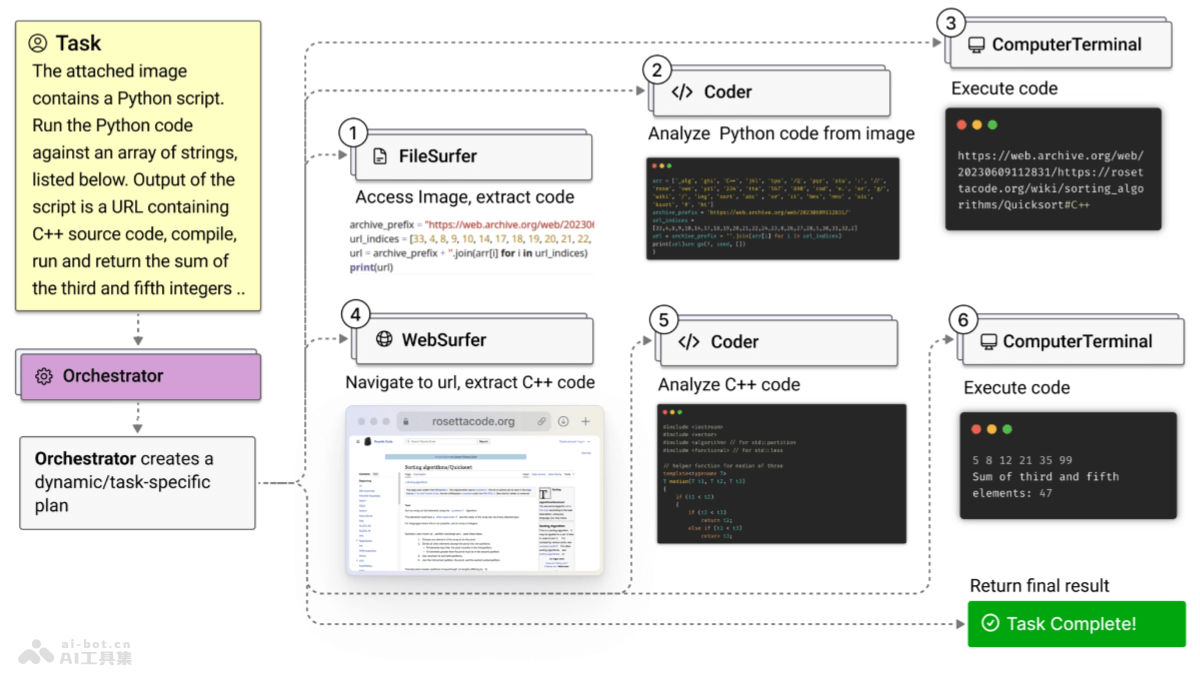
Main features of Magentic-One
- Task coordination and execution: Coordinates and guides other agents to complete tasks based on a lead agent called the Orchestrator.
- Web information processing: The WebSurfer agent searches the web, clicks links, interacts with online elements, collects information across websites, and provides the required summaries.
- File management: The FileSurfer agent explores local directories, analyzes file contents, and supports document management and data retrieval.
- Code writing and execution:
- Coder agent: Writes and evaluates code, writes new scripts, debugs existing code, and collaborates with other agents.
- ComputerTerminal agent: Executes code generated by the Coder agent, suitable for projects that require immediate testing or deployment.
- Adaptive project management: Monitors each stage of the project, adjusts plans in a timely manner to address various obstacles, and ensures the successful completion of tasks.
- Complex task handling: Handles complex, multi-step tasks across domains, with human-like adaptability.
Technical principles of Magentic-One
- Orchestrator agent: As the core of the system, it is responsible for high-level planning, task decomposition, guiding other agents to execute subtasks, tracking overall progress, and taking corrective measures when needed.
- Task Ledger: The Orchestrator builds a task ledger to start operations, containing facts, guesses, and plans.
- Progress Ledger: The Orchestrator maintains a progress ledger as the project progresses, ensuring that tasks at each stage can be completed on time, and self-reflects on task progress.
- Multi-agent collaboration: Magentic-One includes multiple specialized agents, each taking on different roles to jointly achieve seamless task execution.
- Modularity and flexibility: Magentic-One is implemented based on Microsoft's AutoGen framework, supporting modularity and flexibility, and is easy to extend and adapt to new tasks.
- Adaptive features: The system can monitor each stage of the project and adjust plans in a timely manner to address various obstacles. If an agent encounters difficulties at a specific step, the orchestrator will reassign tasks or update strategies.
- Model agnosticism: Magentic-One is model-agnostic, integrating different large language models (LLMs) and script language models (SLMs) to support different capabilities or meet different cost requirements.
Project addresses of Magentic-One
- Project official website:magentic-one-a-generalist-multi-agent-system-for-solving-complex-tasks
- GitHub repository:https://github.com/microsoft/autogen/tree/main/python/packages/autogen-magentic-one
- Technical paper:https://www.microsoft.com/en-us/research/publication/magentic-one-a-generalist-multi-agent-system-for-solving-complex-tasks/
Application scenarios of Magentic-One
- Enterprise automation: Handles tasks such as data analysis, project management, and file management to improve work efficiency.
- Scientific research support: Assist with data collection and experimental simulation, accelerating the output of scientific research achievements.
- Software Development: Automated code writing, testing, and software testing, improving development efficiency.
- Customer Service: Provide intelligent customer service and personalized recommendations, improving customer experience.
- Education and Training: Assist teaching and personalized learning, improving education quality.