
What Is MAETok
MAETok (Masked Autoencoders Tokenizer) is a novel image tokenization method for diffusion models jointly launched by Carnegie Mellon University, the University of Hong Kong, Peking University, and other institutions. MAETok trains an autoencoder (AE) based on Mask Modeling, randomly masking some image tokens in the encoder and using the decoder to reconstruct the features of the masked tokens, thereby learning a more discriminative and semantically rich latent space. The core advantage of MAETok lies in its ability to generate high-quality images while significantly improving training efficiency and inference throughput. In experiments, MAETok uses 128 tokens and can achieve generation performance comparable to or even better than previous state-of-the-art models on ImageNet 256×256 and 512×512 resolutions, demonstrating its effectiveness in high-resolution image generation.
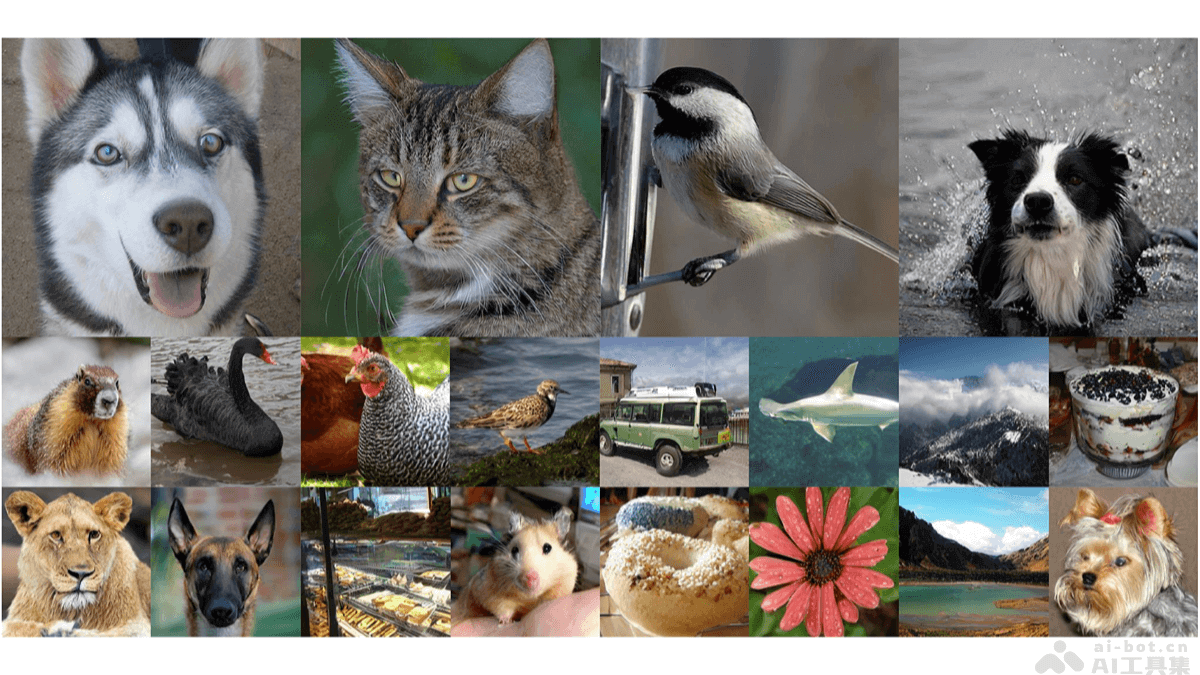
MAETok's Main Features
- Efficient Image Generation: Based on an improved latent space structure, it generates high-quality images and performs exceptionally well in high-resolution image generation tasks.
- Self-Supervised Learning: During training, it learns more semantically rich latent representations by reconstructing masked image tokens.
- Improved Training Efficiency: It significantly reduces training time and computational resource consumption, providing faster training and inference throughput.
- Diverse Feature Prediction: It simultaneously predicts multiple features (such as HOG, DINOv2, CLIP, etc.), enhancing the model's expressive capability.
- Flexible Latent Space Design: It flexibly adjusts the structure of the latent space across different tasks to adapt to different generation needs.
MAETok's Technical Principles
- Mask Modeling: During training, a certain proportion of image tokens are randomly selected for masking and replaced with learnable mask tokens. The encoder learns the latent space based on processing the unmasked tokens, while the decoder reconstructs the features of the masked tokens.
- Autoencoder Architecture: It adopts an autoencoder (AE) architecture, using a simple AE rather than a variational autoencoder (VAE), avoiding complex variational constraints and simplifying the training process.
- Auxiliary Decoders: It introduces multiple auxiliary shallow decoders to predict different feature targets separately, allowing the model to learn richer semantic information while maintaining high reconstruction fidelity.
- Latent Space Optimization: Based on the combination of mask modeling and auxiliary decoders, MAETok optimizes the structure of the latent space, making it more discriminative and semantic, and improving the generation performance of diffusion models.
MAETok's Project Addresses
- GitHub Repository:https://github.com/Hhhhhhao/continuous_tokenizer
- HuggingFace Model Library:https://huggingface.co/MAETok
- arXiv Technical Paper:https://arxiv.org/pdf/2502.03444
MAETok's Application Scenarios
- Entertainment Industry: Film and television special effects, game development, and virtual reality generate high-resolution images, providing high-quality image assets.
- Digital Marketing: In fields such as advertising design, creative art, and digital media production, it generates complete images based on user-input sketches or partial images, or performs stylized transformations on existing images.
- Computer Field: In the fields of machine learning and computer vision, it generates diverse image samples, improving the model's generalization ability and robustness.
- Virtual Content Creation: Emerging fields such as virtual reality (VR), augmented reality (AR), and the metaverse generate virtual characters, scenes, and objects.
- Artistic Creation and Design:As a tool for artists and designers, generating creative images and design concepts.